Quick answer
Nvidia dominates artificial intelligence because it combines five strengths at once: GPUs that are exceptionally well suited to parallel computing, CUDA and a mature software layer, a strong position inside data centers, a developer ecosystem that is already widely adopted and an industrial lead that is difficult to replicate quickly.
In simple terms, Nvidia does not dominate through raw graphics card power alone. It leads because it provides a complete platform that is already embedded in real-world AI workflows.
In brief
If you only keep one idea in mind, make it this: Nvidia turned a technical lead into an industrial standard. When a company equips research labs, cloud platforms, data centers, frameworks and developers, it no longer sells a simple component. It helps define the market itself.
Main question: why does Nvidia dominate AI so strongly?
The most accurate answer fits in a single sentence: Nvidia dominates AI because it managed to connect hardware, software, developer tooling, data centers and industrial adoption into one coherent system.
Many explanations stop at GPU performance. That is part of the story, but not all of it. In the real world, companies do not choose a fast chip in isolation. They choose an environment that is reliable, documented, compatible, cost-effective to deploy, familiar to their teams and already validated at scale.
That is exactly where Nvidia built a major advantage. The company does not lead on compute power alone. It leads because it makes that power easy to use, straightforward to integrate and expensive to replace.
Key takeaways
- Nvidia sells a complete platform, not just GPUs.
- GPUs are highly effective for the massively parallel workloads used in deep learning.
- CUDA acts like a software fortress and creates strong market inertia.
- Libraries and frameworks reduce friction for engineers and enterprises.
- Its presence in data centers makes the dominance structural, not just commercial.
- Network effects amplify the lead: the more Nvidia is used, the more rational it becomes to keep using it.
- Competitors have to catch up across several layers at once: hardware, software, support, integration and industrial trust.
Nvidia dominates AI not because it has a single miracle product, but because it locked together compute, software, developer ecosystems and deployment infrastructure.
Nvidia does not just sell GPUs: it sells a complete platform
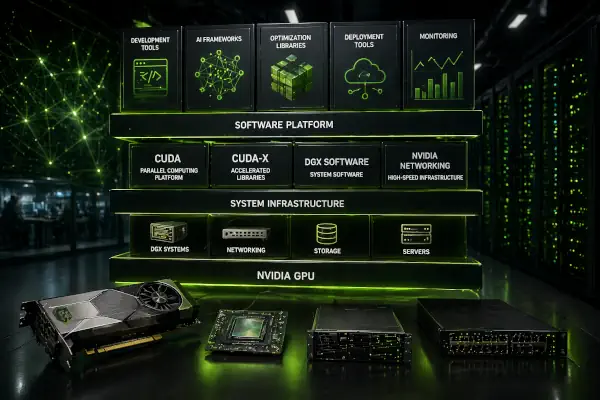
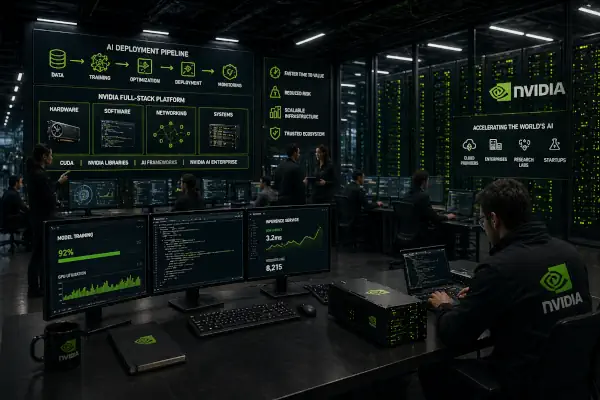
Many people explain Nvidia's dominance with a simple reflex: “their graphics cards are more powerful.” That idea is not entirely wrong, but it is incomplete. Nvidia dominates artificial intelligence because it built far more than a catalog of components. It created a coherent platform in which hardware, software, libraries, developer tools and deployment infrastructure reinforce one another.
In modern AI, the chip alone is not enough. You need to train models, optimize them, deploy them into servers, manage network traffic, distribute workloads, reduce inference latency and give developers a stable environment. Nvidia built its lead precisely on that depth of technological stack.
In other words, the company does not lead through brute compute alone. It leads because it makes that power usable at scale.
GPUs: why they became the central engine of AI
GPUs were first popularized through gaming, where they accelerated graphics rendering. But their real strength goes far beyond visuals. They excel at massively parallel computing, meaning situations where an enormous number of similar operations must be executed at the same time.
Modern artificial intelligence, especially deep learning, relies heavily on that exact kind of workload. Training a model, adjusting its weights, processing massive matrices or serving inference at scale all require an architecture that can parallelize operations efficiently. That is where the GPU becomes decisive.
Nvidia successfully turned this hardware advantage into a strategic one. The company did not just manufacture well-suited chips; it helped establish the GPU as the de facto standard for high-intensity AI computing.
Simple reference points
- GPUs are extremely effective for large-scale parallel workloads
- modern AI depends heavily on this kind of computing
- Nvidia industrialized this fit earlier than many rivals
- hardware leadership then reinforced software leadership
CUDA: Nvidia's real software fortress
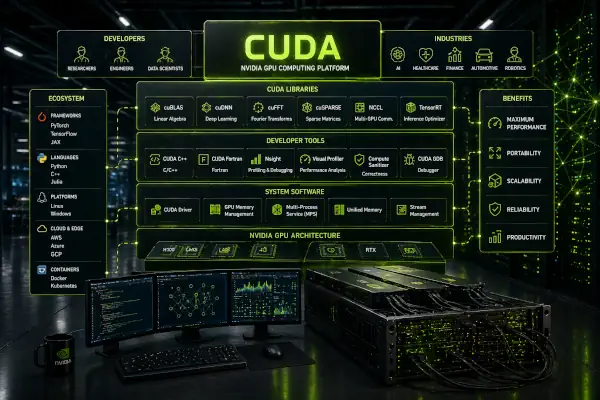
If there is one word that best explains Nvidia's power in AI, it is probably CUDA. CUDA is the software environment that allows developers to use Nvidia GPUs for general-purpose computing far beyond graphics.
This matters enormously. In the technology industry, hardware can sometimes be matched or imitated. But once software, libraries, developer habits and years of compatibility are in place, the advantage becomes much harder to dislodge.
CUDA became the backbone of a vast ecosystem. Researchers, engineers, universities, startups and large enterprises all learned to build around it. Once an entire sector develops, optimizes and deploys on top of the same foundation, the resulting inertia becomes substantial.
That software inertia is a major reason why Nvidia's dominance cannot be reduced to benchmark scores alone. It also reflects deep practical dependence.
From libraries to frameworks: lower friction for industry
A company truly leads when it makes adoption easier. Nvidia gained so much ground because its technical stack connected with frameworks, libraries, SDKs and tools that AI teams use every day.
In practice, that means developers do not start from scratch. They already find software layers that fit their needs, ready-made optimizations, familiar integrations and proven workflows for both training and inference.
That fluidity plays a huge role. In business, people do not choose only what looks theoretically elegant. They also choose what is compatible, documented, available, maintainable and productive quickly. Nvidia understood that logic extremely well.
This also explains why teams often prefer an already standardized environment over a potentially interesting but still immature alternative. In applied AI, execution speed, technical support and the ability to move from prototype to production matter almost as much as raw performance.
Data centers: where dominance becomes structural
Modern AI does not live only in research labs or on personal computers. It scales inside data centers. Those infrastructures train large models, host inference services, power cloud platforms and make industrial-scale AI applications possible.
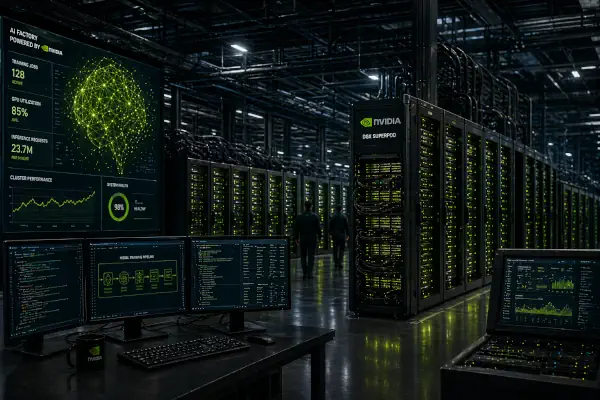
Nvidia established itself as a central part of that infrastructure. Its solutions are not only about GPUs, but also about server architectures, interconnects, throughput optimization, workload orchestration and turning the data center into a true AI factory.
This is a fundamental point: once a company becomes the reference platform inside the data center, it is no longer just selling a component. It becomes part of the system's operating foundation.
Comparison: Nvidia versus a purely hardware competitor
Nvidia's real strength is that it covers several layers at once, while a hardware-only competitor may remain confined to just one.
Quick read
- GPU: Nvidia is very strong, but that is only the first layer.
- Software: CUDA creates a durable advantage.
- Developers: the ecosystem is already in place.
- Data centers: industrial integration reinforces the dominant position.
- Migration risk: changing stacks is costly in time, money and operational stability.
In other words, a competitor may launch an interesting chip. But if that chip does not come with mature tools, recognized libraries, reliable support, credible cloud presence and established usage patterns, adoption becomes far harder.
Nvidia's lead creates a network effect that is very hard to break
The more Nvidia equips enterprises, clouds, laboratories and platforms, the more rational it becomes for other players to adopt its technologies too. It is a classic but powerful mechanism: dominance feeds further dominance.
Engineers are trained on these tools, vendors support them, customers request them, software targets them and systems integrators recommend them. As a result, a competitor does not just need a good chip. It has to persuade an entire market to change habits, rewrite software stacks, migrate infrastructure and accept operational risk.
That is why the gap is not merely technical. It is also institutional, economic and organizational.
Why competitors struggle to regain ground
Nvidia certainly has competitors, whether they are other chipmakers, major cloud providers or designers of specialized hardware. Some have strong ideas, promising architectures or powerful vertical integration strategies.
Yet competing with Nvidia in AI requires meeting several conditions at once: excellent performance, a convincing software chain, tools developers actually like, reliable industrial production, strong relationships with hyperscalers and credible presence in real-world deployments.
Many players can be strong on one or two of these fronts. Nvidia managed to align several of them simultaneously. That is what makes catching up so difficult.
What makes competition difficult
- an early lead in GPU computing applied to AI
- a software ecosystem that is already massively adopted
- a strong position in data centers and cloud infrastructure
- tools and libraries that reduce integration costs
- network effects across developers and enterprises
- high migration costs for already-equipped organizations
The right timing: Nvidia was already ready when AI exploded
A major part of Nvidia's dominance also comes from timing. When generative AI, large language models and the surge in inference demand accelerated, the company already had an exceptional base in place: suitable hardware, proven software, industrial partners, cloud presence and technical credibility.
That preparation changed the nature of the competition. Nvidia did not need to build legitimacy in a rush. It simply converted years of accumulated advantage into dominance at the exact moment global demand multiplied.
In the technology industry, this kind of synchronization between deep preparation and market explosion is rare. When it happens, it can reshape an entire sector for years.
In reality, Nvidia also sells time and trust
For a company, the real cost of an AI project is not limited to the price of a chip or a server. It also includes deployment time, integration complexity, support stability, documentation quality, talent availability and the ability to move quickly from prototype to production.
Nvidia understood that perfectly. By reducing technical friction and offering a familiar environment, the brand is effectively selling part of what industrial users value most: less uncertainty, shorter timelines and more predictability.
This dimension matters because it explains why Nvidia's dominance is not only about prestige. It is rooted in practical value felt during real project execution.
This dominance is powerful, but it is neither magical nor permanent
Dominance does not mean untouchable. Nvidia still faces industrial cycles, supply chain tensions, energy constraints, technological competition, hyperscaler bargaining power and strategic choices made by major platforms.
New players can improve, alternative architectures can gain relevance and many companies will naturally want to reduce dependence on a single vendor. But for now, Nvidia's lead rests on a broad enough combination of advantages to make disruption especially difficult.
That is why this dominance should not be seen as a miracle. It is the result of stacked technical, software, industrial and economic advantages.
Useful comparisons to better place Nvidia in context
- Nvidia vs a simple chipmaker: Nvidia wins mostly because of the breadth of its ecosystem.
- GPU vs CPU: the GPU is not universally better, but it is especially well suited to massively parallel workloads.
- Raw performance vs real adoption: a strong product without an ecosystem can remain marginal.
- Hardware alone vs a full platform: it is usually the latter that dominates a market over time.
Go further: two related reads on this topic
Sources and reference points to go deeper
- official documentation around CUDA and Nvidia developer tools
- technical presentations on GPU computing and AI acceleration
- publications about deep learning, parallel computing and training infrastructure
- industry analysis on data centers, cloud platforms and AI value chains
- technical comparisons between hardware, software and real enterprise deployment
Conclusion: to understand Nvidia, look at the ecosystem, not just the chip
If you only look at a GPU, you see a very powerful card. If you look at the full ecosystem, you understand why Nvidia dominates artificial intelligence.
The real answer lies in the whole system: parallel computing, CUDA software, libraries, developer integration, presence in data centers, industrial deployment capability and network effects. Nvidia turned a technological edge into a power architecture.
That is why the company holds such a central place today: it does not simply provide a tool for AI. It helps define the very ground on which modern AI is deployed.
FAQ
Why is Nvidia so strong in artificial intelligence?
Nvidia is strong in artificial intelligence because it combines GPUs suited to parallel computing, mature software such as CUDA, widely adopted libraries, a massive presence in data centers and strong network effects across the industry.
Is it only about raw GPU power?
No. GPU power matters, but it does not explain everything. Nvidia's dominance also comes from software compatibility, tools, documentation, industrial support and ease of deployment.
Why is CUDA so important in Nvidia's dominance?
CUDA is central because it allows Nvidia GPUs to be used for general-purpose computing and because it became embedded in many long-term development practices. That adoption creates strong market inertia.
Why do data centers reinforce this dominance so strongly?
Because modern AI operates at scale in data centers. Once a company becomes the reference platform for training and inference in those environments, it becomes an operational standard that is difficult to replace.
Can Nvidia's competitors catch up?
Yes, but catching up is complex. It requires not only strong hardware, but also a credible software stack, tools developers appreciate, broad compatibility, solid cloud presence and durable industrial trust.