A new generation of laptops
The Galaxy Book4 series arrives at a pivotal moment in computing history: the laptop is no longer just a general-purpose machine, but a hybrid platform capable of handling advanced productivity, high-end multimedia, graphics-heavy workloads and AI-related computation.
Models such as the Galaxy Book4 Ultra bring together Intel Core Ultra processors, NVIDIA RTX GPUs, LPDDR5X memory, fast storage and high-definition AMOLED displays within a single chassis. This level of integration reflects a clear shift: the modern computer must now manage general-purpose computing, imaging, mobility and advanced algorithmic processing at the same time.
So the issue is no longer raw performance alone. Everything depends on the overall system architecture, in other words on the way components work together to deliver a machine that feels responsive, efficient and credible across an increasingly diverse set of use cases.
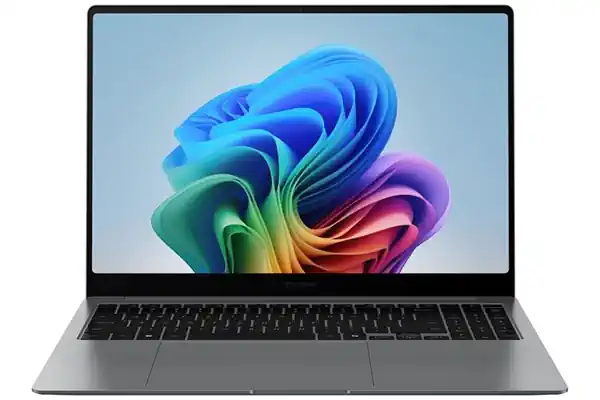
The modern laptop is no longer a simple work terminal. It is becoming a universal computing platform designed to connect processor performance, on-device AI, graphics, security, battery life and connectivity within one coherent system.
At the heart of the system: Intel Core Ultra architecture
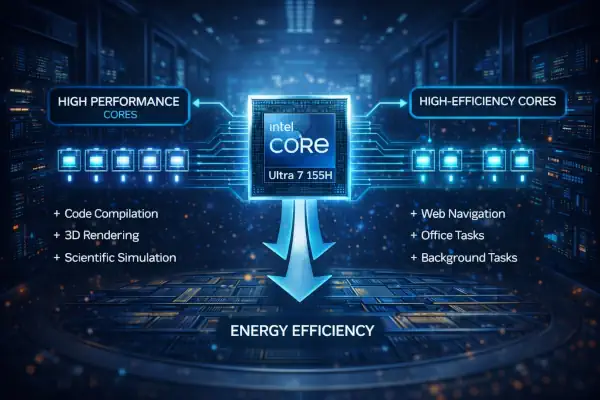
At the center of this evolution are Intel Core Ultra processors, designed to meet the demands of contemporary laptops. In machines such as the Galaxy Book4 Pro, for instance, Samsung uses chips like the Core Ultra 7 155H, a CPU with 16 cores distributed across high-performance cores, energy-efficient cores and low-power cores.
This heterogeneous architecture follows a principle that has become fundamental: matching the right type of core to the right type of task. Heavy workloads are routed to the most powerful units, while lighter tasks move to more efficient cores. The result is not just higher performance, but also better energy management in a portable form factor.
This design makes it possible to
- distribute computing workloads more intelligently
- improve the balance between performance and power consumption
- better support mixed-use scenarios on battery power
This reflects a long-standing line of research in processor energy optimization: a modern machine should not only be fast, it should also know when and how to deploy its power.
The rise of AI PCs
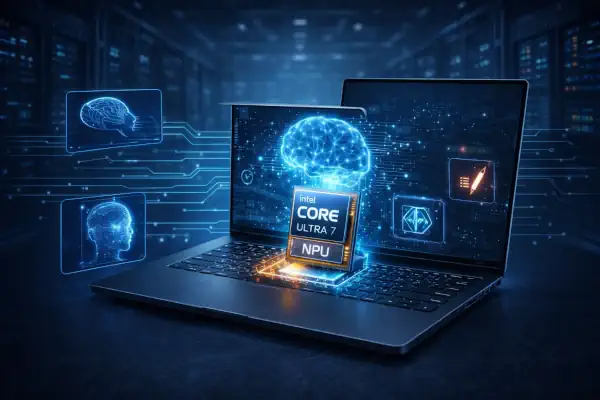
One of the biggest shifts in this generation is the integration of an NPU, or Neural Processing Unit. This specialized unit handles workloads related to neural networks and machine learning. It marks an important stage in the evolution of the personal computer, which no longer relies solely on the CPU and GPU for certain AI tasks.
In recent systems, the NPU accelerates tasks such as image processing, voice analysis, intelligent assistance features and local content generation. The logic is straightforward: run a growing share of artificial intelligence directly on the device, with greater responsiveness and, in some cases, better privacy.
So the idea of an AI PC is more than a marketing label. It reflects a deep hardware reorientation of personal computing, one in which AI becomes a native part of system architecture.
GPU and graphics power
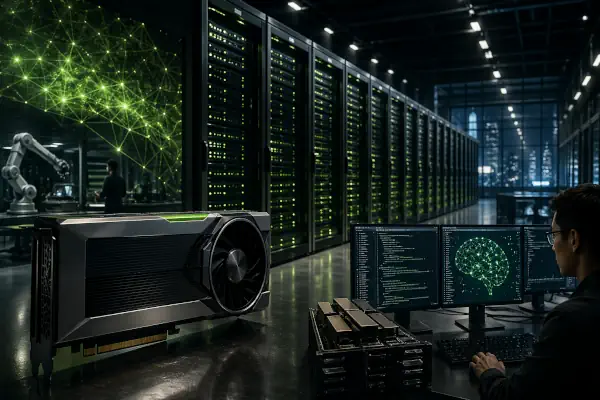
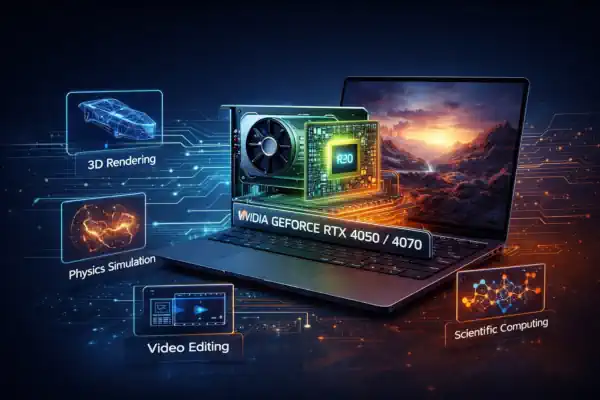
In premium models such as the Galaxy Book4 Ultra, Samsung also integrates dedicated graphics cards such as the NVIDIA GeForce RTX 4050 or RTX 4070. These GPUs are not there just to make an interface look better: they accelerate demanding tasks such as 3D rendering, video creation, some simulations and parallel computation.
Modern GPU architectures rely on thousands of units capable of processing large amounts of data simultaneously. This parallel logic first transformed visual computing, then large parts of scientific computing and AI. In a premium laptop, it helps bring together mobility and power for workloads that once required much larger machines.
The presence of a dedicated GPU therefore changes the nature of the laptop profoundly: it is no longer simply a refined office machine, but a system capable of handling far more ambitious graphics and computational workloads.
The AMOLED display: an inheritance from mobile technology
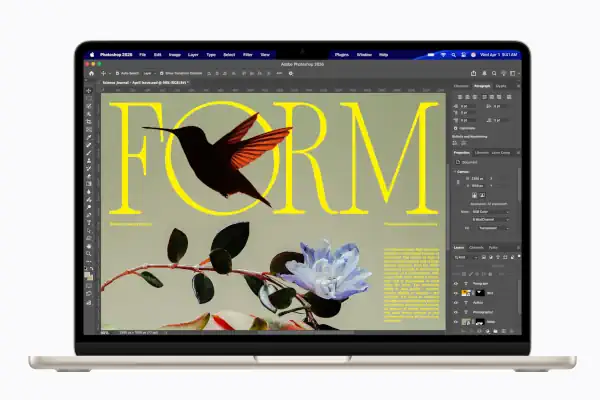
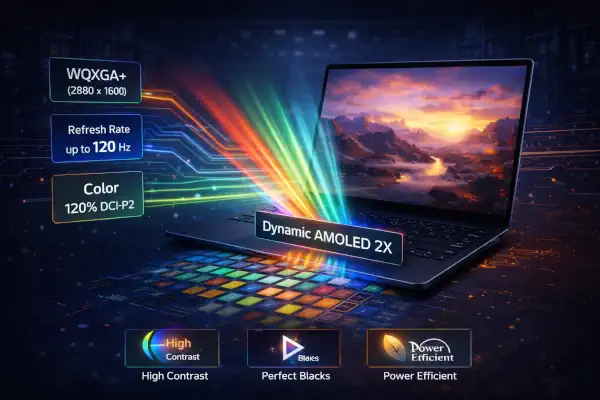
One of the defining features of modern Galaxy Book laptops is the use of Dynamic AMOLED 2X displays. High resolution, refresh rates up to 120 Hz and wide color coverage mean the display is no longer just an output device, but a central part of the overall experience.
AMOLED technology belongs to a long history of research in electronic displays. Unlike a traditional LCD panel, each OLED pixel emits its own light. That allows for much deeper blacks, very high contrast and, depending on usage, more controlled power consumption.
This choice says a great deal about Samsung's strategy: bringing the legacy of its mobile display innovation into the premium laptop space, so the machine stands out not only for its computing power, but also for the quality of its visual output.
Memory and storage architecture
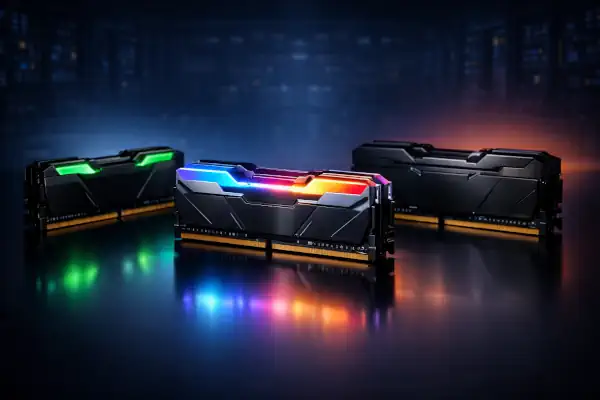
Memory in recent Galaxy Book systems is based on LPDDR5X modules, chosen for their high bandwidth and better energy efficiency in a portable chassis. Depending on the configuration, capacity can reach 32 or 64 GB, placing the machine firmly in the realm of advanced productivity as well as general comfort.
Storage relies on NVMe PCIe SSDs, capable of reaching several gigabytes per second in read speed. Compared with older mechanical drives, this changes the machine's perceived behavior dramatically: boot times, application launches, project loading and overall fluidity.
RAM and fast storage are not minor technical details. They directly shape the sense of responsiveness that now defines a high-end laptop.
Connectivity, security and the technology platform
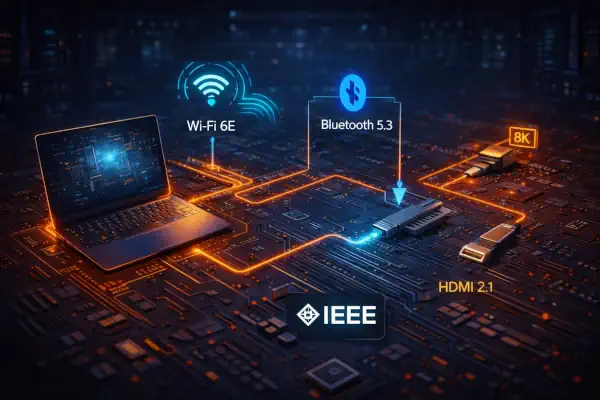
A modern computer is no longer just a computing machine. It is also a node within an ecosystem of devices, networks and services. Galaxy Book laptops therefore include Wi-Fi 6E, Bluetooth 5.3, Thunderbolt 4 ports and HDMI 2.1, all of which reinforce their role as connected platforms.
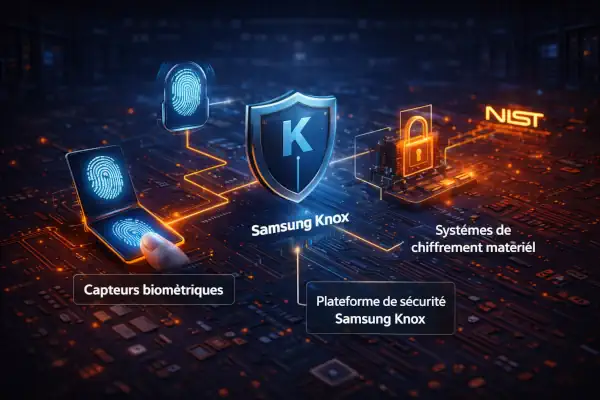
Security also plays a central role. Biometric sensors, hardware encryption and the Samsung Knox platform show that modern architecture is no longer limited to running workloads; it must also protect identity, data and system integrity.
At a deeper level, Galaxy Book laptops illustrate a broader trend: the laptop is becoming a universal platform capable of running AI, producing visual content, analyzing data, remaining mobile and operating in an increasingly interconnected digital environment.