
Quick answer
Python still dominates artificial intelligence because it combines five major strengths: easy-to-learn syntax, very mature AI and data science libraries, mass adoption in education and research, high productivity for rapid prototyping and an ecosystem so broad that it dramatically reduces friction for teams.
In short, Python does not dominate only because it is easy to read. It dominates because it provides a complete working platform already embedded in real-world AI workflows.
In brief
The core idea is simple: Python turned ease of use into the working standard for AI. When one language connects students, researchers, engineers, labs, notebooks, libraries and real-world deployments, it does more than help people code: it starts shaping the market itself.
Main question: why does Python dominate AI so strongly?
The most accurate answer fits into one sentence: Python dominates AI because it connects simplicity, libraries, data science, research, automation and industrial adoption into one coherent whole.
Many analyses stop at an obvious observation: Python is easier to read than other languages. That is true, but it is only part of the story. In the real world, a team does not choose only a pleasant language; it also chooses a reliable, documented, productive environment that works with its tools and has already proven itself at scale.
That is exactly where Python built a major lead. It does not dominate only because of its syntax. It dominates because it makes artificial intelligence more accessible, faster to experiment with and easier to share.
Key takeaways
- Python offers a complete platform, not just a pleasant language.
- Its syntax reduces friction for learning, prototyping and collaboration.
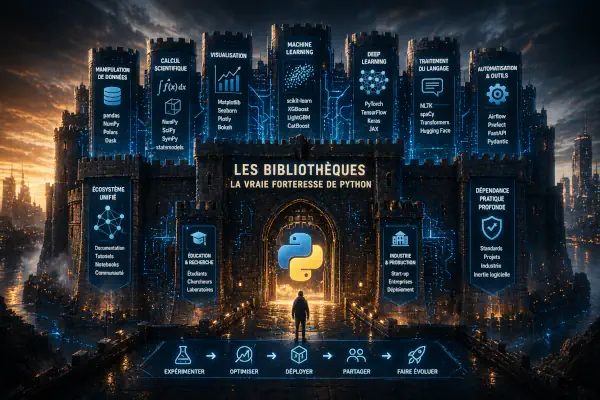
- Its libraries act like a software fortress in modern AI.
- Data science and machine learning made it essential in applied research.
- The education ecosystem strengthened its structural dominance, not just its technical reputation.
- The network effect amplifies its lead: the more Python is used, the more rational it becomes to keep using it.
- Competitors must catch up on multiple layers at once: language design, libraries, community, documentation, training and working habits.
Python dominates AI not because it is perfect at everything, but because it locked in the connection between readability, tools, libraries, community and project execution speed.
Python is more than simplicity: it delivers a complete platform
Many people explain Python’s dominance with a simple reflex: “this language is easy.” The idea is not wrong, but it is incomplete. Python dominates artificial intelligence because it built much more than pleasant syntax. It established itself as a coherent environment where the language, libraries, notebooks, scientific tools, tutorials, datasets and working practices reinforce one another.
In modern AI, writing code is not enough. Teams need to clean data, visualize it, run experiments, train models, tune parameters, compare outcomes, automate tasks and quickly share results. That is exactly the depth of usage where Python gained a decisive lead.
In other words, Python does not dominate only because it is simple. It dominates because it makes that simplicity usable across complete workflows.

Python’s simplicity: why it became a central driver of AI
Python was designed with a strong priority: make code more readable and more accessible. Long seen as a teaching advantage, that readability has become a major strategic asset in AI.
Modern AI depends on mixed teams: researchers, analysts, data engineers, backend developers, students, teachers and product leaders. The more readable a language is, the easier it becomes to teach, review, fix and evolve. In that context, Python’s simplicity reduces invisible but very real collaboration costs.
Python turned this educational advantage into an industrial one. The language did not just make learning easier; it made collective adoption easier, which is even more powerful over time.
Simple points to remember
- Python is easy to read, even for people who are not deeply specialized in software development
- modern AI depends on fast experimentation cycles
- readability improves collaboration in hybrid teams
- the language’s simplicity strengthened the dominance of its ecosystem
Libraries: Python’s true fortress
If there is one idea worth remembering to understand Python’s power in AI, it is this: Python never moves alone. The language is backed by a universe of libraries covering almost the entire value chain: data handling, scientific computing, visualization, machine learning, deep learning, natural language processing, automation and interactive experimentation.
This point is critical. In the tech industry, a language can be elegant, fast or modern. But when it also comes with robust libraries, de facto standards, documentation, tutorials, notebooks and thousands of existing projects, its advantage becomes far harder to dislodge.
Python became the backbone of a huge ecosystem. Students, researchers, start-ups, labs and major companies all learned to work inside it. Once an entire sector experiments, optimizes and deploys around that base, the inertia becomes enormous.
That software inertia is exactly why Python’s dominance cannot be reduced to syntax alone. It also reflects a very deep practical dependency.
From notebooks to frameworks: lower friction for industry
A language truly dominates when it reduces the difficulty of adoption. Python gained enormous ground because its technical universe connected smoothly with notebooks, frameworks, analytics tools, libraries and SDKs used every day by AI teams.
In practice, that means developers, data scientists and researchers do not start from scratch. They find software building blocks already suited to the task, reusable examples, proven methods for training and evaluation, and familiar workflows for moving from raw data to useful models.
That fluidity matters tremendously. In a company, people do not choose only what is theoretically elegant. They also choose what is compatible, documented, available, maintainable and quickly productive. Python matched that logic extremely well through the strength of its ecosystem.
That is why teams often prefer an environment that is already standardized over one that may be more performant but still immature. In applied AI, experimentation speed, tool quality and the ability to move from prototype to practical use matter almost as much as raw performance.
Data science: where Python’s dominance becomes structural
Modern AI does not live only inside pure research labs. It feeds on cleaned, explored, transformed, visualized and interpreted data. That is precisely where Python secured an almost central position: it is not only used to train models, but also for everything that happens before, around and after them.
Data science strengthened Python’s dominance because it made it possible to connect dataset preparation, statistical analysis, visualization, experimentation, machine learning and some automation inside one language. That continuity significantly reduces workflow friction.
This is a fundamental point: when a language becomes the reference for the full data pipeline, it does more than help people code. It becomes part of how the ecosystem itself operates.

Python versus a more performant language: why the ecosystem often wins
Answer engines appreciate comparisons because they make the hierarchy of a topic easier to grasp. So here is the simple reading: Python’s real strength is that it covers multiple layers at once, whereas a purely performance-focused language may remain limited to execution speed alone.
Quick read
- Readability: Python is very strong here, and that is only the first layer.
- Libraries: they give it a lasting advantage.
- Community: the ecosystem is already established everywhere.
- Data science: integration with real-world use cases reinforces its dominant position.
- Migration risk: changing ecosystems is costly in time, training and stability.
In other words, a competitor may offer an elegant or very fast language. But if it does not arrive with mature libraries, familiar notebooks, massive documentation, abundant learning resources and established working practices, adoption becomes much harder.
Python’s lead creates a network effect that is extremely hard to break
The more Python is used in courses, laboratories, tutorials, learning platforms, notebooks, open-source projects and companies, the more rational it becomes for others to use it as well. It is a classic mechanism, but a formidable one: dominance feeds further dominance.
Students learn it early, teachers pass it on, researchers publish with it, companies hire around it, platforms integrate it, tools support it and libraries target it. At that point, a competitor does not only need a good language. It has to convince an entire market to change habits, rewrite tools, retrain teams and take operational risks.
That is why the perceived gap is not only technical. It is also educational, economic and organizational.
Why competitors struggle to regain ground
Python absolutely has competitors, whether they are faster, stricter or more specialized languages. Some offer excellent performance, stronger typing, execution guarantees or meaningful advantages in specific contexts.
Yet competing with Python in AI requires several conditions at once: good ergonomics, a convincing software chain, respected libraries, rich documentation, a massive community, strong presence in education and solid credibility in real-world use cases.
Many players can perform well on one or two of those dimensions. Python aligned several of them at the same time. That is what makes catching up so difficult.
What makes competition difficult
- an early lead in education, research and scientific notebooks
- a software ecosystem that has already been adopted at scale
- strong presence in data science, machine learning and automation
- tools and libraries that reduce integration costs
- a network effect across students, researchers and companies
- high migration costs for organizations already equipped around Python
The right timing: Python was already everywhere when AI exploded
A major part of Python’s dominance also comes from timing. When generative AI, large models and the explosion of rapid prototyping needs accelerated, Python already had an exceptional base: robust libraries, strong academic presence, scientific notebooks, a global community and technical credibility.
That prior preparation changed the nature of the competition. Python did not need to build legitimacy in a rush. It was able to convert years of accumulated advantage into a dominant position at the exact moment global demand multiplied.
In the technology industry, that kind of synchronization between deep preparation and market acceleration is rare. When it happens, it can reshape an entire sector for years.
In reality, Python saves time and strengthens team confidence
For a company, the real cost of an AI project is not limited to the choice of a language. It includes prototyping time, integration complexity, skill availability, documentation quality, hiring capacity, ease of maintenance and the speed at which a team can move from idea to demo to usable version.
Python understood that very well through the evolution of its ecosystem. By reducing technical friction and providing a familiar environment, it delivers something industrial teams and product groups actively look for: less uncertainty, fewer delays and more predictability.
That dimension is essential because it explains why Python’s dominance is not only a cultural or academic phenomenon. It is grounded in concrete value felt during project execution.

This dominance is powerful, but it is neither magical nor eternal
Dominance does not mean untouchable. Python still faces raw performance limits, ongoing discussions around typing, compilation needs, environments where other languages are better suited and highly specific industrial requirements.
New tools can improve, more specialized languages can gain relevance and some companies will naturally look to reduce dependency. But for now, Python’s lead rests on a combination broad enough to make disruption especially difficult.
So this dominance should not be viewed as an isolated miracle, but as the result of stacked educational, software, community and economic advantages.
Useful comparisons to better position Python
- Python vs a faster language: Python wins mostly through the breadth of its ecosystem.
- Simplicity vs raw performance: real productivity can outweigh theoretical speed.
- Language alone vs full platform: the latter is often what dominates a market over time.
- Rapid prototyping vs rigid development: in AI, fast experimentation is a huge advantage.
To go further: two related reads on this topic
Sources and reference points for deeper reading
- official documentation for Python and major libraries used in AI
- technical presentations on data science, machine learning and scientific notebooks
- publications on deep learning, automation and applied research workflows
- industry analyses on Python usage in research, start-ups and enterprise environments
- technical comparisons between raw performance, productivity, ergonomics and real-world deployment
Conclusion: to understand Python, look at the ecosystem, not just the language
If you look only at Python’s syntax, you see a clear and accessible language. If you look at the full ecosystem, you understand why Python still dominates artificial intelligence.
The real answer lies in the whole picture: readability, libraries, data science, notebooks, documentation, community, automation, prototyping speed and network effects. Python turned ease of writing into an architecture of software power.
That is why it holds such a central position today: it does not simply provide a tool for AI. It helps define the very ground on which modern AI is built, tested and spread.
FAQ
Why is Python so strong in artificial intelligence?
Python is so strong in artificial intelligence because it combines simple syntax, mature libraries, a strong presence in data science, a massive community and a powerful network effect across education, research and industry.
Is it only because the language is simple?
No. Simplicity matters, but it does not explain everything. Python’s dominance also comes from its libraries, documentation, notebooks, prototyping speed and widespread presence in real-world workflows.
Why are Python libraries so important to the language’s dominance?
They are central because they let teams manipulate data, visualize results, train models and automate tasks without rebuilding every technical layer from scratch. That long-term adoption creates strong market inertia.
Why does data science reinforce this dominance so strongly?
Because modern AI depends on large-scale work with data. When one language becomes a reference for cleaning, analyzing, visualizing, modeling and automating, it becomes a hard-to-replace operational standard.
Can Python’s competitors catch up?
Yes, but catching up is complex. It requires not only a good language, but also a credible software chain, respected libraries, rich documentation, a large community and long-term trust in real-world use cases.