System-on-a-Chip architecture: maximum integration
The defining feature of recent MacBook Pro models lies in their adoption of a System on a Chip, or SoC. With this approach, the machine is no longer organized around largely separate components, but around a central chip that brings together the CPU, GPU, neural engine, memory controllers and several specialized accelerators.
The benefit of this architecture is significant: it reduces latency, limits internal data transfers and physically brings compute units closer together. In practice, this makes the machine more responsive, more consistent and often more energy-efficient than a traditional platform, where memory and some processing tasks remain more fragmented.
This integration logic is not just a detail of industrial design. It redefines the overall behavior of the computer by making the chip the true architectural center of gravity.
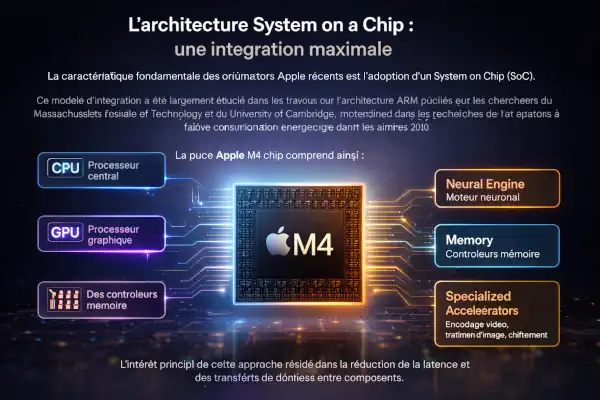
With Apple Silicon, performance no longer depends on raw speed alone. It depends on how computing, memory, graphics and artificial intelligence are brought together in a unified architecture.
3-nanometer process: a major technological leap
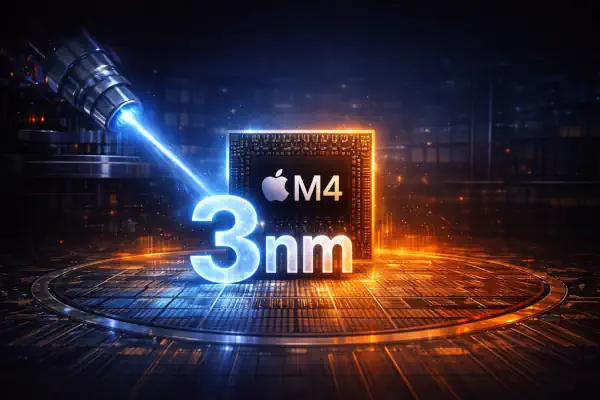
The Apple M4 chip is built on an advanced 3 nm manufacturing process produced by TSMC. In the semiconductor industry, this level of process refinement plays a major role in transistor density, power consumption and the ability to sustain high performance within a compact footprint.
The finer the process becomes, the more transistors can be integrated into a limited surface area. This drives a double advantage: more computing power and better energy efficiency. It is one of the technical foundations that explains the strength of Apple Silicon chips in demanding mobile workflows.
The 3 nm process should therefore not be read as a simple marketing figure. It represents a major industrial milestone in miniaturization and in the sophistication of contemporary architectures.
Hybrid CPU: performance and energy efficiency
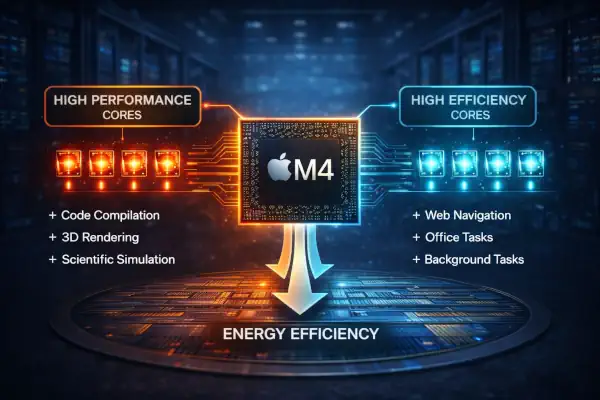
The M4 chip uses a heterogeneous architecture inspired by big.LITTLE-style models popularized in the ARM ecosystem. The principle is straightforward: some cores are dedicated to intensive workloads, while others are optimized for lighter and continuous tasks.
This distribution allows the computer to allocate its resources more intelligently. A compilation, render, simulation or demanding creative task will engage the most powerful cores. Simpler or background operations, by contrast, can be handled by the most efficient ones.
This approach notably improves
- dynamic management of computing power
- battery life in mixed-use scenarios
- thermal stability in a premium laptop
The result is not just a speed boost. It is a better balance between compute intensity, mobility and long-term power efficiency.
Integrated GPU and unified graphics architecture
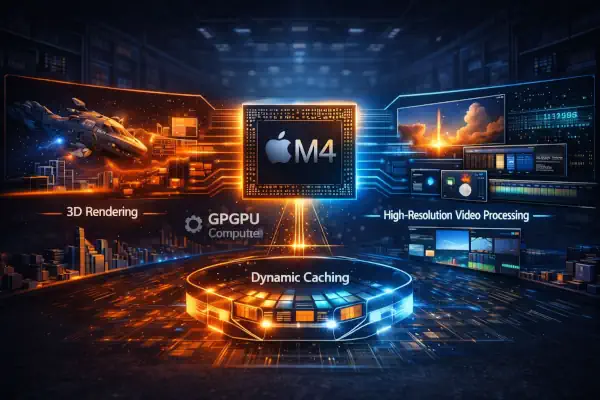
The M4 chip’s integrated GPU is designed to meet the growing demands of graphics processing and parallel computation. It is not limited to displaying the interface: it also supports 3D rendering, video processing, certain creative workloads and accelerated computing tasks.
One of the innovations Apple has emphasized in recent generations is Dynamic Caching, which allocates graphics memory more precisely according to real-world needs. This kind of mechanism improves rendering efficiency while also supporting the broader optimization logic that defines Apple Silicon.
Here again, what matters is not simply the presence of a GPU, but the way it communicates with the rest of the system. In a unified architecture, graphics processing directly benefits from decisions made at the SoC and memory levels.
Unified memory: an optimized data architecture
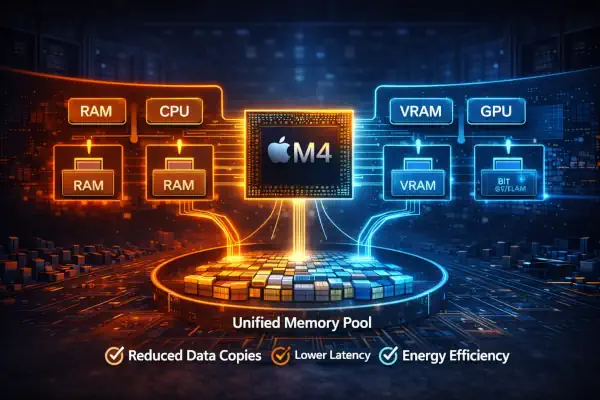
One of the most structurally important elements of Apple Silicon is unified memory. In a traditional architecture, processor memory and graphics memory are largely separate. In the M4 chip, the CPU and GPU share a common high-bandwidth memory pool.
This approach reduces data copies, lowers certain forms of latency and improves energy efficiency. It also benefits workloads that manipulate large amounts of information, especially in imaging, video and some artificial intelligence applications.
Unified memory is therefore not just a technical talking point. It is an architectural choice that fundamentally changes the machine’s overall behavior.
Neural Engine: hardware acceleration for artificial intelligence
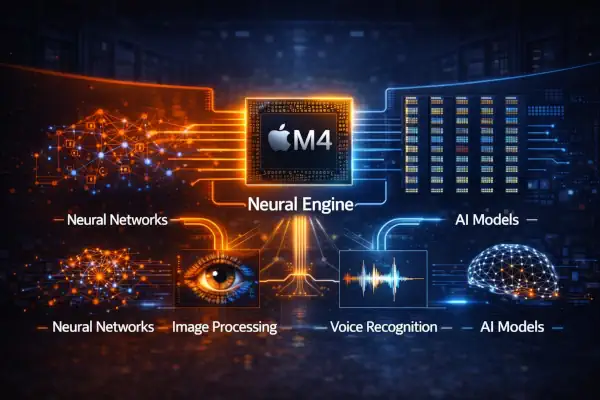
The M4 chip includes a Neural Engine, a specialized unit dedicated to machine-learning workloads. This type of hardware accelerator is designed to process the massively parallel operations used in neural networks, speech recognition, image processing and some generative AI tasks more efficiently.
Its value is twofold: it delivers greater speed on these specific workloads while limiting the energy cost that would come from running them systematically on the CPU or GPU. The native integration of a neural engine confirms the direction of personal computing: AI is no longer peripheral, it is becoming a structural function of the hardware itself.
With Apple Silicon, this means that certain AI-related tasks can be handled more locally, more quickly and within an architecture that is better aligned with modern usage patterns.
Thermal management and energy efficiency
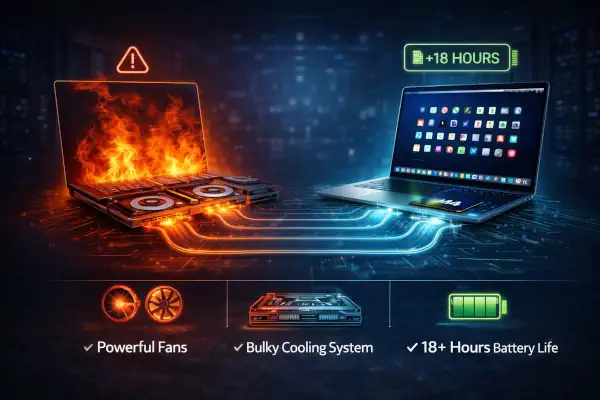
One of the major challenges in portable computing is thermal dissipation. The more a machine computes, the more heat it generates, and the more intelligently it must manage that heat to remain stable, quiet and mobile. Apple Silicon architectures stand out here because of their overall energy efficiency.
Thanks to the consistency between advanced manufacturing, a hybrid CPU, unified memory and SoC integration, the MacBook Pro can sustain high performance while limiting its thermal demands. This leads to better stability under load and battery life that remains one of the strongest advantages of the platform.
In other words, energy efficiency is not a secondary quality. It sits at the heart of the modern architecture of Apple machines.
A new direction for personal computing
Apple Silicon chips reflect a broader transformation across the industry: ARM-derived architectures are gradually becoming credible alternatives to traditional x86 platforms in high-end personal computers.
The modern MacBook Pro powered by the M4 chip therefore represents more than a successful product. It embodies a clear direction: computing that is more integrated, more efficient and better adapted to new workloads tied to AI, digital creation and complex professional tasks in a mobile form factor.
At its core, this architecture does not simply redefine an Apple computer. It helps redefine what a modern laptop is expected to be.