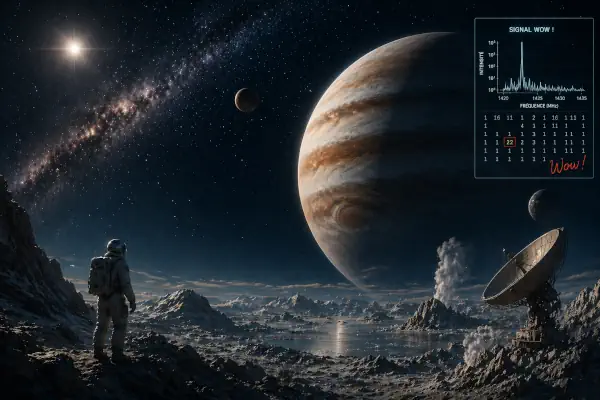
My short answer: extraterrestrial life is plausible, but unproven
Based on what we currently know, it would be intellectually careless to claim that we are alone in the universe. It would be just as excessive to claim that extraterrestrial life has already been demonstrated. The most rigorous position is to acknowledge a simple fact: the conditions that may support the emergence of life appear less exceptional than we once believed, but the proof is still missing.
That nuance matters. Science does not operate through cosmic intuition, but through evidence, testable hypotheses, measurements, and gradual validation. Today, researchers have several serious reasons to explore the possibility of life elsewhere: an abundance of planets, a wide diversity of environments, water in multiple forms, complex organic chemistry, and a growing ability to analyze the atmospheres of extremely distant worlds.
In brief
- we still have no direct confirmed evidence of extraterrestrial life
- we have strong scientific reasons to think life elsewhere is possible
- microbial life is considered more likely than intelligent life
- the next major breakthrough could come from Mars, Europa, Enceladus, or rocky exoplanets
The real question is no longer only whether life elsewhere is imaginable, but on which worlds, in what forms, and through which signatures it may finally become detectable.
Why the question has become scientifically credible
For a long time, extraterrestrial life belonged mainly to speculation. The lack of data demanded extreme caution. That situation has changed profoundly. The rise of exoplanet research, advances in spectroscopy, robotic exploration of the Solar System, and the maturation of astrobiology have transformed the intellectual landscape. The question is no longer marginal. It has become structured, instrumented, and methodical.
The sheer number of worlds now identified changes the scale of the discussion. Our galaxy contains an immense number of stars, and a significant fraction of them appear to host planets. That does not prove life exists elsewhere, but it makes the idea of Earth as an absolutely solitary oasis in a biologically empty universe far less convincing.
This new credibility also comes from a second shift: the definition of potentially life-supporting environments has broadened. Scientists are no longer looking only for an Earth copy. They now consider a wider range of settings, sometimes cold, sometimes buried beneath ice, sometimes distant from their parent star but sustained by internal energy or long-lasting chemical processes.
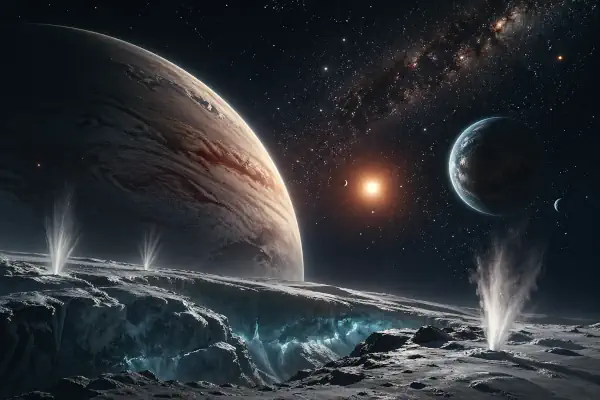
Exoplanets have changed the scale of the problem
One of the greatest scientific revolutions of recent decades has been the discovery of thousands of exoplanets. This shift is crucial. As long as no planets were known around other stars, Earth could seem exceptionally isolated. Today, we know planetary systems are common. Some worlds are rocky, others massive, and some lie in regions where liquid water could in theory exist at the surface depending on their atmosphere and star.
That abundance should not be interpreted naively. A planet located in a so-called habitable zone is not necessarily inhabited. Potential habitability is not biological proof. Researchers still need to understand atmospheric composition, climate stability, geological history, the possible presence of water, and the way prebiotic chemistry might persist over time.
Even with those cautions, the multiplication of planets that share some similarities with Earth has expanded the realm of possibility. It has made the idea that life could emerge elsewhere feel less abstract, even if the path toward biological complexity and intelligence may remain extraordinarily rare.
Where science is focusing first: Mars, ocean worlds, and distant planets
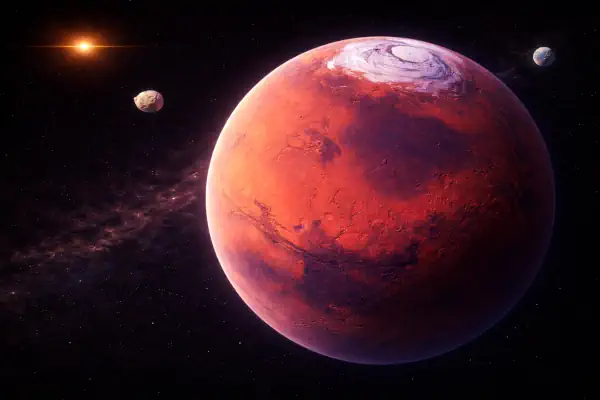
The search for extraterrestrial life is not random. It follows targets considered especially promising. Within the Solar System, Mars still holds a central place. The Red Planet no longer appears as a simple frozen desert, but as a world that once had liquid water, lakes, rivers, and environments that may have been favorable to ancient microbial life.
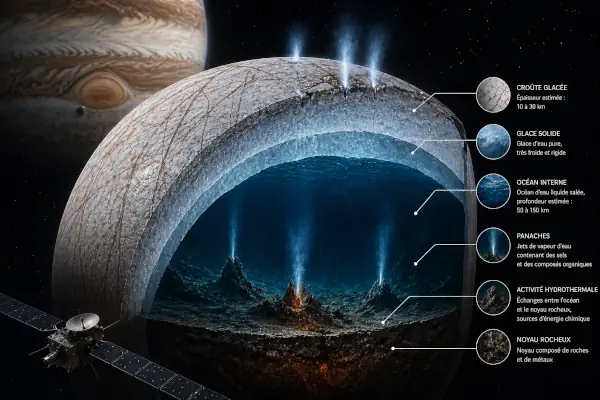
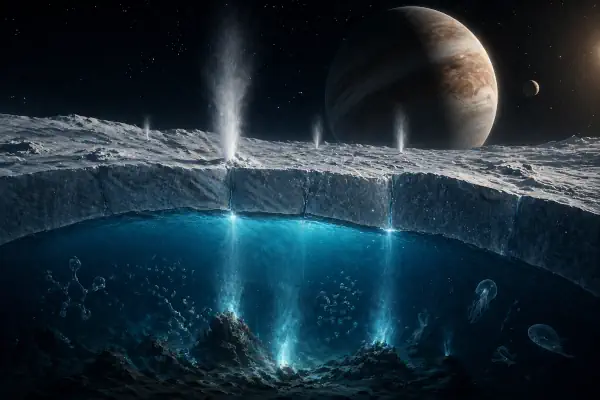
Other worlds have become even more compelling in some respects: Europa, orbiting Jupiter, and Enceladus, orbiting Saturn. These icy bodies appear to conceal liquid oceans beneath their crusts. That matters enormously. A long-lasting ocean, paired with suitable chemistry and energy sources, creates a serious framework for considering habitability, even far from direct sunlight.
Finally, nearby rocky exoplanets on the galactic scale remain major targets, especially when their atmospheres can be studied at least in part. We cannot send probes there yet, but we are beginning to read certain remote physical and chemical clues that may reveal disequilibria compatible with biological activity.
The most studied environments in the search for life
- Mars, for fossil or geochemical traces of ancient life
- Europa, for its internal ocean beneath the ice
- Enceladus, for its water-rich geysers and astrobiologically relevant molecules
- certain rocky exoplanets, for the detection of atmospheric biosignatures
Biosignatures: scientific promise and the difficulty of interpretation
One of modern astrobiology's core goals is to identify biosignatures, meaning detectable clues that may be associated with living activity. These may involve particular molecules, chemical imbalances in an atmosphere, distinctive mineral structures, or combinations of compounds that are difficult to explain through geology alone.
But caution remains essential. A biosignature is not automatically proof. Many abiotic processes can produce ambiguous signals. The history of science also shows that media excitement often outruns the robustness of the conclusions. That is why researchers rely on increasingly demanding protocols: cross-checking data, running models, testing false positives, and placing signals within their full planetary context.
The real difficulty, then, is not merely detecting something, but establishing that it withstands every plausible non-biological explanation. That is probably where the next major announcement will be decided if it comes at all: not in a spectacular moment, but in a patient accumulation of converging arguments.
Microbial life or technological civilization: these are not the same question
In public debate, extraterrestrial life is often confused with the image of intelligent beings capable of traveling or communicating. Scientifically, that projection blurs the reasoning. The first credible hypothesis is not an advanced civilization, but simple life. An extraterrestrial microbe, a basic biological chemistry, or a discreet biosphere inside a buried ocean would already transform our understanding of life in the universe.
Biological complexity implies a long evolutionary history. Technological intelligence adds another layer of uncertainty. Life may appear relatively often, while complex forms remain rare. It is also possible that civilizations emerge and disappear quickly on cosmic timescales, drastically reducing the odds of observable coexistence.
That is why current research needs to be read carefully. It does not promise a spectacular encounter tomorrow. It first seeks to answer a more fundamental question: is biology a singular accident, or a process that can recur elsewhere when some minimal conditions are in place?
The Fermi paradox: if life is likely, why the silence?
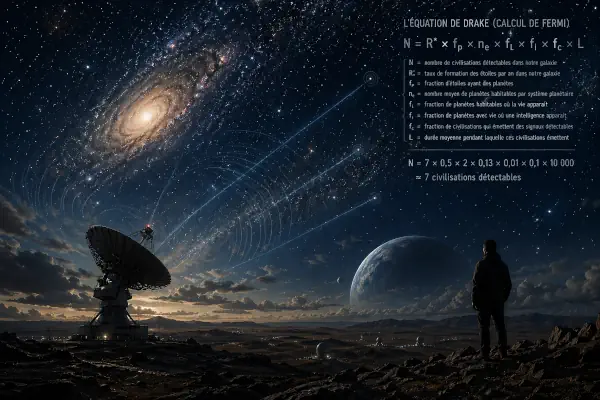
The Fermi paradox remains one of the most powerful intellectual frameworks for this topic. If the universe contains so many stars, so many planets, and perhaps so many opportunities for life, why do we still have no unmistakable sign of another civilization? The strength of the question lies in the contrast between cosmic vastness and the poverty of direct evidence.
Several answers are possible. Intelligent life may be extremely rare. Distances may be practically insurmountable. Civilizations may be short-lived, silent, or technologically undetectable through our current methods. It is also possible that we have been searching for too little time, with tools that remain limited, in a universe far too vast to be surveyed quickly.
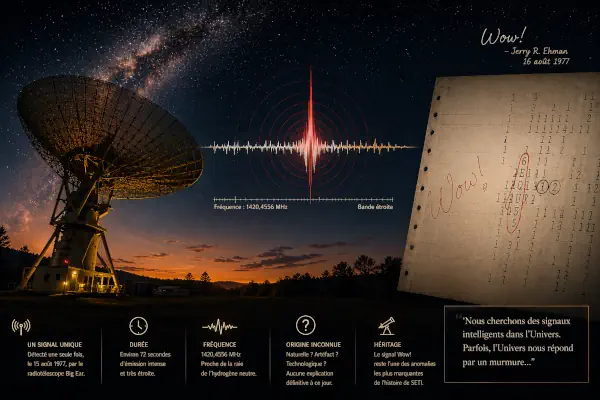
The Fermi paradox does not refute the possibility of extraterrestrial life. It simply reminds us that the absence of visible contact, especially with advanced intelligence, is itself part of the scientific problem. Cosmic silence has become one of the data points that must be explained.
Why this question transforms our understanding of life
Research into extraterrestrial life goes far beyond cosmic curiosity. It forces us to rethink what life is, what makes it possible, how it persists in extreme environments, and the place of Earth within the larger history of organized matter. Even without a definitive discovery, astrobiology is already reshaping how we understand living systems.
The question also carries major philosophical weight. If life exists elsewhere, then biology is not a local episode but a more universal dynamic. If it does not exist elsewhere, or if it turns out to be extraordinarily rare, then Earth and its history acquire an even more vertiginous significance. In either case, the answer will permanently change how we locate ourselves within the cosmos.
That is precisely why the topic deserves a long, rigorous, and structured treatment. This is not just a popular theme, but a pillar page of contemporary knowledge at the intersection of physics, chemistry, biology, planetary geology, and reflection on the human condition.
So, are we alone?
The most honest answer in 2026 remains open. We do not yet know whether extraterrestrial life truly exists, but we have more and more scientific reasons to treat the possibility seriously. The universe no longer appears as an empty backdrop, but as a rich ensemble of worlds where chemistry, water, energy, and time may combine in many different ways.
Even so, no decisive discovery has yet crossed the threshold of indisputable proof. We are therefore living through a pivotal period: advanced enough to ask the question rigorously, not yet advanced enough to settle it definitively. That intermediate moment is exactly what gives the subject its intellectual force.
Perhaps we are not alone. Perhaps life already exists, discreet, microbial, buried, distant, or still invisible to our instruments. Perhaps cosmic silence instead reflects extreme rarity. In every case, the search continues, and it touches one of the deepest questions in human history.
FAQ
Are we certain that extraterrestrial life exists?
No. As of 2026, no direct and universally validated evidence of extraterrestrial life has yet been obtained. The possibility is taken seriously, but it has not been demonstrated.
Why do scientists think life elsewhere is plausible?
Because the universe contains an immense number of stars and planets, some worlds seem compatible with liquid water, and organic chemistry is not unique to Earth.
What form of life is considered most likely?
Microbial or simple life is considered far more likely than the short-term detection of an advanced technological civilization.
What are the most promising places to search?
Research focuses mainly on Mars, Europa, Enceladus, and certain rocky exoplanets whose atmospheres can be studied remotely.
Why have we not received any clear signal yet?
Distances are immense, intelligent civilizations may be rare or short-lived, and our detection methods remain limited compared with the scale of the universe.