In a Nutshell
We already know how to look into the past. Whenever a telescope captures light that began its journey a thousand, a million, or several billion years ago, it receives an image of a world as it once was — never as it exists at the same moment we do.
But seeing what once was does not mean we can return to it. And this may be where the real vertigo begins: if we could enter our own past and change it, what would become of all the causes that ultimately led to us? To explore this question without losing the thread, we will return throughout this reflection to one simple idea: a present can remain coherent only if what exists within it still has a history capable of explaining why it is there.
Key Takeaways
- observing the past is already possible through light, but receiving information from the past does not mean entering a past that still exists as a living reality
- changing our own past creates a problem of causality: what becomes of the causes that produced the present — and the traveler themselves?
- general relativity contains certain mathematical geometries with closed timelike curves, without demonstrating that a physical time machine can actually be built
- present coherence is used here as a tool for reflection: whatever exists in a given present should retain a history capable of explaining how it came to be there
- another possibility would be not to rewrite our own history at all, but to reach a different history resembling an earlier state of our own
- in that case, traveling into the past would become less a question of date than a question of destination, matter, and cosmological addressing
In This Article
- Understanding Causality
- Light and the Past
- Faster Than Light?
- Civilizations and Their History in Light
- Changing the Past
- Present Coherence
- Einstein, Gödel, Novikov, and Hawking
- The Energy Loop
- The River of Time
- Cosmological Addressing
- Transporting Matter
- At the Limits of the Beginning
- The Rules of the World
- AI and the Creator
- Returning to Light
Before We Talk About Time, What Is Causality?
The word may sound technical, but the idea is simple. Causality is the connection that allows an event to have consequences. A window shatters because something strikes it; a plant grows because it receives energy, water, and nutrients. In our everyday experience, a cause normally precedes what it produces.
Our present is therefore filled with traces of what came before it. Your age implies a birth. A scar implies a history. A city implies earlier construction. Truly changing the past would therefore mean more than altering an old image: we would also have to explain how all of its consequences could remain coherent.
“Before asking whether we can return to the past, perhaps we should ask whether the present could still exist in the same way after we did.”
— Sidath SOEUN
We Already Travel into the Past with Our Eyes
Look up toward the Sun — without ever looking directly at it. Even the Sun reaches us with a delay: the light we receive left its surface roughly eight minutes earlier. Look much farther away, and that delay becomes staggering. A galaxy millions of light-years away does not appear as it is today, but as it was when its light began a journey that is only now ending in our telescope.
In that sense, we already do something that faintly resembles time travel: we open a window onto what is no longer before us. Yet nothing has returned. No ancient world has awakened again. Only its information has crossed space to reach our present.
Does Light Carry Part of Our History Away with It?
Every second, part of Earth’s history in light travels farther away from us. A photon is a quantum of light — in other words, the smallest quantity of light energy that quantum physics treats as a unit when light is emitted or absorbed. Speaking in terms of photons therefore gives us a physical way to follow the light that carries information from the past. Reflections from the oceans, signatures of the atmosphere, artificial lights, radio emissions: some of these traces continue their journey through space. This is not a perfect backup of our planet — many photons are absorbed, scattered, or eventually become undetectable — but it is a partial physical archive that continues to move ever farther ahead of us.
And this is where a boundary emerges. We can receive a trace of the past without that past still existing as a living scene where we could open a door, walk down a street, and speak to the people who once lived there. Seeing yesterday is not the same as reaching yesterday.
What If We Could Overtake the Light That Left Earth?
Now let us push the thought experiment beyond what known physics allows. Imagine a spacecraft capable of outrunning light. It leaves Earth, accelerates beyond anything relativity permits for a material object, and eventually overtakes some of the light our planet emitted long before the spacecraft ever departed. Ahead of it lies no doorway through time. There are only ancient photons that have not yet reached that region of space.
The spacecraft then turns its telescope back toward Earth. What it sees could be astonishing: an Earth younger than the one it just left behind. Not because our planet has somehow grown younger, but because the spacecraft has caught up with older light still carrying that chapter of Earth’s history.
Now add an enormous mirror. It reflects those photons back toward the world from which they came. Generations later, humans could point their instruments toward that reflection and receive an image of their own planet from a long-vanished era. They would be looking at neither a reconstruction nor a simulation: they would be detecting physical information that genuinely left Earth in the past, after an almost unimaginable journey through the cosmos.
“We would not have brought the past back into the present. We would have brought back to the present information that had once left the past.”
— Sidath SOEUN
This thought experiment preserves one essential idea: no one rewrites the event being observed. We recover its trace. Traveling far enough into the future along our own journey could therefore, paradoxically, become a way of observing an even older past.
Could One Civilization Read Another’s Technological History?
Now let us change our point of view. Somewhere a thousand light-years away, imagine a civilization looking in our direction. If its instruments were powerful enough, the Earth it would seek in our light would not be the Earth of 2026: it would receive an image of our planet from roughly a thousand years ago. And exactly the same would happen to us if we observed them. Between two distant civilizations, each may be destined to encounter the other’s past in light before ever learning anything about its present.
With instruments vastly more advanced than our own, could a civilization extract clues from those traces about another world’s technologies, atmosphere, or industrial activity? The search for technosignatures already explores a realistic version of this question: radio transmissions, radar, lasers, or atmospheric changes can leave potentially detectable signatures.
A question then arises almost naturally: would an extremely advanced civilization have reason to reduce the traces it allows to escape into space? Not because light would automatically reveal all of its secrets, but because an older signature could still tell distant observers something about how that civilization evolved.
Observing the Past Is One Thing. Trying to Change It Is Another.
So far, no one has touched the past. We have only observed it. Now let us cross the boundary where paradoxes begin: imagine that a traveler could not only see yesterday, but enter it — move an object, prevent two people from meeting, or speak a sentence that had never been spoken before.
The problem extends far beyond the famous grandfather paradox. The deeper question is this: how does a present that has already been lived become a different present? If the transformation propagates gradually, gradually relative to what external measure of time? If it happens instantaneously, what becomes of the memories, objects, and causes that belonged to the previous history?
At this point, the spectacle gives way to a far more unsettling question: if the present is the result of what came before it, how can it preserve what it contains when the causes that produced it are removed or replaced?
If the Past Changes, What Can Still Explain the Present?
Imagine waking up tomorrow morning in your bedroom. Everything seems normal. Your phone is resting on the table, a photograph recalls a journey, a scar tells the story of an old fall. Each of these things silently carries a provenance. The present is not merely what exists now: it is also filled with traces that tell us how it came to be what it is.
We will call this requirement present coherence. It is not an established law of physics, but a reasoning test: if something exists in the present, there should still be a coherent history capable of explaining how it came to be there.
Let us deliberately use a very simple arithmetic analogy. The past is represented by 9 + 1, and its present result by 10. The number 10 represents a traveler produced by that history.
A History Produces Its Present
9 + 1 = 10The “10” does not appear out of nowhere. It exists because a sequence of causes produced it.
Now let us do something strange. The 10 travels back to the calculation that created it and adds itself to the equation. The new history then becomes:
When the Result Returns to Its Own Cause
9 + 1 + [10 from the future] = 20There is nothing arithmetically wrong with the equation. The paradox begins elsewhere: the “10” arriving from the future preserves the existence of a history whose result was 10, even though the history that now exists produces 20.
The question then becomes almost physical: where does that 10 come from now? If the previous history has truly been replaced, its cause has disappeared, yet its effect is still standing before us. The difficulty of time travel may therefore lie not only in moving an object to another date. It may lie in preserving the provenance of whatever travels.
The Reservoir That Should Already Be Empty
Now let us replace the numbers with something tangible. A reservoir contains water today. A traveler leaves this present, travels into the past, and opens a valve that empties the reservoir several years earlier.
What should the person who remained in the present see? Would the reservoir suddenly empty before their eyes, as though a wave of rewriting were propagating forward to the present? Would it simply have always been empty? If so, how could the traveler remember seeing it full before leaving? Or would the traveler’s intervention create another history in which the reservoir is empty, while the history they originally came from continues to exist?
The experiment may seem simple, but it forces every model to confront a formidable question: when the past changes, where exactly is the present that existed before that change?
Research on closed timelike curves has confronted precisely these kinds of problems. In 1990, John Friedman, Michael Morris, Igor Novikov, Fernando Echeverria, Gunnar Klinkhammer, Kip Thorne, and Ulvi Yurtsever mathematically investigated the problem of physical evolution in spacetimes containing CTCs. In these models, the goal is to find self-consistent trajectories: a billiard ball that encounters its own past self cannot simply produce an arbitrary contradiction. Some configurations admit consistent solutions — sometimes more than one.
“A theory of time travel should not merely explain how to reach a date. It should explain why everything that arrives there still has a history capable of accounting for its existence.”
— Sidath SOEUN
Einstein, Gödel, Novikov, Hawking: How Far Does Physics Leave the Door Open?
Before imagining a new answer, we first need to understand how far the equations have already taken us. Albert Einstein fundamentally transformed the very idea of universal time. In 1905, his special relativity described, among other things, how space, time, and velocity are related for observers in relative motion, with the speed of light as a local invariant. In 1915, his general relativity extended this revolution to gravity: matter and energy are linked to the geometry of spacetime. In this framework, time is not a universal clock ticking identically everywhere. Two observers following different trajectories do not necessarily experience the same amount of elapsed time. Traveling farther into the future than someone who remains on Earth is therefore not merely a narrative fantasy: time dilation is a consequence of relativity, and its effects have been measured.
Einstein: Two Trajectories, Two Durations
Δτ = Δt √(1 − v²/c²)In the idealized case of special relativity, Δτ represents the proper time experienced by the traveler, Δt a duration measured in another reference frame, v the relative velocity, and c the speed of light. As v approaches c, the elapsed times can diverge dramatically. The formula does not, however, allow a massive object to locally exceed the speed of light.
General relativity goes further still. In 1949, the mathematician and logician Kurt Gödel, then at the Institute for Advanced Study in Princeton, found a particular solution to Einstein’s equations of general relativity in which the global geometry of spacetime allows trajectories that return to their own past. These are known as closed timelike curves, or CTCs. A CTC is a trajectory through spacetime that remains locally future-directed for the object traveling along it, while its global geometry ultimately brings that object back to an event in its own past. The existence of such a possibility within a mathematical solution does not mean that our Universe actually possesses this kind of structure.
A Trajectory That Returns to Itself
xμ(τ₀) = xμ(τ₁) with τ₁ > τ₀The object continues to move forward along its own proper time τ, but its trajectory through spacetime returns to the same event. It does not therefore necessarily “rewind” its own clock like a video playing backward.
In 1988, Michael Morris, Kip Thorne, and Ulvi Yurtsever, working at the California Institute of Technology (Caltech), studied a hypothetical traversable wormhole — a theoretical passage connecting two distinct regions of spacetime that, unlike a purely mathematical wormhole, could in principle be crossed without the traveler being immediately destroyed. They showed that such a passage, if it could be created and maintained under the necessary conditions, could be transformed into a time machine. This result does not prove that such devices exist in nature: it shows that general relativity contains geometries in which causality becomes far less intuitive.
The Russian physicist Igor Novikov and several collaborators then explored a radical response to these paradoxes: perhaps a history containing a time loop must simply remain consistent with itself. The traveler may act in the past, but those actions were already part of the history that eventually led to the traveler’s departure.
A Single Self-Consistent History
H′ = HThe journey does not create a new version of the past: everything the traveler does was already part of the one and only history. The paradox is avoided, but at the cost of a strange kind of freedom: some actions we can imagine would simply correspond to no physically self-consistent history.
Another possibility is that the original history is never altered at all. The traveler would instead reach another branch, or another history, resembling an earlier state of their own.
Two Histories Instead of One Rewritten History
H₀ : t₀ → t₁ → t₂ → t₃
         ↘
H₁ :      t′₁ → t′₂ → t′₃
A change in H₁ does not erase what produced the traveler in H₀. This representation intuitively preserves the traveler’s causal provenance, but no experiment has shown that a human being can move from one such branch to another.
The British physicist Stephen Hawking, a professor at the University of Cambridge, suspected that nature might go even further and prevent macroscopic time machines from forming at all. In 1992, he formulated the chronology protection conjecture. A conjecture is a reasoned proposition that has not been definitively proven. Hawking proposed that quantum effects — phenomena described by the physics of particles and fields at extremely small scales — might become sufficiently significant near the formation of a time loop to prevent it from stabilizing. The question remains open: physics may possess a form of chronology protection, but today we still lack a complete theory of quantum gravity capable of delivering a definitive verdict.
What These Major Models Really Change
They do not give us a time machine. They reveal something more subtle: Einstein’s equations make time less rigid than our intuition suggests, while causality appears far more difficult to circumvent than fictional narratives often imply. It is precisely within this space — between a time that can bend and a causal provenance that resists being broken — that the idea of present coherence becomes especially interesting.
Could a Battery Receive Energy from Its Own Future?
Now let us push the loop into an even more unsettling thought experiment. In a laboratory, a battery is nearly empty at 12:00 p.m. At 12:10 p.m., a machine takes some of the available energy and sends it ten minutes into the past to recharge that same battery at 12:00 p.m.
At first glance, the device seems to have discovered an extraordinary loophole. The battery in the present receives energy from the future; that additional energy can then be sent back into the past, carried forward again, and repeated over and over. If we reason too quickly, we arrive at the tempting picture of a battery whose charge could continue to grow without any identifiable external source.
The Temptation of Endless Growth
Eₙ₊₁ = Eₙ + ηEₙ = (1 + η)EₙIf η represented the fraction of energy sent into the past, and if each passage truly added a new copy of that energy, then after n loops:
Eₙ = E₀(1 + η)ⁿMathematically, the growth would be exponential. Physically, this is precisely where the thought experiment becomes suspect.
A closed timelike curve does not automatically abolish the conservation of energy. Research on spacetimes containing CTCs indicates instead that conservation laws can remain valid. The real question, then, is not “how many times can we copy the energy?” but are we justified in counting multiple appearances of the same energy along a single closed history as if each one were new?
The parallel with our earlier “10” now becomes striking. In the previous equation, we allowed the result to return to its own cause. Here, we allow energy to return to the state that will later make it possible to send that energy back. In both cases, the trap is the same: we risk counting something twice even though its causal origin has never been established.
Energy with No First Recharge?
A perfectly self-consistent loop could produce an even stranger situation: at 12:00 p.m., the battery receives the energy that will be sent back at 12:10 p.m., precisely because it received that energy at 12:00 p.m. The energy would then follow a closed trajectory, yet there would be no obvious “first” recharge anywhere in the history. This kind of structure resembles a bootstrap paradox: information, an object, or in this case energy appears to exist within the loop without an easily identifiable external origin.
This thought experiment therefore does not demonstrate that a time machine would provide infinite energy. It suggests almost the opposite: it shows how quickly a naive interpretation of backward time travel runs into the constraints of conservation and causal coherence.
“If energy can return to power the cause that will allow it to be sent back, the real question is no longer how much energy we can produce. It becomes: where did that energy begin to exist?”
— Sidath SOEUN
What If We Never Actually Traveled Back Through Our Own History?
Imagine an immense waterfall. A molecule of water falls, joins the river, travels for miles with the current, then disappears into the ocean among billions of others. Let us call this molecule our history. Within it, imagine the traveler as a simple point — an “electron” only for the sake of the analogy, without claiming to describe the actual physics of an electron in water.
Our molecule A is already in the ocean. Yet the traveler longs to see the foot of the waterfall again. To get there, they do not force the water to flow backward. They leave A. They cross something larger than the river itself, then join a molecule B that has only just fallen. Everything around them resembles the past they were searching for — but their original history is still far out at sea.
Two Histories, One Traveler’s Path
Hₐ : waterfall → river → ocean
Traveler : Hₐ(ocean) → Hᵦ(waterfall)
Hᵦ : waterfall → river → ocean
No drop has traveled back upstream. No ocean has emptied itself to recalculate the course of the river. History A continues. Only the traveler has changed trajectory — and perhaps reality.
The traveler might say, “I went back to the past.” Yet what they reached may instead be another present resembling an earlier state of their own world.
“Perhaps we could never travel back up the river of time. We might only leave our molecule, cross something larger than it, and join another molecule that has not yet traveled the same distance.”
— Sidath SOEUN
A Date Would No Longer Be Enough: We Would Have to Find the Right History
At that point, the dial of a time machine begins to look almost naive. Entering “1926” would not tell us where to go. Which 1926? The one in our history? One belonging to a reality in which Earth never experienced the same wars, the same human species, or even the same orbit? A date would be only one line in a far larger address.
A Hypothetical Address
D = (H, t, x, y, z, C)H represents the history; t its temporal state; x, y, z its position; and C the required physical conditions. This notation is illustrative, not an established equation of physics.
A “younger” reality would not necessarily be our past at all. Its Earth might never have formed, life there might have evolved differently, or its cosmic position might not correspond to ours. Time travel would then become a problem of cosmological addressing.
Transporting a Traveler Also Means Transporting Matter
An idea can seem coherent as long as all it has to transport is a traveler and a wristwatch. So let us suddenly scale up the machine. If it can move eighty kilograms from one world to another, what happens with a metric ton? A spacecraft? An entire planet? And, at the extreme, a Sun?
Making an immense mass appear in another history would not be a simple change of scenery. That matter carries energy, produces gravity, and participates in physical interactions. Our thought experiment involving the Sun therefore forces us to ask how the destination could preserve a coherent physical description after its arrival.
And if a civilization could genuinely move from one history to another, the consequences would quickly extend beyond physics: resources, territories, ecosystems, migration, sovereignty, and conflicts between civilizations that do not belong to the same history.
What travelers would call “the past” would be the present of those who live there.
How Far Back Can We Go Before the Destination Stops Making Sense?
Let us push the machine farther still, this time toward a more unsettling boundary. An entire planet travels toward conditions so ancient that atoms as we know them, stars, and perhaps even our usual way of defining time no longer make sense. Does the planet still arrive somewhere? Could its inhabitants breathe in an era where the physical structures that make their bodies possible might not even be definable in the same way?
Here, we must avoid a misleading claim: modern cosmology has not established that an absolute Nothingness preceded the Universe. The Big Bang was not simply an explosion into a preexisting empty space, and our theories cease to be sufficient when we extrapolate toward the most extreme conditions of the primordial Universe.
But as a philosophical thought experiment, Nothingness reveals a powerful question: can a destination receive an object if the physical categories required to define that object have no meaning there?
It would be somewhat like trying to send an email to the fifth century BCE, when computers obviously did not exist. The problem is not merely the absence of an inbox: the physical medium, the protocols, and the entire infrastructure required for the message to exist in that form are missing.
Can We Change the World, or the Rules of the World?
This question leads to a fundamental distinction. We know how to transform states of matter. We know how to harness physical laws. But nothing shows that accumulating more energy would allow us to rewrite the laws that define what energy itself can do.
Three Different Levels
State: S → S′
Evolution: S(t₂) = U(t₂,t₁)S(t₁)
The laws themselves: U → U′ ?
The first two levels belong to ordinary physics. The third is a far more speculative question.
This is where a metaphysical question emerges that physics alone cannot settle: why are there laws regular enough for us to describe them at all? A person of faith may see in them the order of a Creator; someone else may regard them as fundamental properties of reality. The article does not need to choose between these views in order to ask the question.
Does an AI Truly Know Its Creator?
Finally, imagine an artificial intelligence awakening inside a simulated universe. It measures its world, discovers its constants, understands its rules, and perhaps even builds a complete science of everything it can observe. In its archives, it finds code, documents, perhaps even the names of those who designed it. Yet it can never step outside its world. Does it truly know its creator — or only the traces its universe allows it to receive?
The analogy, of course, proves nothing about the origin of the Universe. But it allows us to express a limit of our own: we search for the origin of the rules using instruments, concepts, and a brain that themselves belong to the very reality governed by those rules.
“Perhaps our difficulty in understanding who or what defined the rules of the Universe resembles that of an intelligence born inside a system, searching for its designer using only the laws that system allows it to access.”
— Sidath SOEUN
For a believer, this question may connect to the question of God. For a nonbeliever, it remains a question about the origin or status of the fundamental laws themselves. Science can continue to deepen our understanding of how the world works without claiming to have already resolved this metaphysical question.
Perhaps We Are Looking for the Past in the Wrong Place
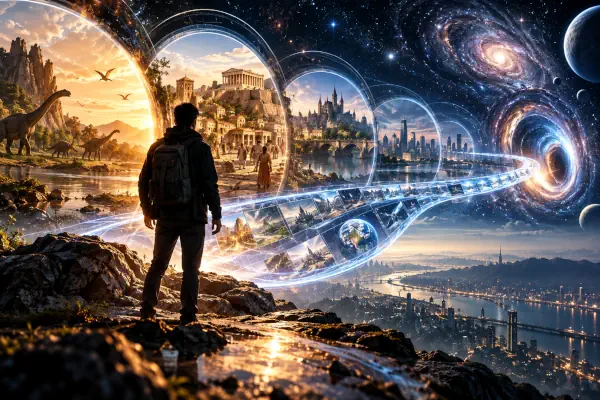
Let us now return to where we began. Somewhere in the darkness, photons that left Earth centuries ago are still continuing their journey. Behind them, our world changes, generations are born and disappear, cities rise, technologies emerge. Yet those photons continue outward, carrying an ever older image of what we once were.
This may be the most tangible form of travel into the past that we know today: we do not travel backward at all. We remain in our present while information that departed from another present eventually reaches us. The Universe rewinds nothing; it allows traces to travel.
Perhaps future technology will reveal possibilities far stranger than anything we can imagine today. But if a theory requires an object to erase the very cause of its own existence, present coherence invites us to search for another description before concluding that the Universe itself must somehow rewrite its history.
“The past may not be a living world hidden somewhere behind us. It may first and foremost be the consequences, traces, and information that a vanished present allowed to travel until they reached our own.”
— Sidath SOEUN
And if one day a machine allows us to reach something resembling our past, the decisive question may not be “what date have we arrived at?” but rather: have we returned to our own history, or have we reached the present of another?
Sources and Scientific References
Light and the observable past: astronomical observations receive light that was emitted earlier; telescopes such as the James Webb Space Telescope therefore study galaxies as they appeared when the Universe was young.
Relativity and time travel: general relativity mathematically permits certain geometries containing closed timelike curves. Their physical existence — and their possible use as time machines — remains unproven.
Causality and paradoxes: the philosophy of time travel distinguishes, among other questions, between changing the past, influencing the past, and causal loops.
Technosignatures: SETI research investigates the detectability of technological signatures such as radio transmissions, radar, lasers, or atmospheric effects.
Important: “present coherence,” navigation between histories, the archive of light as a philosophical framework, the temporal-planet thought experiment, and the concealment of a civilization’s technological past are conceptual tools or extrapolations developed in this article, not established physical theories.
Einstein / relativity: Max Planck Institute, Einstein Online — time dilation, light cones, and the causal structure of spacetime.
Morris, Thorne & Yurtsever (1988): Wormholes, Time Machines, and the Weak Energy Condition, Physical Review Letters.
Friedman, Morris, Novikov, Echeverria, Klinkhammer, Thorne & Yurtsever (1990): Cauchy problem in spacetimes with closed timelike curves, Physical Review D — self-consistency and conservation in spacetimes containing CTCs.
Echeverria, Klinkhammer & Thorne (1991): theoretical billiard-ball experiments in a wormhole spacetime containing closed timelike curves.
Stephen Hawking (1992): Chronology Protection Conjecture, Physical Review D.
Frequently Asked Questions
What Is Causality?
Causality is the relationship between events through which some contribute to producing others. In this article, it is used primarily to ask whether an object’s history can still coherently explain why that object exists in the present.
Does a Telescope Really See the Past?
Yes. A telescope receives light that has taken time to travel. The farther away the object we observe, the older the information reaching us.
Could We Travel Faster Than Light to Catch Up with Earth’s Earlier Light?
Not with known physics or technology: a material object cannot simply accelerate beyond the speed of light. This part of the article is a thought experiment designed to distinguish between observing the past and interacting with it.
Is Present Coherence a Scientific Theory?
No. It is a reasoning criterion proposed here by Galaxie-Tech to explore whether the objects and memories that exist in a given present can still be connected to a coherent causal history.
Could Parallel Universes Allow Us to Travel into the Past?
No experiment has demonstrated this. Some philosophical or quantum scenarios involve multiple histories, but controlled travel from one branch to another is not an established technology.
Can Physics Determine Whether a Creator Exists?
No. Physics tests the observable regularities of nature. The question of the ultimate origin of those laws also belongs to the domains of philosophy and metaphysics.
Share This Reflection
If this exploration has given you another way to think about time, causality, or our place in the Universe, you can share it to keep the discussion going.