A transformation of work and social organization
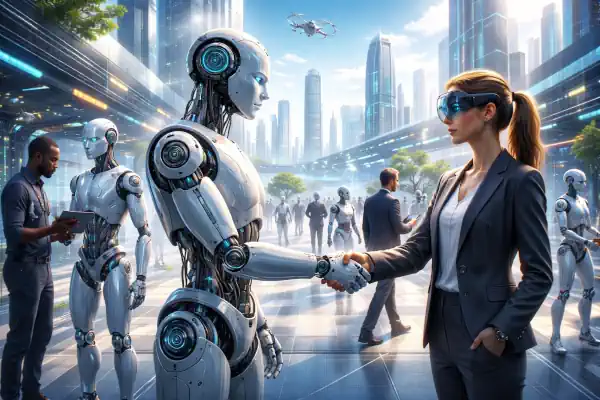
As robots become more mobile, more precise and better integrated with artificial intelligence systems, their impact on society could extend far beyond the industrial sphere. The central question is no longer purely technical; it is becoming social, economic and political.
In many sectors, robots could take over a growing share of physical, repetitive or dangerous tasks. This evolution could ease certain forms of hardship, improve safety and deeply reorganize production chains.
Sectors particularly affected
- Industry and maintenance
- Logistics and warehouses
- Precision agriculture
- Construction
- Space exploration
In the most favorable scenario, this automation would free part of human time for design, research, care, coordination or creative work. But it could also deepen imbalances if productivity gains are not accompanied by serious thinking about the distribution of work, training and social protection.

The real challenge is not only to build more capable robots, but to decide what place a human civilization truly wants to grant them.
The major scientific and technical questions
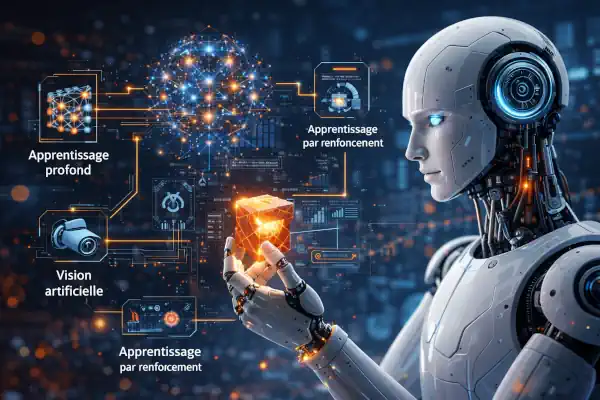
Despite the rapid progress of artificial intelligence, several major limitations remain. Robots are still highly dependent on well-defined frameworks, limited energy resources and models that struggle to generalize beyond their training contexts.
Current limits of robotic systems
- No artificial general intelligence
- Still-constrained energy autonomy
- Difficulty handling the complexity of the real world
Human environments are dynamic, ambiguous and filled with unexpected situations. This is precisely where robots still reveal their fragility: imperfect perception, limited contextual understanding, and difficult coordination with humans or with other machines in non-standardized spaces.
These obstacles show that the scientific challenge is not only to increase computing power, but to make systems more robust, more interpretable, safer and truly adaptive.
Responsibility, governance and AI ethics
From the moment autonomous machines make decisions in the real world, the question of responsibility becomes central. Who is accountable for damage caused by a robotic system? The designer, the operator, the company deploying it, or the organization that allowed it to act?
The ethics of robotics is therefore not only about abstract principles. It touches on law, safety, decision transparency, technical traceability and human oversight. International institutions such as UNESCO have already stressed the importance of an ethical framework for the development of artificial intelligence.
One of the major challenges of the 21st century may therefore be this: ensuring that AI-powered robotics remains a driver of progress without becoming a source of opacity, dependency or social imbalance.
If intelligent robots become tomorrow essential partners in work, science, medicine or exploration, then human civilization will have to define not only what they are capable of doing, but also what we accept them to do.