In short
Modern cosmology describes much of the history of our observable Universe with extraordinary success, but it still has no demonstrated answer to the ultimate question of its origin. The hot Big Bang describes an ancient, extremely hot and dense phase. By itself, it does not prove that absolute nothingness suddenly produced all existence.
The question explored here is therefore different. Why are there fields, particles, constants, symmetries, and relations capable of producing consequences? Galaxie-Tech will call this architecture the causal grammar of the Universe. The phrase is not a recognized physical theory. It is a philosophical metaphor for distinguishing the objects of nature from the rules that determine what they can become.
At a glance
- The Big Bang is not necessarily an absolute beginning: it describes the evolution of an ancient, hot, dense Universe while the ultimate origin remains open.
- Physical vacuum is not nothingness: in quantum field theory it is the lowest-energy state of fields.
- Vacuum transitions are genuinely studied: Sidney Coleman in 1977, then Coleman and Frank De Luccia in 1980 with gravity, formalized false-vacuum decay.
- Distinct cosmological regions appear in some hypotheses: eternal inflation, studied notably by Alan Guth, can produce causally separated pocket universes in some models.
- Cosmological bubble collisions have also been studied: Anthony Aguirre, Matthew Johnson, and Assaf Shomer examined possible signatures of bubble collisions in 2007.
- Fundamental constants are tested: astronomers experimentally investigate whether some constants may vary across cosmic time or distance.
- Hidden sectors are being searched for at CERN: SHiP is designed to look for particles that interact extraordinarily weakly with ordinary matter.
- The Galaxie-Tech thought experiment goes further: if two different physical grammars could interact, their encounter would already imply a deeper rule common to both.
In this article
- Did we begin with the wrong question?
- What the Big Bang actually tells us
- Why physical vacuum is not nothingness
- When vacuum can change state
- The causal grammar of the Universe
- Are the rules the same everywhere?
- Cosmological horizons
- A region A and a region B
- What if two grammars met?
- The grammar of grammars
- Hidden sectors
- What particle collisions teach us
- When a consequence becomes a cause
- The impossible probe
- The space of what can exist
- What if the creator is not a person?
- Earth as our first causal environment
- Learning to read the grammar
Did we begin by asking the wrong question?
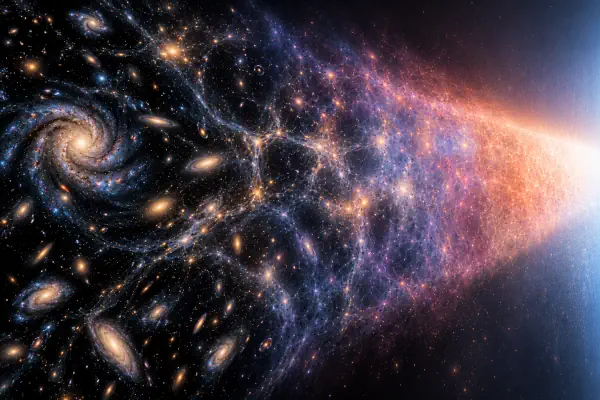
Ever since human beings became capable of looking at the sky and reflecting on their own existence, one question has returned in many forms: who created the Universe, how did it begin, and what came before it? The question feels natural because everyday experience is built around beginnings. A house is constructed. An organism is born. A machine has a maker. An event has prior causes.
Yet applying that intuition to the Universe as a whole already hides an assumption. We picture the Universe as though it were an object sitting inside something larger, with a before, an outside, and a cause comparable to those we observe within it. But if space, time, and the causal relations we know are themselves part of the Universe, asking what existed “before” may be far less straightforward than the word suggests.
The issue is not choosing between science and religion
Religion may propose a creator, but that is not a physical demonstration. Science can reconstruct ancient states of the Universe with remarkable precision, yet it still has no experimentally confirmed theory describing the absolute origin of all existence. Acknowledging both limits does not make every answer equivalent. It simply marks, as honestly as possible, where established knowledge ends.
Perhaps the question should therefore be reframed. Instead of immediately asking who might have created the Universe, we can first ask why matter is able to transform, assemble, and produce structures of increasing complexity. Why are some interactions possible while others are forbidden? Why do particles have properties stable enough to form atoms, then molecules, stars, planets, and eventually living beings capable of asking where they came from? Behind the question of the Universe’s birth may lie an even deeper mystery: why does the Universe possess, at its most fundamental levels, the rules that make all of these transformations possible?
The Big Bang describes an ancient history, not necessarily the beginning of all existence
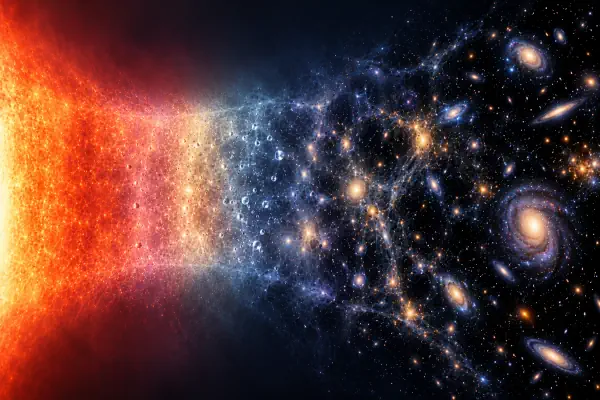
The Big Bang model is not merely a mathematical belief. Cosmic expansion, the cosmic microwave background, and the measured abundances of light elements provide independent lines of evidence pointing toward an extremely hot and dense early phase. Roughly 380,000 years after that primordial era, the Universe had cooled enough for nuclei to retain electrons and form neutral atoms. The light released around that time is observed today as the cosmic microwave background.
But one distinction is crucial: describing the very early Universe is not the same as demonstrating that all existence emerged from absolute nothingness. When our known equations are pushed toward the most extreme conditions, the description becomes incomplete. General relativity and quantum theory have still not been unified into a complete, experimentally verified theory of quantum gravity.
What we know
CERN notes that the Standard Model describes known particles and three fundamental interactions with extraordinary success, but it does not include gravity. Physics can therefore possess extremely powerful models without yet having a single description of every interaction under every condition.
This article will not challenge the Big Bang. It will look beyond the question of its beginning. If the Big Bang describes an extremely ancient, hot, dense state of our observable Universe, another mystery remains: why did physical reality already have properties that allowed matter to exist, interact, and transform? Before asking what might have preceded the Big Bang, perhaps we should first ask why the Universe can have a history at all.
Physical vacuum is already not nothingness
In everyday language, a vacuum suggests the complete absence of anything. In quantum field theory, that picture becomes misleading. Quantum fields are fundamental to the description of particles, and the vacuum corresponds to their lowest-energy state. It is therefore not philosophical nothingness.
This distinction changes the question profoundly. If what we call vacuum is not absolute nothingness, but still has a physical state and fields capable of evolving, then asking “how could something come from nothing?” may already be misleading. The mystery shifts: why does even the emptiest state physics can describe still possess properties and the possibility of transformation? The deeper we descend toward what intuition calls “nothing,” the more physics still finds something to describe.
An essential distinction
Philosophical nothingness: no matter, energy, fields, space, time, or laws.
Physical vacuum: a physical state defined within a theory, already possessing properties and obeying rules.
Confusing these two ideas would make it sound as though physics had explained how existence emerges from nothing. That is not what the quantum vacuum means. But the distinction opens a more interesting door: perhaps what everyday intuition calls “nothing” already contains, physically, an architecture that intuition was never built to picture.
Since 1977, physics has at least known how to calculate the idea of a vacuum changing state
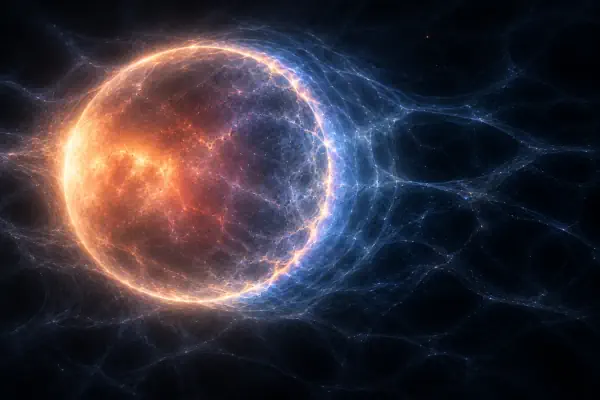
In 1977, physicist Sidney Coleman, then at Harvard, published in Physical Review D a semiclassical theory of “false vacuum” decay. In this framework, a higher-energy state can be metastable and undergo a quantum transition toward a lower-energy state.
In 1980, Sidney Coleman and Frank De Luccia extended that work by including gravity. Their calculations do not show that our Universe was born this way, nor that the vast near-empty spaces between galaxies are producing new atoms today. They reveal something more precise and more useful here: in physics, vacuum is not necessarily condemned to remain forever in the same state. Some models allow physicists to study how one vacuum state might evolve into another with different physical properties. Vacuum then stops looking like an inert background and becomes something whose state and possible transformations can themselves be investigated.
What research considers
Vacuum transitions are serious objects of study in quantum field theory and cosmology. Whether such transitions occurred in our cosmic history, what role they played, and under what conditions they could occur are separate questions from the thought experiment developed in this article.
This is where imagination can begin without being confused with observation. Suppose a causally inaccessible region of the cosmos could occupy a different physical vacuum state. Could it develop a cosmic history unlike ours? And more importantly, would its effective rules necessarily be identical to ours?
What if the laws of nature formed a causal grammar?
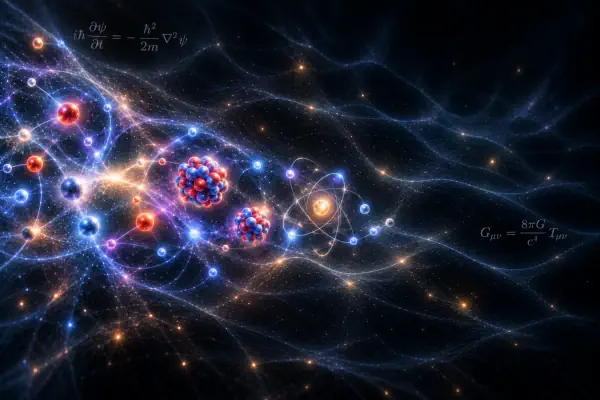
An alphabet is not enough to produce a language. Rules are also needed for symbols to form coherent structures. Matter presents something loosely comparable, although the comparison must remain a metaphor. Particles have properties. Interactions determine what they can exchange. Symmetries impose constraints. Constants set characteristic scales. From this architecture emerge nuclei, atoms, molecules, and structures of increasing complexity.
Galaxie-Tech will call this set of possibilities and constraints a causal grammar. The term adds no new equation to physics. It is a philosophical tool for asking a question that equations do not automatically answer: why does this architecture of possibilities exist rather than another?
“Matter changes form; structures appear and disappear. But behind every transformation lies a deeper question: what determines what matter is allowed to become?”
— Sidath SOEUN
The metaphor leads to a stranger question. When we speak of the laws of the Universe, where are they, exactly? We can observe a particle, measure its energy, or detect its interactions, but we cannot isolate the “law” that determines what it can and cannot do. Yet everywhere we look, matter appears to follow the same regularities. The same properties allow atoms to form, stars to shine, and light to cross the cosmos.
We can express part of that extraordinary consistency in equations. But this still does not answer the question at the center of this article: are those regularities the deepest layer of nature, are they consequences of a structure we have not yet discovered, or is “law” simply the name we give to the order we observe? We are becoming better at reading the grammar. We still do not know why there is a grammar to read.
Is the grammar really the same everywhere?
Everything we observe across great distances points to a remarkable continuity in physical laws. The spectra of distant stars and galaxies reveal the signatures of familiar elements. The same theories describe phenomena separated by billions of light-years. This apparent universality is one of the foundations of cosmology.
But physicists test that universality rather than turning it into dogma. In 2001, Michael Murphy, John Webb, Victor Flambaum, and collaborators published an analysis of quasar absorption spectra looking for a possible variation in the fine-structure constant, α. The reported results prompted years of follow-up work, systematic checks, and debate. A variation of α is not an established fact today.
Why a constant can matter so much
same constituents + different parameters = potentially different possible structures
This is not a physical equation. It summarizes the idea that changing fundamental parameters can change the states and structures a theory permits.
Our thought experiment can now go further. Imagining “another grammar” does not require magical matter or fantastic phenomena. In some theoretical frameworks, different values of certain constants, a different vacuum state, or a different pattern of symmetry breaking could be enough to give a region a very different effective physics. Particles might not have exactly the same properties. Some interactions could become stronger or weaker. Structures we take for granted might never appear. There might be no stable atoms like ours, no stars like ours, and no chemistry capable of building the same molecules.
The vertigo begins when we realize that our entire Universe would not need to be rewritten to make our world impossible. A few different fundamental properties might be enough to prevent the whole history that eventually led to us.
A deeper question follows: if several physical organizations are possible, why does our region have this one, the one that allows matter to assemble, complexity to emerge, and after billions of years, some of that matter to begin asking about the rules that made it possible?
Expansion can make regions causally inaccessible
Saying that the Universe “expands faster than light” requires precision. Relativity forbids matter or information from locally moving through vacuum faster than light. In cosmology, however, the distance between sufficiently remote regions can increase at a rate corresponding to more than c because the geometry of space itself evolves.
This does not mean those regions possess physics incompatible with our photons. The explanation is geometric. Yet cosmological horizons have an important consequence for our reflection: there can be regions from which no information will ever reach us. Their inaccessibility allows us neither to claim that their laws are different nor to prove directly that every property is rigorously identical to ours.
The limit of every claim
Our thought experiment must never turn the unobservable into evidence. A region beyond our horizon is not automatically different. It is simply beyond direct verification using the physical means available in our region.
Thought experiment: a region A and a region B
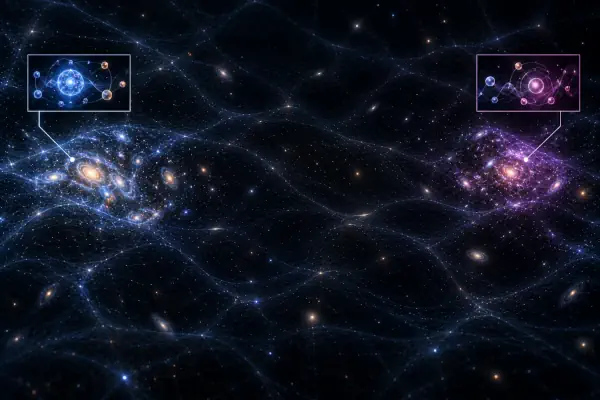
A Galaxie-Tech thought experiment
What follows is not an established cosmological model. It begins with phenomena genuinely studied in physics, including possible vacuum states, cosmic inflation, and causal horizons, then deliberately extends them beyond what has been demonstrated in order to explore their consequences.
Imagine a region A, the one from which we emerged, with the physical properties we know. Now imagine that somewhere in the immensity of the same Universe, a region B formed under different conditions, perhaps from a different vacuum state. We would not need to imagine two completely separate Universes. A and B could belong to the same cosmos while developing two physical histories that never meet.
Some models of eternal inflation, notably developed by Alan Guth, allow distinct cosmological regions sometimes called pocket universes to form. Our scenario does not claim that these models describe the real Universe, nor that such regions would necessarily have different laws. They provide only an important precedent: in some theoretical models, the portion of the cosmos we can observe need not be the totality of what exists.
Suppose A emerged from a vacuum state that produced the physics we know, while B settled into another. Let us call the causal grammar of our region GA and that of B GB. Each would have its own range of possibilities: structures that can form, transformations matter can undergo, and chains of causes and consequences its history can produce.
As long as no interaction is possible between them, their histories remain independent. Stars could form in A without ever affecting B. Other structures could appear in B without any information reaching A. The same Universe would then contain two causal histories that, naturally, never cross.
“Two histories can belong to the same Universe without ever sharing a single consequence. The real vertigo begins when we imagine what might happen if something one day forced them to meet.”
— Sidath SOEUN
What would happen if two grammars met?
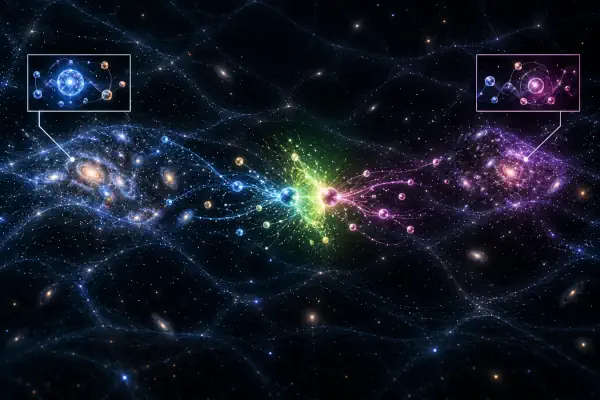
The idea of collisions between cosmological regions is not entirely foreign to research. In 2007, Anthony Aguirre, Matthew C. Johnson, and Assaf Shomer studied possible observable effects of vacuum-bubble collisions in an eternal-inflation scenario. Their work does not describe our A/B experiment, but it shows that encounters between cosmological regions can be formulated as physical problems in some models.
Now take one further step. Suppose an object made in A somehow managed, by a mechanism completely unknown to us today, to interact with B. That object would carry the entire physical history of A with it: its particles, its structure, its materials, and the causal chain that made its construction possible. It would then encounter an environment shaped by GB.
We cannot know what would happen. The object might lose its stability. Some interactions might change. Nothing dramatic might occur. But one possibility is enough to open the question: the encounter could produce a physical state that had never existed in the history of A alone or B alone.
That would not necessarily mean a new law had appeared from nowhere. The new state might simply become possible because two sets of conditions that had always remained separate were finally brought together. A could not have produced it alone. Neither could B. Their interaction would open a new branch of history.
And here the problem becomes deeper. If A and B can truly affect one another, even once, then the encounter itself must be physically possible. Something must determine what GA and GB are allowed to become when they are no longer separate.
If GA meets GB, what governs their encounter?
The core of the thought experiment
GA ≠ GB
But if GA ↔ GB, then some more fundamental relation, which we can provisionally call G0, must at least make that interaction possible.
GA, GB, and G0 are philosophical symbols used to follow the reasoning. They are not a published physical theory.
If the rules of A and B had absolutely no relation to one another, the word “encounter” might cease to have meaning. For a particle from A to produce an effect in B, some common possibility must exist. We can call it G0, not as a newly discovered law, but as a temporary name for the problem.
And immediately another question appears: where does G0 come from? If a deeper rule permits several grammars and determines how they can interact, then the local laws of each region are no longer the final level of explanation.
“If two worlds governed by different rules can nevertheless meet, then their encounter already reveals a rule that neither world possesses on its own.”
— Sidath SOEUN
We have returned to our original question without needing to imagine a human-like creator enlarged to cosmic scale. Perhaps the deepest layer is not one more particle, but the possibility itself that one physical state can produce another.
Physics is already searching for sectors that could almost ignore us
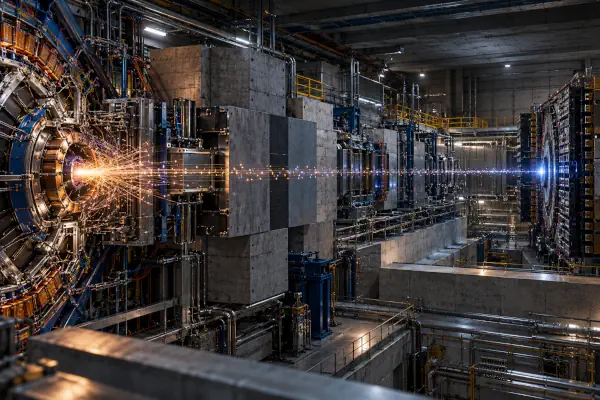
In April 2024, CERN announced the approval of SHiP, Search for Hidden Particles, designed to search for hypothetical particles that interact extraordinarily weakly with ordinary matter. Candidate targets include dark photons, axions and axion-like particles, and heavy neutral leptons. The experiment is planned to explore this territory beginning in the next decade.
A hidden sector is not our region B with another cosmic grammar. Such models are formulated within physical theories connected to ours. But they provide a valuable intuition: two sets of particles can, in theory, share very few interactions and become extraordinarily difficult for one another to detect.
Dark matter itself is a reminder of how much remains unknown. Standard cosmological estimates assign roughly 27% of the cosmic mass-energy budget to dark matter, compared with about 5% to ordinary matter. We observe its gravitational effects without yet knowing its microscopic nature.
How much of physical existence could we fail to notice simply because it interacts too weakly with instruments made from our own matter?
At CERN, breaking a structure does not mean breaking the laws
When an accelerator collides particles at very high energy, it does not destroy the laws governing them. Available energy can be redistributed into new states and other particles, but the outcomes remain constrained by quantum rules and the relevant conservation laws.
This distinction matters for our philosophy. A structure can disappear while the possibilities of transformation remain. A molecule can dissociate. A nucleus can change. Particles can be produced or disappear in allowed reactions. What changes is the physical state. What makes that change possible belongs to a deeper level of description.
Another way to read a collision
A collider does not only ask, “what is this particle made of?” It also asks, “what transformations does nature allow when enough energy is available?” That second question already resembles an experimental exploration of the grammar of possibilities.
Even today, we still do not know the nature of what appears to dominate cosmic expansion
Philosophical caution is not a weakness when it accompanies science. In standard cosmological estimates, roughly 68% of the Universe’s mass-energy content is associated with what we call dark energy. The name describes our ignorance almost as much as it describes something inferred through its effect on expansion.
In March 2025, the DESI collaboration announced that its first three years of data strengthened hints that dark energy might evolve with time when combined with other cosmological measurements. These results do not yet amount to a definitive discovery of dynamical dark energy. They show that even a central component of contemporary cosmology remains under active test.
This article will therefore not use dark energy as a substance that creates atoms. That would go beyond the evidence. Its mystery reminds us of something more important: we are trying to understand the ultimate origin of the rules while still not knowing the fundamental nature of much of the cosmic content those rules appear to govern.
Wheeler: what if information belongs to a deeper level of physics?
American physicist John Archibald Wheeler pushed questions about the foundations of physics remarkably far. His famous phrase It from Bit explored the possibility that information might play a fundamental role in what we call physical reality. Wheeler also reflected on “law without law,” questioning the origin and status of physical laws themselves.
Galaxie-Tech does not present Wheeler’s ideas as the answer. They provide an important intellectual precedent: asking where laws come from is not automatically abandoning science for mysticism. Major physicists have themselves regarded that boundary as worthy of serious thought.
Our idea of causal grammar shifts the emphasis slightly. Before asking whether physical reality is made of information, we ask what makes relations between its components possible. A particle is not described only by what it “is.” Its place in physics also depends on what it can interact with and what transformations it can participate in.
When a consequence of the Universe becomes a cause
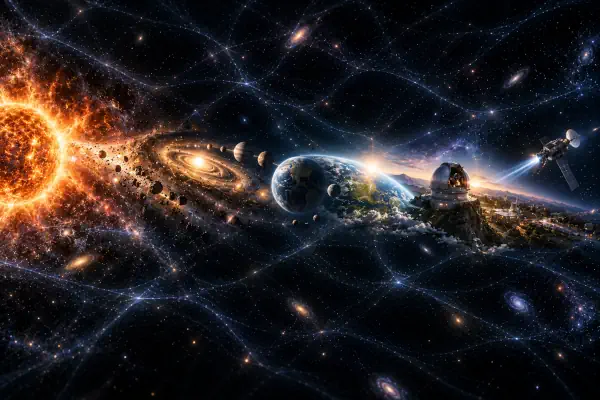
Stars forged many of the heavy elements required for planets and complex chemistry. On Earth, that matter entered a long biological history. Then a remarkable threshold was crossed: one organization of matter became capable of studying other organizations of matter, building models of their behavior, and acting on what it had learned.
There is no need to imagine that the Universe intended to produce intelligence. Biological evolution demonstrates no cosmic goal. Yet the result exists: we can build lasers, particle accelerators, computers, and interplanetary probes. None of these objects violates physical law. But their precise organization does not arise solely from a spontaneous local process. It also depends on a causal chain containing observation, memory, choice, transmission, and fabrication.
This is where intelligence acquires a distinctive role in our reflection. It does not create the laws on which it depends. But it can understand some possibilities well enough to deliberately bring together conditions that local natural evolution might never have assembled on its own. A consequence of cosmic history becomes capable of consciously influencing part of the history that follows it.
“We were born from a chain of causes we did not choose. But as we gradually learn its grammar, we become capable of writing the causalities that follow.”
— Sidath SOEUN
The impossible probe: causing an encounter the Universe might never have produced on its own
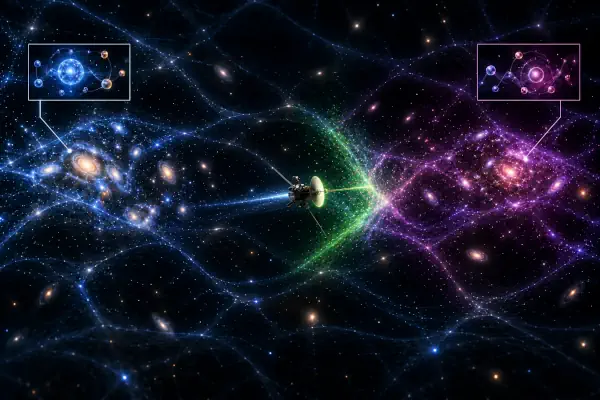
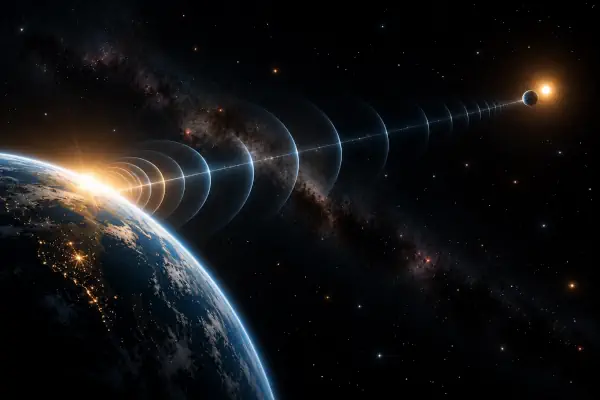
Return once more to A and B. Their natural separation was supposed to keep their histories from crossing. Yet imagine that after billions of years, A produces stars, planets, complex chemistry, life, and eventually a civilization advanced enough to send a probe to B through some mechanism entirely unknown to us today.
At the moment of contact, the probe would bring more than foreign matter into B. It would carry the condensed outcome of an entire causal history. Without A’s stars, its planet, its biological evolution, and the intelligence and technology that followed, this particular object would never be present at that location.
If its arrival triggered in B a state that neither A nor B would have produced separately, the civilization would not have created a fundamental law. It would have done something subtler: turned a previously unrealized physical possibility into an actual event.
The vertigo lies in the loop. GA would have allowed intelligence to emerge. That intelligence would have learned part of GA. That knowledge would then have enabled it to bring GA into contact with GB, opening a sequence of events that might never have begun without it.
“A law can make an event possible for billions of years without ever producing it. Sometimes an intelligence only has to discover that possibility for it to finally enter the history of the Universe.”
— Sidath SOEUN
Is the Universe only what exists, or also everything that can exist?
This thought experiment reveals a distinction we already encounter on much more ordinary scales. The laws of nature do not merely describe objects that exist today. They also permit a far larger range of states that may never have been realized.
Before they were manufactured, some synthetic molecules may never have existed on Earth. The same is true of countless electronic architectures, materials, and experimental devices. Their appearance did not require changing the laws of physics. It required discovering that a configuration allowed by those laws could actually be built.
Two philosophical spaces
The space of the realized: states that have actually occurred in physical history.
The space of the possible: states and transformations compatible with the rules, even if no natural history has yet produced them.
The distinction looks small, but it changes the meaning of creation. To create does not necessarily mean to make something appear outside the laws. It can mean moving a possibility from what could exist into what actually exists.
Intelligence would then be neither a miracle outside matter nor the demonstrated goal of the Universe. It would be a property that appeared somewhere within the realized and became capable of deliberately exploring part of the possible.
What if the “creator” were not a person, but the source of possibility itself?
We can now return to a question that has accompanied humanity for millennia: who created all of this? A religious answer may place a will or an entity at the origin. Science searches for mechanisms, earlier states, and laws. But when either form of explanation is pushed toward its first principle, a difficulty returns.
If an external creator explains the Universe, we can ask why that creator exists. If a fundamental law explains matter, we can ask why that law has this form. If an original quantum state gives rise to our cosmos, we can still ask why that state was capable of changing. Each answer seems to move the boundary of explanation without necessarily removing the question.
Perhaps the word “creator” makes us personify too quickly what we are actually seeking. It need not mean a being located before the Universe. It might instead point toward the foundation that allows possible states to exist, relations to connect them, and one state to lead to another.
“Perhaps we gave the creator a face because it was difficult to imagine an origin that was not a being, but the very possibility for existence to produce what comes next.”
— Sidath SOEUN
This proposal proves no god, demonstrates no cosmic intention, and does not claim that the Universe wrote its own laws. It simply pushes the question to its most difficult point: why are there physical possibilities rather than an absolute absence of any possibility at all?
Earth may not be our destination, but our first causal environment
No human being can spontaneously appear in interplanetary space. Our history requires a planet, chemistry, a biosphere, and an immense succession of prior conditions. Earth can therefore be compared to an egg, not because it was intentionally built for us, but because it is the environment in which our causal history was able to begin.
For almost all of its existence, terrestrial life remained confined to that environment. Then one species began sending objects beyond the atmosphere, toward other planets and eventually into interstellar space. For the first time we know of, a consequence of Earth’s biosphere is deliberately carrying its constructions beyond the world that produced it.
If life one day spreads beyond Earth, that change will prove no cosmic destiny. It will simply change the scale of its history. A causal chain born in one local environment will begin producing consequences at distances its original biological evolution could never have reached on its own.
And if other civilizations exist, they may have undergone their own transition from a home world to a wider history. We have no evidence that this has happened. The possibility nevertheless reminds us that Earth can be the place of our origin without necessarily being the limit of how far our causal history may someday extend.
We do not know who wrote the grammar, but we are beginning to read it
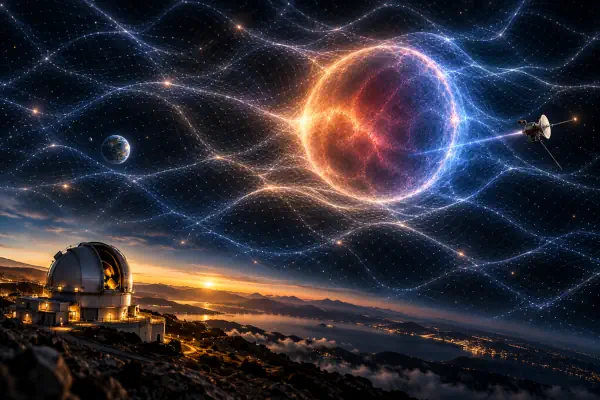
We began with an almost instinctive question: what was there before the beginning? But as we descended through the problem, the beginning itself stopped being the only mystery. Physical vacuum is already not nothingness. Laws describe regularities without telling us why those regularities exist. And even if a deeper theory explained our present laws tomorrow, we could still ask why that deeper structure is possible.
Perhaps physics has a final layer. Perhaps our laws emerge from a structure still unknown. Perhaps some questions lose their meaning once we descend far enough. We do not know. But one point becomes clearer: to search for the origin of the Universe is, sooner or later, to search for the origin of possibility itself.
And while that question remains open, something unexpected has already happened. Matter that silently obeyed these regularities formed stars, planets, chemistry, and at least one form of life capable of reconstructing part of them. We did not write the rules we discover. Yet understanding them already changes what we can do within them.
“We do not know who wrote the first sentence of the Universe, or even whether anyone wrote it at all. But for the first time in our history, some of its matter is learning to read the rules that made its own existence possible.”
— Sidath SOEUN
That may be the deepest vertigo. We are neither at the center of the cosmos nor separate from it. We are made from the same matter, produced by the same transformations, and confined by the same limits. Yet here, that matter has become capable of turning back toward its own history and asking why it was able to have a history at all.
The final question may therefore no longer be only “who created the Universe?” It also becomes this: when the Universe produces something capable of understanding part of its rules and then using that understanding to realize possibilities that had never occurred before, are we still only products of its history, or are we becoming one of the ways that history continues to open?
Sources and scientific references
1977, Sidney Coleman: the false vacuum
In Fate of the False Vacuum: Semiclassical Theory, Sidney Coleman formalized the quantum decay of a metastable false-vacuum state.
1980, Coleman and De Luccia: vacuum and gravity
Sidney Coleman and Frank De Luccia extended the study of vacuum decay by including gravitational effects.
2001, Alan Guth: eternal inflation
Alan Guth described how many inflationary models can lead to eternal inflation and the production of causally separated regions or “pocket universes.”
2007, Aguirre, Johnson, and Shomer: bubble collisions
The authors studied possible observable signatures of bubble collisions in an eternal-inflation scenario.
2001, Murphy, Webb, Flambaum, and collaborators: testing constants
An analysis of quasar spectra searched for a possible cosmological variation of the fine-structure constant. The results fueled a long scientific debate and do not constitute established evidence of variation.
2024, CERN: SHiP and the hidden sector
CERN presents SHiP as an experiment designed to search for particles that interact extremely weakly with ordinary matter, including dark photons, axions, and heavy neutral leptons.
2025, DESI: dark energy remains an open question
DESI’s first three years of data strengthened hints of possible evolution in dark energy. The collaboration continues testing the result and does not present it as a definitive discovery.
CERN: the limits of the Standard Model
CERN notes that the Standard Model describes three fundamental interactions but does not incorporate gravity and leaves major questions unanswered, including the nature of dark matter.
NASA: dark matter and dark energy
NASA presents the standard estimates of roughly 5% ordinary matter, 27% dark matter, and 68% dark energy while emphasizing that the nature of the dark components remains unknown.
Frequently asked questions
Does the Big Bang prove that the Universe had an absolute beginning?
No. The hot Big Bang model successfully describes an early hot, dense phase and its evolution. By itself, it does not demonstrate that all existence emerged from absolute nothingness.
Can the quantum vacuum spontaneously manufacture atoms?
That is not what current physics says. Quantum vacuum has physical structure, and some models allow transitions between vacuum states, but nothing demonstrates that intergalactic space progressively manufactures new atoms with new laws.
Could regions of the Universe have different laws?
Some cosmological hypotheses allow different vacuum states or effective parameters in different regions. Their real existence has not been established. Within our observable Universe, observations instead reveal a remarkable universality of the known laws.
What does “causal grammar” mean?
It is a philosophical metaphor specific to this article. It refers to the rules, constants, symmetries, and interactions that determine which physical transformations are possible. It is not the name of a new scientific theory.
What does G0 represent?
G0 is a symbol used in the thought experiment. If two regions governed by different effective physics could interact, that interaction would have to be permitted by some more fundamental common structure. G0 provisionally names that question, not a discovered law.
Do CERN hidden sectors come from other universes?
No. Hidden sectors are hypothetical extensions of particle physics containing particles very weakly coupled to known matter. The article uses them only as a real example showing how weak interaction and difficulty of detection can go together.
Does this article claim that the Universe is conscious or created us for a purpose?
No. A physical possibility implies no intention. Intelligence can emerge as a consequence of natural processes and later become a cause of new events without the Universe having planned its appearance.
Why use the word “creator” if no entity has been demonstrated?
The article uses the word to question what we mean by it. It asks whether what we seek behind the idea of creation might be the foundation of causality itself rather than an anthropomorphic entity. This is a philosophical proposal, not a scientific conclusion.
Share cette reflection
If this exploration gave you a different way to think about origins, the laws of nature, or the place of intelligence in cosmic history, you can share it and continue the discussion.