Quick answer
The Fermi paradox does not prove that we are alone. It highlights a troubling gap: the Universe appears vast and old enough to have produced other civilizations, yet we have no confirmed evidence of their existence.
This silence may have many explanations: intelligent life may be rare, technological civilizations may not last long, distances may be too great, our instruments may still be limited, or some advanced intelligences may choose not to intervene in worlds they consider too young, unstable or morally immature.
At a glance
- the Fermi paradox questions the apparent silence of the Universe
- it contrasts the vastness of the cosmos with the absence of confirmed contact
- we may still be a very young civilization on a galactic scale
- advanced civilizations might avoid interfering with immature worlds
- above all, the paradox reminds us of our ignorance and humility before the cosmos
In this article
- The central question behind the Fermi paradox
- Are we alone, or simply unaware?
- A cosmos filled with young civilizations
- Advanced civilizations and moral distance
- The hypothesis of a non-interference code
- Why giving technology too early could be dangerous
- Could every planetary species have a cosmic role?
- Are we the guardians of Earth?
- What if the Milky Way already has guardians?
- The great lesson of cosmic humility
- Conclusion
- Full FAQ
The Fermi paradox does not only ask where everyone else is. It also asks whether we are already capable of understanding what we are looking for.
The Fermi paradox: why this Great Silence?
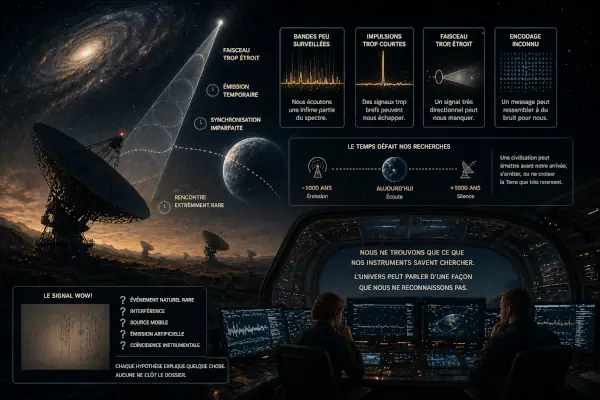
The Fermi paradox begins with an apparent contradiction. On one side, the Universe contains hundreds of billions of galaxies, each of which may contain billions of stars and an immense number of planets. On the other, we have not yet received any confirmed message, observed any indisputable megastructure, or encountered any extraterrestrial civilization.
The question can be stated simply: if intelligent life can emerge elsewhere, why does the cosmos not already carry obvious traces of ancient, advanced or expansive civilizations? Why this silence, when the stage itself seems so vast?
The paradox is powerful because it does not offer a single answer. It opens a field of hypotheses. Perhaps we are alone. Perhaps we are too young. Perhaps we are searching badly. Perhaps others are hiding. Or perhaps advanced civilizations have no reason to reveal themselves to us.
Are we alone, or are we like isolated peoples unaware of the wider world?
Humanity has often confused its own horizon with the whole of reality. For a long time, some societies believed their territory represented the center of the known world. Others were unaware of continents, peoples, languages, cities and civilizations that were nevertheless real.
On a cosmic scale, we may be in a similar position. We observe a small portion of the sky, with recent instruments, over a period that is almost absurdly short compared with the age of the Milky Way. Our silence may not be the silence of the Universe; it may be the silence of our ignorance.
An isolated people on an island might believe they are alone in the world if they have no boat, no map, no telescope and no radio. That does not mean the rest of the planet is empty. It only means their technical level does not yet allow them to perceive the scale of the world.
We have radio telescopes, probes, space telescopes and powerful scientific models. But in the face of the whole cosmos, those tools may still be the first rafts of a humanity standing at the edge of the beach.
What if the Universe is filled with young civilizations?
Another hypothesis deserves serious attention: the Universe may host many forms of life, but very few civilizations capable of crossing space, emitting detectable signals over long periods or mastering interstellar engineering.
On Earth, life has existed for billions of years, but our technological civilization is extremely recent. Radio, aviation, computing, spaceflight and artificial intelligence belong to a tiny fraction of the history of life. On a cosmic scale, we have barely switched on a lamp.
If many planets host intelligent species that are still preindustrial, agricultural, tribal, medieval or simply non-technological, contact becomes almost impossible. Crossing space requires an enormous level of scientific, energetic and organizational mastery.
From this perspective, the cosmos could be alive without being loud. It could be inhabited by young worlds, local civilizations, conscious species unable to send a signal beyond their planet. The Fermi paradox would then not be proof of loneliness, but the sign of an immense evolutionary gap.
Would a highly advanced civilization still think like us?
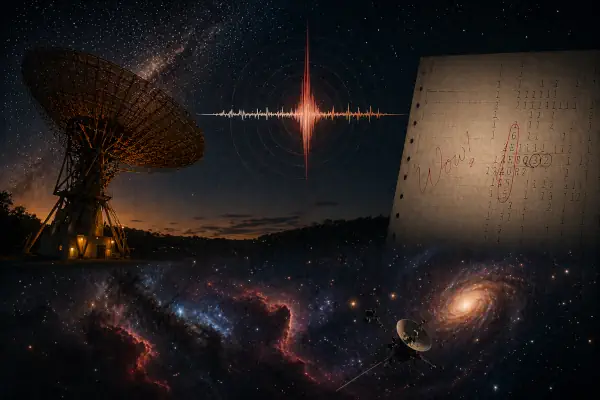
If some civilizations have already crossed space and expanded into the cosmos, it is risky to imagine that they would still share our political, economic, military or territorial reflexes. An older intelligence may have moved beyond logics that still dominate humanity: conquest, domination, accumulation, fear of the other and exploitation of living systems.
A civilization capable of surviving for a very long time would likely have to solve problems we have not yet mastered: energy management, social stability, control of violence, environmental preservation, transmission of knowledge, and the balance between technological power and moral responsibility.
That does not mean an advanced civilization would necessarily be wise or peaceful. Technical progress does not automatically imply moral progress. But a brutal, unstable and expansionist civilization might also destroy itself before becoming sustainably interstellar.
The Fermi paradox therefore raises a disturbing question: to reach the stars, is intelligence enough, or must a species also become responsible enough not to turn every discovery into an instrument of domination?
What if advanced civilizations created a code of non-interference?
The idea is speculative, but powerful: highly advanced civilizations might deliberately avoid interfering with younger worlds. They may consider that premature contact would damage the cultural, moral, scientific or spiritual evolution of a planet.
On Earth, we already understand this dilemma on a smaller scale. When a technologically dominant society enters into sudden contact with an isolated society, the result can be catastrophic: cultural imbalance, dependency, violence, exploitation, the collapse of reference points and the disappearance of entire ways of life.
At a cosmic scale, the problem would be even greater. Giving an immature civilization access to technology capable of manipulating energy, matter, planets or space-time could amplify its flaws instead of correcting them.
An advanced civilization might therefore wait until a world reaches a threshold of maturity: relative peace, respect for living systems, ecological stability, and the ability to cooperate beyond tribes, nations and immediate interests. Contact would not be a reward, but a shared responsibility.
Why could giving major technology too early become dramatic?
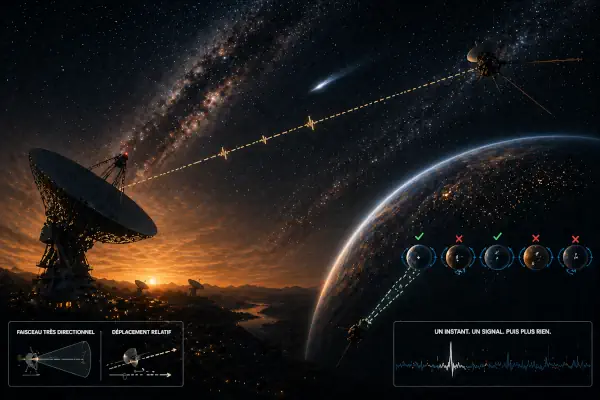
Technology is never neutral when it arrives in a civilization still ruled by force. It increases the capacity for action, but also the capacity for destruction. A society that has not learned to protect life can turn a scientific breakthrough into a weapon, a tool of control or a means of extraction.
On Earth, we already have examples. Advances in energy, industry, digital systems and biology can heal, feed, connect and liberate. But they can also surveil, pollute, exploit, manipulate and destroy. The problem is not only the power of the tool; it is the maturity of those who use it.
At a cosmic scale, the question becomes dizzying. An immature civilization receiving interplanetary technology too early could colonize without understanding, extract without protecting, dominate without legitimacy and prevent other forms of life from evolving naturally.
In this hypothesis, extraterrestrial silence could be a form of caution. Not contempt for humanity, but restraint in the face of the risk of strengthening our most dangerous instincts before our collective consciousness is ready.
What an advanced civilization might wait for before contact
- moral stability: reducing organized violence and systemic domination
- protection of life: treating the biosphere as a collective responsibility
- planetary cooperation: moving beyond destructive rivalries between human groups
- technological mastery: using power without triggering collapse
- cosmic humility: understanding that intelligence does not grant every right
Could every planetary species have a natural role in the cosmos?
On Earth, every species participates in a larger balance. Some pollinate, others recycle, regulate, transform soil, disperse seeds or stabilize ecosystems. Even discreet species often play roles we only understand after they disappear.
We can then imagine a cosmic analogy. If life appears on many planets, every biosphere could be a unique experiment of the Universe: a different way for matter to become sensitive, conscious, organized and capable of spreading.
An advanced planetary species could resemble the pollen of a flower: not a conqueror meant to possess other worlds, but a vector capable of enriching life, carrying the memory of its planet, preserving diversity and perhaps contributing to the natural or cultural seeding of the cosmos.
This vision remains philosophical, but it changes the question. It no longer asks only: “Are we alone?” It asks: “If we are not alone, what kind of presence do we want to become in the Universe?”
Can we call ourselves guardians of Earth?
Humanity likes to think of itself as the dominant species on Earth. But dominating is not protecting. We have developed science, art, medicine, space exploration and an extraordinary ability to understand the world. Yet we have also caused massive destruction, weakened ecosystems and turned our power into a threat for other species.
Calling ourselves guardians of Earth therefore requires more than technical intelligence. It demands moral responsibility. A guardian does not only protect what resembles them. A guardian also protects what does not speak their language, what cannot vote, what does not produce immediate wealth, what simply exists because life has the right to continue.
If we cannot yet protect our own planet, how could we claim to become a legitimate interplanetary civilization? Here, the Fermi paradox reflects a severe image back at us: perhaps the cosmos is not only waiting for us to learn how to travel, but for us to become worthy of the journey.

What if the Milky Way already has its own guardians?
Now imagine that we stop thinking at the scale of one planet and begin thinking at the scale of the Milky Way. If very ancient civilizations exist, they may have developed a form of galactic responsibility. Not necessarily a visible empire, but a way of monitoring, protecting or regulating certain regions of the cosmos.
In this scenario, humanity would not be the center of the story. It would be a young local species, still loud, divided, brilliant and dangerous, observing the sky without understanding the deeper rules of the galactic neighborhood.
Perhaps there are intelligences that no longer seek to conquer, but to preserve. Perhaps they consider a living planet more precious than an impatient civilization. Perhaps they have learned, through ancient and painful experience, that poorly prepared contact can destroy more than it elevates.
This idea is not proof. It belongs to speculative reflection. But it reminds us how limited our perspective is. We look at the cosmos from a young planet, with a short history, many remaining conflicts and a technology barely out of its cradle.
Does the Fermi paradox remind us of our cosmic humility?
Yes, profoundly. The Fermi paradox is not only a scientific puzzle. It is also a lesson in humility. It reminds us that we know little, see little, have listened for only a short time and may define intelligence in ways that are far too human.
We search for radio signals, chemical signatures, megastructures, traces of energy and luminous anomalies. But a highly advanced civilization could be undetectable to us not because it is absent, but because it has learned not to waste energy, not to radiate unnecessarily or not to reveal itself naively.
Conversely, the silence may also be a warning. Perhaps many civilizations fail before becoming interstellar. Perhaps the transition between technological power and collective wisdom is the true filter. Perhaps surviving oneself is harder than crossing the stars.
In every case, the Fermi paradox forces us to look at humanity with clarity. We are capable of poetry, science and compassion. We are also capable of brutality, blindness and destruction. Before asking why the cosmos does not come to us, perhaps we should ask what face we would present to it.
The main families of explanations for the Fermi paradox
- rarity of intelligent life: technological civilizations may be extremely rare
- short lifespan of civilizations: many may disappear before becoming interstellar
- immense distances: signals and travel are limited by space and time
- wrong listening strategy: we may not be looking for the right signals
- non-interference: advanced civilizations may choose to remain discreet
- human immaturity: we may not yet be ready to understand or receive contact
So why does the Universe seem so silent?
The most honest answer is that we do not know. The apparent silence of the cosmos may mean that we are rare, that we are alone, that we are too young, that we are listening poorly, or that other civilizations exist but do not yet wish to reveal themselves.
The Fermi paradox is fascinating because it does not only speak about extraterrestrials. It speaks about us. It questions our maturity, our brutality, our relationship with living systems and our ability to become something more than a brilliant but dangerous species.
If the Milky Way already has guardians, then we may still be children looking at the stars from the doorway of our home. If it does not, then the question becomes even heavier: will we learn to protect what we encounter, or will we merely inherit our own instincts of conquest?
The Fermi paradox closes no doors. It simply invites us to listen farther, think larger and grow morally faster than we grow technologically. Because in a cosmos that may be inhabited, the real question is not only where everyone else is. It is whether we will be worthy of meeting them.
Go further: three related reads
FAQ
What is the Fermi paradox?
The Fermi paradox is the apparent contradiction between the vastness of the Universe, the possible number of habitable planets and the absence of confirmed evidence for an extraterrestrial civilization.
Does the Fermi paradox prove that we are alone?
No. It asks a question, but it does not provide proof. We may be alone, but we may also be searching too little, too recently or with instruments that remain too limited.
Could advanced civilizations observe us without intervening?
That is a speculative hypothesis. An advanced civilization might choose not to interfere with worlds considered too young or too unstable, in order not to disrupt their evolution.
Why could technology given too early be dangerous?
Because powerful technology amplifies both the strengths and weaknesses of a civilization. In a violent or immature society, it can reinforce domination, exploitation or destruction.
Is the Fermi paradox also a moral question?
Yes. It questions our ability to become a responsible civilization. Before meeting other intelligences, we may need to learn how to protect our own planet and the life it shelters.