Quick answer
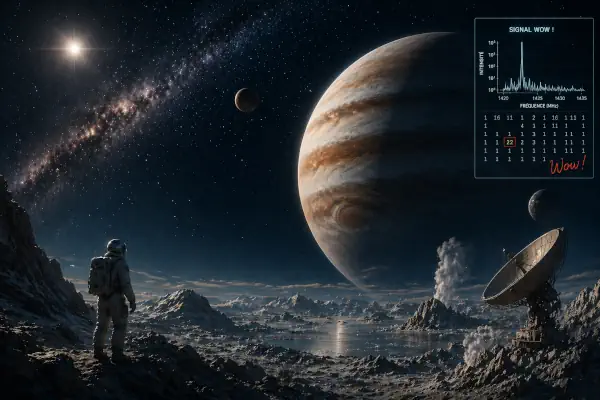
The Wow! Signal is not proof, but it is an exceptional anomaly. It was a narrowband radio signal detected by Big Ear in Ohio during a SETI observing program. Its 72-second duration matches the time the instrument could observe the same patch of sky as Earth’s rotation carried sources through its beam.
What makes it so remarkable is the combination of several features: strong intensity, a frequency near 1420 MHz, a narrow bandwidth, a direction toward Sagittarius and, above all, a total lack of repetition. The Wow! Signal therefore does not confirm the existence of an extraterrestrial civilization. Yet it remains one of the clearest examples of a phenomenon sharp enough to intrigue, but too solitary to conclude.
At a glance
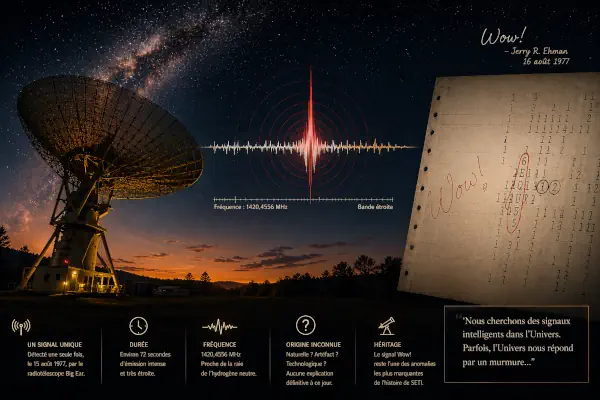
- detected on August 15, 1977 by the Big Ear radio telescope
- identified by Jerry R. Ehman through the sequence 6EQUJ5
- lasted 72 seconds, consistent with Earth’s rotation sweeping the sky through Big Ear’s beam
- frequency near 1420 MHz, the radio line of neutral hydrogen
- never detected again despite numerous follow-up searches
In this article
- August 15, 1977: Big Ear listens to the sky
- Why 1420 MHz attracts attention
- The direction of Sagittarius
- Why the signal became a scientific legend
- Moving source, beam and Voyager probes
- Artificial or natural signal
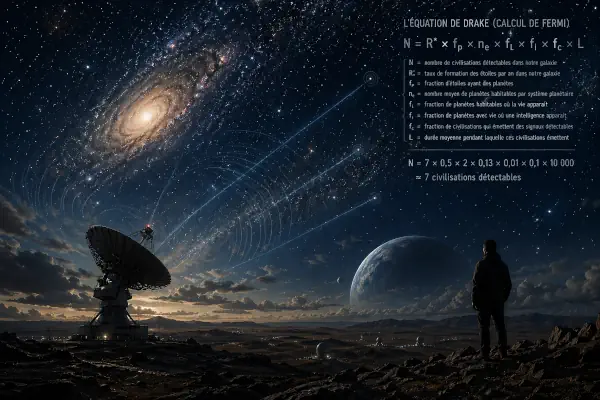
- Detectable cosmic signals
- Earthly signals and a lesson for SETI
- Extraterrestrial signals we might miss
- Hypotheses around the Wow! Signal
- What the Wow! Signal teaches us
- Conclusion
- Full FAQ
The Wow! Signal fascinates because it feels like a door left slightly open: clear enough to stop us in our tracks, too brief to reveal what was behind it.
August 15, 1977: when Big Ear listened to the sky at the right moment
Big Ear was a radio telescope operated by the Ohio State University Radio Observatory. Unlike a modern antenna that can be steered toward a precise target, it observed the sky by drift scanning. Earth rotated, celestial regions passed through its field of view, and each source remained visible for only a limited time.
That detail is exactly what makes the Wow! Signal so unsettling: its duration matches Big Ear’s observing window. The signal did not look like a simple instant burst of interference. It rose, peaked and faded in a pattern consistent with a source passing through the telescope’s beam.
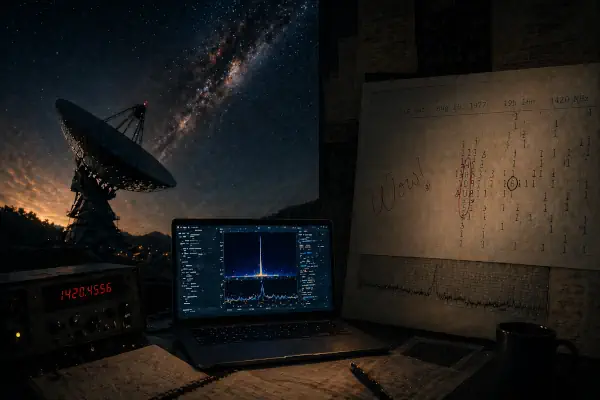
The famous sequence 6EQUJ5 is not a decodable message. It represents radio intensity levels. Yet when Jerry R. Ehman circled it and wrote “Wow!”, he gave this anomaly a perfect name: short, human and unforgettable.
Why does the 1420 MHz frequency attract so much attention?
The Wow! Signal was detected near the radio line of neutral hydrogen, around 1420 MHz. This part of the spectrum is symbolic for SETI because hydrogen is the most abundant element in the Universe. A civilization capable of radio astronomy could, in theory, recognize that frequency as a shared natural reference point.
It was not a sound heard in space. The vacuum does not carry sound the way air does. Big Ear detected an electromagnetic radio wave that was later translated into data. When we “listen” to the cosmos, we often transform invisible measurements into charts, numbers or artificially rendered sounds.
Its narrow bandwidth strengthened the interest. Many natural phenomena produce broad or variable radio emissions. A thin signal concentrated on a precise frequency can suggest a technical emission. That is not enough to conclude anything, but it is enough to deserve a very close look.
Where did it come from? A direction toward Sagittarius, not a precise address
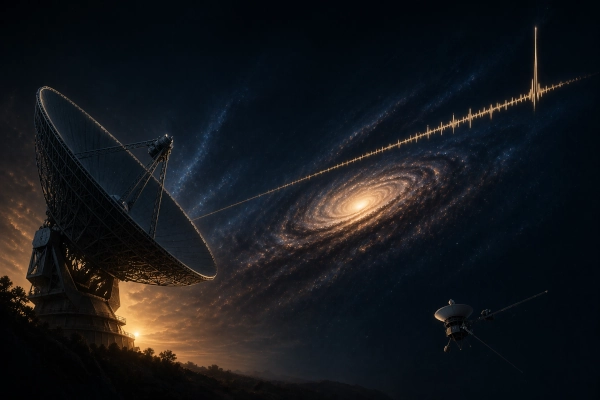
The signal appeared to come from the direction of the constellation Sagittarius, a region close to the general direction of the Milky Way’s center. But this information must be handled carefully: Big Ear could not identify a specific star, planet or exact system.
The instrument had two observing beams, and the signal was detected in only one of them. That configuration makes localization even more difficult. We can therefore speak of a portion of the sky, not a cosmic street address.
This is one reason follow-up work has been so difficult. Searching for a one-time signal in an imperfectly constrained region of the sky is like returning to a beach days after a wave and hoping to find an intact trace.
Why did the Wow! Signal become a scientific legend?
The Wow! Signal checks several boxes that matter to SETI: it was brief, strong, narrowband, close to a symbolic frequency and consistent with a source crossing Big Ear’s beam. For those fascinated by the search for extraterrestrial intelligence, it is a compelling candidate. For scientists, it remains first and foremost an anomaly to explain.
Its reputation also comes from its narrative power. A unique signal, a date, a telescope, a paper printout, an attentive researcher and one handwritten word in the margin: all the ingredients of a memorable scientific scene are there.
But science requires more than a story. It needs repetition, reliable localization and independent verification. That is why the Wow! Signal occupies such a special place: too remarkable to ignore, too isolated to proclaim extraterrestrial.
Could a one-time signal come from a moving source?
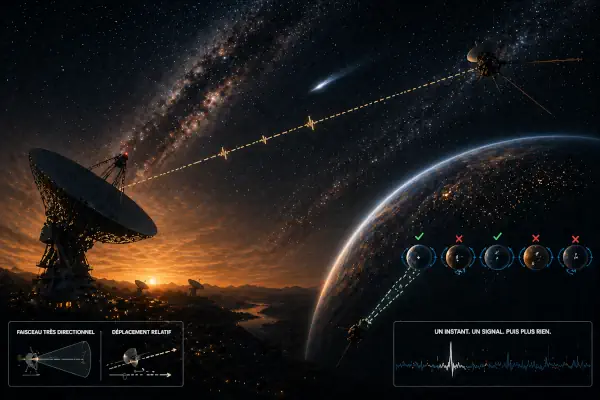
The lack of repetition does not necessarily mean that a fixed source simply went silent. A moving source, a highly directional beam or an object in motion could cross a line of sight for a short moment and then disappear from the observable region.
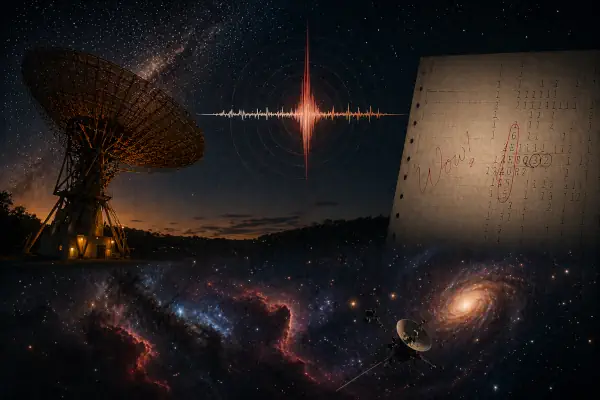
This idea makes an interesting comparison with the Voyager probes. Voyager 1 and Voyager 2 still transmit radio signals toward Earth, but those transmissions are extremely weak, directional and dependent on precise geometry. If a distant civilization briefly crossed their beam, it might receive only a very limited trace, or nothing at all.
We can imagine the reverse situation: an extraterrestrial object or probe emits a signal, but each planet receives it only if it happens to be in the right place, at the right time, with the right antenna orientation. Because planets rotate and orbit their stars, some civilizations might catch such a signal only once. Others would miss it entirely.
The Wow! Signal could then be compared to the light of a very narrow lighthouse: it does not reveal the whole sea, only a fleeting pass through darkness. This hypothesis proves nothing, but it shows why a non-repeating signal is not necessarily absurd in a Universe where everything is moving.
How can we distinguish an artificial signal from a natural one?
The Universe can produce astonishing phenomena: pulsars, fast radio bursts, astrophysical masers, magnetars, active galactic nuclei and hydrogen clouds. Some natural signals are so regular that they initially surprised researchers before they were understood.
A credible artificial signal would therefore need more than strangeness. Researchers look for a verifiable celestial origin, narrow bandwidth, coherent stability, repetition, identifiable modulation or informational structure. A sequence of prime numbers, robust mathematical encoding or a response to our own transmissions would radically change the analysis.
The Wow! Signal contains no such informational proof. It is intriguing because of its shape, frequency and intensity, but it delivers no message. That is exactly what makes it fascinating: it resembles a possible signature without becoming usable evidence.
What cosmic signals can we detect today?
Humanity observes the Universe through several channels. Electromagnetic waves remain the best known: radio, microwaves, infrared, visible light, ultraviolet, X-rays and gamma rays. They reveal stars, galaxies, planets, explosions and extreme environments.
These signals are joined by particles, such as neutrinos and cosmic rays, as well as gravitational waves, directly detected since 2015. This is multi-messenger astronomy: the sky is no longer only seen, it is measured through multiple physical messengers.
Yet our instruments remain limited. We do not detect everything, all the time, in every direction. A signal that is too weak, too brief, too rare or too directional can cross our cosmic neighborhood without being noticed.
Main families of detectable signals
- radio waves: pulsars, neutral hydrogen, planetary emissions, SETI searches
- visible and infrared light: stars, exoplanets, dust, thermal signatures
- ultraviolet, X-rays and gamma rays: black holes, supernovae, magnetars
- neutrinos: deep astrophysical events and extreme explosions
- cosmic rays: energetic particles from powerful sources
- gravitational waves: collisions of black holes and neutron stars
On Earth, signals are everywhere: a lesson for SETI
Earth is saturated with signals. Humans use voice, writing, images, radio networks, satellites, fiber optics, submarine cables and digital protocols. But living organisms also communicate through sounds, colors, scents, gestures, vibrations, electric fields and chemical signals.
Whales sing, bees dance, ants lay chemical trails, fireflies flash, and some plants respond to their environment through subtle signals. This diversity reminds us of a crucial idea: an extraterrestrial intelligence might not use the kinds of signals we imagine.
It could communicate by radio, laser, spectral variations, orbital structures, neutrinos or methods we do not yet know how to recognize. The silence of the sky may therefore be real silence, but it may also be a translation problem.
What extraterrestrial signals might we fail to see?
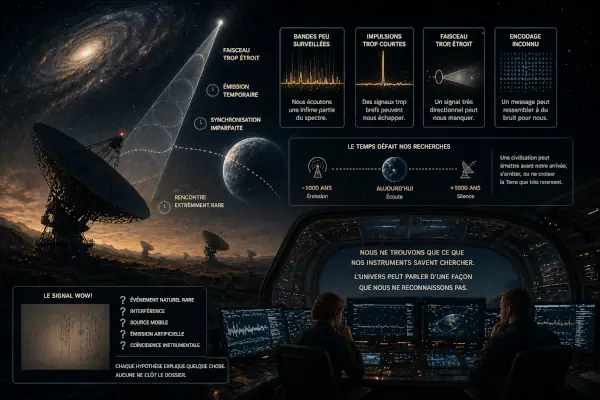
The trap is confusing absence of detection with absence of message. We only find what our instruments know how to search for. A civilization could transmit in a poorly monitored band, send pulses that are too short, use a beam that is too narrow or encode information in a way we would mistake for noise.
Time makes everything even more complicated. A civilization may transmit for a thousand years and stop before we begin listening. Another may send a beam that crosses Earth only once every six millennia. Two intelligences can live in the same galaxy and never become synchronized.
The Wow! Signal embodies that difficulty: rare natural event, interference, moving source, artificial emission or simple instrumental coincidence? Each hypothesis explains something, but none closes the case completely.
Why does the Wow! Signal still fuel so many hypotheses?
The Wow! Signal remains powerful because it combines three dimensions: an interesting scientific profile, a memorable human story and a lack of conclusion. It is precise enough to resist being forgotten, but too singular to become a confirmed discovery.
Several explanations have been proposed: terrestrial interference, reflection from a space object, a rare astrophysical phenomenon, a transient source, a moving emission or a technosignature. Some ideas have been challenged, others remain open. None has gained broad consensus.
Main families of explanations
- terrestrial interference: possible in principle, but difficult to establish definitively
- reflection from a space object: a scenario that has been discussed, without decisive proof
- rare astrophysical phenomenon: plausible if a natural mechanism can produce such a narrow signal
- moving or transient source: useful for thinking about non-repetition
- extraterrestrial technosignature: fascinating, but not demonstrated
What the Wow! Signal teaches us about how we search for intelligence
The Wow! Signal first reminds us that we search with our own tools, our own frequencies and our own ideas of what a message should look like. An extraterrestrial intelligence may not communicate at the right time, in the right band or in a format we recognize.
It also reminds us of scientific discipline: a fascinating signal is not proof. We must be able to say “this is remarkable” without rushing to say “this is extraterrestrial.”
Finally, it teaches us that listening to the cosmos is an exercise in patience. Some anomalies will become understood natural phenomena. Others will remain in the archives. A few, like the Wow! Signal, will continue to force us to listen better.
So, was the Wow! Signal a message from elsewhere?
The most honest answer is simple: we do not know. The Wow! Signal could have been a natural anomaly, an exceptional interference event, a transient phenomenon or a technosignature that crossed our listening field only once. Nothing today allows us to turn that last idea into certainty.
What we do know is already enough to inspire awe: for 72 seconds, a human instrument detected a strong, narrow signal near a frequency important to SETI, and then that signal disappeared.
Perhaps it was only a cosmic accident. Perhaps the echo of an event nobody will ever see again. Perhaps a fleeting pass comparable to a probe beam lost in immensity. The Wow! Signal does not give us the answer. It simply reminds us that the silence of the sky is never completely simple.
Go further: three related reads on this topic
FAQ
Was the Wow! Signal received as sound?
No. It was an electromagnetic radio wave. The instruments measured radio intensity, which was then translated into printed data.
At what frequency was the Wow! Signal detected?
It was detected around 1420 MHz, near the neutral hydrogen line, a region of the spectrum important to radio astronomy and SETI.
Did the signal come from a specific star?
No. It appeared to come from the direction of Sagittarius, but its localization was not precise enough to associate it with a specific star or planet.
Why has the Wow! Signal never been found again?
We do not know. It may have been transient, mobile, natural, linked to exceptional interference or simply non-repeating.
Is the Wow! Signal proof of intelligent extraterrestrial life?
No. It is a famous and intriguing candidate, but proof would require repetition, reliable localization, informational structure or independent confirmation.