In short
Calculators, computers and spell-checkers are not AI in the modern sense, but they belong to the same long history of cognitive offloading. For centuries, humanity has built tools to count faster, remember more, write with fewer errors and process volumes of information that no individual could manage alone.
AI nevertheless marks a new stage: it no longer merely performs a clearly defined operation. It can interpret a request, generate language, connect information, suggest a course of action and support a decision. Its social implications will therefore be immense: used as an assistant, it can reduce mental load, broaden access to knowledge and help make some organisations fairer. Used as a surveillance instrument or an autonomous authority, it can instead reinforce existing imbalances.
At a glance
- humanity has delegated mental operations to tools since long before computing
- calculators did not eliminate accountants: they changed the nature of their work
- computers have automated a growing share of calculation, writing and information organisation
- modern AI adds interpretation, generation, synthesis and contextual assistance
- at work, it can become either a protective assistant or an instrument of excessive control
- the right target is not to “reprogram humans”, but to improve the systems, decisions and conditions that shape their behaviour
In this article
- Before AI, we were already automating parts of our thinking
- Have calculators made us less intelligent?
- The computer, word processing and the disappearance of certain tasks
- When computation becomes too fast for humans alone
- What modern AI actually changes
- Cognitive offloading: the tool that helps, or the tool that replaces
- The trust paradox: when an excellent AI becomes harder to challenge
- More creative individually, more alike collectively?
- Why a good AI should not always give us the answer immediately
- The apprentice paradox: if AI does beginners’ work, who will train the experts?
- What happens after ten years of daily AI use?
- What if the right unit of measurement were human + AI intelligence?
- The contact centre as a laboratory for useful AI
- Mistral and the question of a European AI
- AI to understand the city better, not to score citizens
- Can AI improve institutions?
- Can knowledge finally become accessible to far more people?
- Can AI make humanity more reasonable?
- The safeguards we cannot do without
- What we choose to preserve
- Full FAQ
The history of technology is not simply the story of humans being replaced by machines. It is often the story of humans handing a repetitive task to a tool so they can redirect their attention towards a harder problem.
— Sidath SOEUN
Before AI, we were already automating parts of our thinking
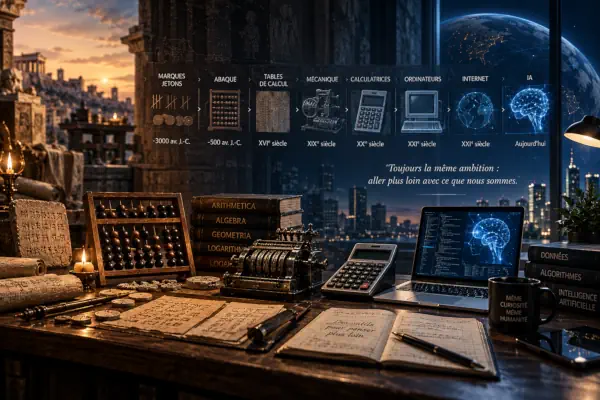
For much of human history, calculating meant counting with memory, fingers, marks, tokens or tables. Then came instruments such as the abacus and its many variants. An abacus does not “think”. It does not learn. It does not understand a question. Yet it already performs something fundamental: it moves part of the reasoning outside the human brain and gives it a material form in a tool.
That shift may seem ordinary today, but it is one of the recurring threads of technological history. A society becomes more complex when it can record, reproduce and accelerate certain operations. Writing externalised part of memory. Numerical tables externalised results. Calculating instruments reduced the effort required to manipulate numbers. At every stage, human beings accepted that an external support could perform part of what they had previously done mentally.
Modern AI is not technically descended directly from the abacus. The two do not work in the same way and do not have the same capabilities. But they belong to the same cultural history: that of a humanity that builds extensions of its memory, its capacity to calculate and, now, its language.
Have calculators made us less intelligent?
As electronic calculators became widespread, they made instantaneous operations that had previously required time, attention and sometimes considerable practical expertise. Adding long columns, calculating percentages or checking accounts became faster. Yet accounting did not disappear. The profession shifted towards control, interpretation, regulation, analysis and decision-making.
This distinction is essential. Knowing how to perform an operation and knowing what to do with its result are not the same skill. A calculator can multiply two numbers without understanding a balance sheet. A spreadsheet can apply a formula to a million cells without understanding a company’s situation. The tool absorbs the repetitive operation; responsibility remains in understanding the context.
We accepted this transformation because its benefits became obvious. Today, no one asks an engineer to give up a calculator in order to prove their intelligence. Instead, we expect them to choose the right formula, check the assumptions and spot an implausible result. The shift in skill has already happened.
What the machine really changes
- before: much of the effort goes into producing the result
- after automation: more effort can go into checking, interpreting and deciding
- new risk: no longer understanding the operation and accepting the result blindly
- new skill: knowing how to supervise the machine instead of mechanically reproducing its work
The computer: when the typewriter becomes an intellectual tool
The personal computer produced an even more visible shift. It did not merely replace the typewriter. It made instant correction possible, duplication without retyping, searching within a document, copy and paste, templates, email and, soon, spelling and grammar checkers.
Functions that once justified specialised jobs were integrated directly into the everyday work tool. Professional typing did not disappear overnight, but part of the data-entry work was absorbed by employees themselves, equipped with software capable of correcting and formatting their texts. Humanity did not stop writing: it learned to write differently.
This already contains a lesson for AI. When a technology automates a task, the important question is not only “which job disappears?”. We also need to ask: what new tasks emerge? Which skills become more important? And how do we prevent productivity gains from simply becoming greater pressure on those who remain?
When computation becomes too fast and too complex for humans alone
Space exploration shows just how indispensable this delegation can become. A space mission requires calculations for navigation, trajectory, speed, timing and control. Humans design the equations, models and procedures, but some operations must be performed at a speed and with a consistency that a crew could not reproduce manually, second after second.
The Apollo programme already relied on a guidance computer to perform calculations for navigation, guidance and spacecraft control. Since then, scientific computing and supercomputers have made it possible to simulate ever more complex phenomena: climate, materials, astrophysics, fluid dynamics and the behaviour of entire systems.
Saying that a computer calculates “for us” does not mean that we have stopped understanding. On the contrary, it sometimes enables us to explore problems that would otherwise be beyond the reach of our brains, our available time and our calculation speed.

So what does modern AI actually change?
The break comes from the fact that we are no longer automating only a clearly defined operation. Contemporary models can analyse language, recognise patterns, generate text, connect information, summarise documents, translate, code, converse and suggest directions. The machine is no longer merely placed at the end of a formula: it enters tasks in which context matters.
That does not mean it necessarily “understands” the world as a human does, or that it possesses moral wisdom. An AI can produce a convincing answer and still be wrong. It can reproduce biases present in its data, miss a specific context or propose a statistically plausible solution that is nevertheless inappropriate.
That is precisely why the right model is not one in which the human fades away, but one of supervised cooperation: the machine processes, connects and proposes; the human checks, contextualises, takes responsibility and decides when the consequences matter.
Offloading a task does not necessarily mean offloading your thinking
Cognitive science uses the term cognitive offloading to describe shifting part of a mental effort onto an external support. Writing a shopping list so you do not have to remember everything, using a calculator, checking a calendar or asking software to verify spelling are already forms of cognitive offloading. Generative AI extends this phenomenon to more complex operations: rephrasing, summarising, comparing, proposing a structure, explaining or generating counterarguments.
The term itself does not tell us whether this delegation is good or bad. Everything depends on what remains in the user’s own mind. A qualitative study published in 2026 on doctoral learning with generative AI distinguishes precisely between uses in which AI lowers the initial difficulty of a task while preserving reading, verification and personal reconstruction, and uses in which a coherent answer is accepted before the user has built their own understanding.
Two ways to use the same tool
Dependent offloading: “Give me the answer; I’ll use it.”
Autonomous offloading: “Here is my reasoning. Look for its flaws, give me the strongest objections, then help me verify what still holds.”
The difference is considerable. In the first case, the tool gradually receives cognitive authority. In the second, it becomes scaffolding: it helps the user climb higher without deciding in place of the person doing the building. This may be one of the major skills of the AI era: learning not only how to obtain good answers, but how to retain ownership of your reasoning.
The trust paradox: the better AI becomes, the harder some of its mistakes become to see
A mediocre AI forces us to remain cautious. An excellent AI creates a subtler problem: after nine remarkable answers, the tenth — even if wrong — can sound just as credible. Researchers use the term automation bias when we place too much trust in an automated recommendation, sometimes despite contradictory evidence that is readily available.
A 2026 article in Philosophy & Technology distinguishes a “weak” form of the bias — failing to check information that is available — from a more troubling “strong” form, in which people follow the machine even after seeing evidence that contradicts it. The authors describe this as epistemic deference: the system’s authority eventually carries more weight than our own examination of the evidence.
The danger of a mediocre AI is that it is often wrong. The danger of an excellent AI is that we may eventually forget that it can still be wrong.
— Sidath SOEUN
The aim, then, is not to learn to “trust AI” or to “never trust AI”. It is to learn calibrated trust: adjusting our confidence to the domain, the uncertainty, the consequences of an error, our own expertise and the possibility of verification. A recipe, a medical diagnosis, a tax return and a court decision should obviously not receive the same level of delegation.
What if AI increased our individual creativity while reducing collective diversity?
There is a paradox that is still largely absent from public debate. One person may produce a better text, more ideas or a more convincing presentation with AI, while an entire population using similar models may gradually produce texts, arguments and styles that resemble one another more closely.
Several recent studies describe this risk of homogenisation. A 2026 review in Trends in Cognitive Sciences notes that cognitive diversity — diversity of languages, perspectives and ways of reasoning — contributes to creativity and collective intelligence. Other experiments show that generative AI can improve some individual outputs while reducing diversity across the group. This outcome is not inevitable, however: 2026 research indicates that genuinely diverse personas and prompting strategies can mitigate some of this convergence.
This changes how we should evaluate an AI. The “best answer” may not always be the answer that should be given. For a creative, political, strategic or philosophical question, an excellent AI might sometimes present several genuinely different lines of reasoning, explain their assumptions and preserve relevant disagreements instead of smoothing everything towards an elegant average.
Should an excellent educational AI sometimes refuse to make things easier for us?
We tend to measure technological progress by the disappearance of friction: fewer clicks, less waiting, less effort. That is desirable when the friction is a pointless administrative procedure or a tedious search. But not every difficulty is useless. Some difficulties force us to recall knowledge, formulate a hypothesis, compare two explanations or discover that we do not yet know.
Learning science has long discussed desirable difficulties: challenges that can strengthen learning when they are appropriately calibrated. Research in 2026 on generative AI connects this question to cognitive load and the risk of “cognitive debt”: saving time immediately can become costly if we systematically remove the effort required to build a skill.
A simple experiment to try with an AI
The next time you ask a question about a subject you do not know well, first write down what you think you know. Then ask the AI to find the weaknesses in your reasoning, and only afterwards ask it to explain the full answer.
You have just used the same tool in two radically different ways: not as a substitute for your thinking, but as a temporary intellectual adversary.
An excellent educational AI should perhaps not try to remove every difficulty. It should remove unnecessary difficulties while preserving the ones that help intelligence grow.
— Sidath SOEUN
The apprentice paradox: if AI does beginners’ work, how will we produce experts?
The phrase “apprentice paradox” is an editorial proposal here, not the name of an established scientific theory. Yet it describes a concrete problem. In many professions, simple, repetitive or less-than-exciting tasks are also the tasks through which beginners acquire their first automatisms. A lawyer starts by reading and classifying. A developer fixes small bugs. An adviser handles routine situations. A writer learns by rephrasing, making mistakes and trying again.
If AI absorbs precisely these tasks, it can increase productivity immediately while removing part of the training ground that used to produce tomorrow’s experts. The answer is not to preserve unpleasant tasks artificially. It is to invent new forms of learning: simulations, AI-augmented mentoring, exercises without assistance, mandatory explanations of decisions, rotation through real cases and progressive training in challenging AI.
If artificial intelligence performs beginners’ work perfectly, we will have to invent a new way of producing experts.
— Sidath SOEUN
What happens after ten years of daily AI use?
This question is often framed as a concern: what will remain of our abilities if an AI accompanies us every day for ten years? But it deserves to be turned around. What can a person become after using AI for ten years not to avoid thinking, but to deepen their curiosity systematically?
Before conversational assistants, a curious child could browse an encyclopaedia, a dictionary or a science collection and discover an immense universe. Books have an irreplaceable strength: an author has chosen a path, built an argument, created depth and sometimes devoted years to the subject. But books also have a physical boundary. When a very specific question arises halfway down a page and the book does not answer it, curiosity has to find another book, a library, a teacher — or accept that it must wait.
Conversational AI changes this relationship with knowledge. One question can immediately lead to another: “why?”, “in what context?”, “give me the objection”, “explain it another way”, “compare it with this specific case”, “what have I failed to understand?”. The depth of exploration can therefore follow the depth of curiosity. This does not make books or experts obsolete; on the contrary, AI can become a gateway to them. But it dramatically lowers the cost of reaching a first level of understanding.
As a child, I read the Tout l’Univers books and Larousse dictionaries. They fed my curiosity, but a question could still remain unanswered when the book came to an end. With AI, one answer can become the starting point for ten new questions. After ten years, that can also mean ten years of enrichment and deepening — provided we continue to verify, read and think.
— Sidath SOEUN
Writing an email is not necessarily the same as learning to be a secretary
Take an everyday task. A professional email has to convey information, strike the right tone, organise a few points and avoid ambiguity. For a long time, being able to produce this kind of text quickly was a skill acquired through experience, training and repetition. AI can now turn rough instructions into a clear message in a few seconds.
Is that a loss of skill? Sometimes, yes, if the user becomes unable to understand or correct what is being sent. But it can also be the modern equivalent of the typewriter or word processor: form takes less time, while the human focuses on the value of the message, the intention, the facts and the relationship with the recipient. The skill shifts.
Shopping with an adviser who has nothing to sell you
Commerce offers another example. A skilled salesperson can provide real expertise, but they also work within a system of targets, margins, stock and sometimes commissions. A well-designed shopping assistant can start with the customer’s actual need: budget, expected lifespan, constraints, repairability, genuinely useful features and conflicting reviews. It can explain why a cheaper product fits the need better than a model that is more profitable for the seller.
This possibility does not eliminate bias: an assistant funded by advertising, commissions or partnerships can be influenced too. The challenge will therefore be the economic transparency of assistants. But for the first time at scale, consumers can have a tool capable of tirelessly comparing dozens of characteristics according to their own context.
Finally understanding what used to be written for specialists
Energy bill, tax return, insurance contract, administrative letter, terms and conditions, technical decision: a large part of modern life is written in specialised language. It could once take years of training to master these codes. AI can translate a document into plain language, explain each concept, simulate examples and answer follow-up questions.
Here again, it does not automatically replace the expert: an error involving a contract, health matter or tax issue can have serious consequences. But it can reduce the initial asymmetry between the person who knows the vocabulary and the person encountering it for the first time. Access to explanation becomes less scarce.
A person can also become capable of producing what they would never have dared to begin
This may be the hardest effect to measure. Someone with ideas but limited spelling skills, editorial method, technical knowledge or access to specialised interlocutors can now work with several forms of assistance brought together in one tool. They can learn by producing. A website, article, analysis or project that would have remained only an idea can become real.
What if we were measuring the wrong intelligence?
Much of the public debate still compares humans and machines as two competitors sitting the same exam. Who writes better? Who diagnoses better? Who programs faster? Who passes the test? These comparisons are useful for measuring capabilities, but they can obscure the configuration that will probably become the most common: the human working with AI.
Research from 2026 on public decision-making shows that respondents may perceive AI as more efficient, humans as fairer, and some forms of human–AI collaboration as particularly acceptable when they combine those qualities. This does not prove that the combination will always be superior. It shows instead that the design of collaboration is itself becoming a scientific subject.
Perhaps we are looking for the wrong intelligence. The future may not necessarily be decided between human intelligence and artificial intelligence, but by the quality of the intelligence we are able to form together.
— Sidath SOEUN
A human–AI team is not automatically intelligent, however. If the human mechanically approves the machine, what remains is essentially a machine with a human signature. If the human systematically rejects the tool, there is no collaboration either. The quality of the system depends on how roles are distributed: who explores, who calculates, who verifies, who provides context, who can challenge the result and who ultimately bears responsibility.
The contact centre could become a laboratory for genuinely useful AI
Few jobs reveal the ambivalence of artificial intelligence as clearly as customer-service work. In many contact centres, quality is still assessed using a limited sample of calls. A handful of interactions may then weigh heavily in an employee’s evaluation even though they represent only a fraction of their days, difficult customers, quiet successes and efforts.
A well-designed AI could change this balance. It could transcribe conversations, objectively identify certain procedural steps, retrieve contractual information in seconds, prepare an after-call summary, detect moments when the adviser asks for help and highlight recurring difficulties. The analysis would then cover a far more representative body of interactions than a few calls selected at random.
But call quality cannot be reduced to procedural compliance alone. A contact centre also depends on a resource that is much harder to measure: the adviser’s cognitive and emotional availability when the next customer answers the line.
A call can be over in the software without being over in the adviser’s mind
After an ordinary interaction, a few seconds may be enough to move on to the next case. But not every call draws on the same resources. A long, confrontational or emotionally demanding interaction may require the adviser to listen to an angry person, search for a solution at the same time, monitor their own wording, follow a procedure, contain any irritation they may feel and maintain a calm voice until the very last second.
Technically, the call ends when the customer hangs up. The mental load does not necessarily disappear at the same moment.
Several concepts help explain this phenomenon. Emotional labour refers in particular to the effort required to present the attitude expected by the organisation to the customer even when the employee’s actual emotional state is different. When the gap between what a person feels and what they must display becomes large, this is described as emotional dissonance.
This demand can be compounded by cognitive load, sustained attention, simultaneous information searches, the management of several software tools and the need to make good decisions quickly. After some interactions, this combination can produce a temporary state of cognitive exhaustion or emotional tension.
In operational terms, we might call this operational fatigue: the accumulation of cognitive and emotional load significant enough to temporarily reduce the resources available for the next call. The expression is not a medical diagnosis. It simply describes a reality that conventional productivity indicators still struggle to measure.
A call can be finished in the software before it is genuinely finished in the adviser’s mind. After an especially difficult customer, immediately sending another call into the headset can amount to assuming that a human being can instantly reset their mental pressure. That is not always the case.
— Sidath SOEUN
Two eight-minute calls can represent two completely different levels of effort
This is one of the limits of traditional indicators. Two calls can display exactly the same duration in a productivity dashboard while representing radically different loads.
Same duration, different load
Call A — 8 minutes:
change of address, calm customer, familiar procedure, no particular difficulty.
Call B — 8 minutes:
angry customer, several objections, complex case, contractual research, threat of cancellation, verbal tension and a requirement for the adviser to remain perfectly calm until the end.
In a conventional duration metric, these two interactions can appear almost identical. For the adviser’s brain, they are nothing alike.
This difference becomes particularly important when calls arrive one after another without any real recovery period. After a demanding interaction, a few minutes may be needed for tension to subside, to regain one’s bearings, complete the case properly and restore sufficient attention before welcoming another person.
Occupational-health literature notably uses the concept of need for recovery — need for recovery — to describe the state in which resources mobilised during work need to be restored. This does not necessarily mean a long break is required. In some cases, a short period without a new demand may already help restore more stable mental availability.
This distinction matters for management: a statutory break and recovery after a difficult event do not meet exactly the same need. An adviser may handle many ordinary calls in succession without any particular difficulty and still need a few minutes after one exceptionally demanding interaction.
Measuring productivity alone can make part of the real work disappear
Contact centres can measure average handling time, waiting time, availability, call volumes, sales, compliance and after-call work with great precision. These indicators are useful for operating a complex activity.
But they rarely answer another question: how much mental effort did the call that just ended actually require?
Yet this invisible dimension can directly affect the next call. An adviser who is still under tension may have less patience, less attention or less capacity to process several pieces of information at once. Trying to recover a few minutes of productivity immediately can then produce the opposite effect: a less fluid next interaction, more errors or poorer relational quality.
A supervisor should therefore not observe only what an adviser produces. They should also pay attention to the conditions under which that output is produced.
AI could detect the difficulty of a call without pretending to read an employee’s emotions
This is precisely where artificial intelligence could be useful. Its role should not be to claim that it can determine whether an employee is sad, stressed, motivated or unmotivated. Automated emotion inference in the workplace raises major ethical and legal concerns in any case.
A much more cautious approach would be to observe only objective operational indicators: unusually long call duration, repeated objections, recurring complaints, explicit insults or threats in the conversation, a high number of procedural searches, supervisor intervention, escalation to another department, or a recent succession of several difficult interactions.
From those elements, the system could flag that an interaction probably required more resources than an ordinary call and suggest — without imposing — a short recovery period.
Example of assistance after a difficult call
Exceptionally demanding interaction detected.
Several objective indicators point to an unusual load: long duration, a highly confrontational customer, multiple searches and procedural escalation.
A short recovery period before returning to available status may be considered.
The decision remains with the adviser and supervisor.
This approach would be very different from emotional surveillance. The AI would not try to guess what the person is feeling. It would analyse only observable characteristics of the interaction and suggest a proportionate preventive measure.
The supervisor would remain essential
Artificial intelligence does not know the full history of a team. It may not know that one adviser has just returned from an absence, that another is highly experienced with a certain type of case, that someone else is having an especially difficult day, or that a seemingly complex call caused no tension at all.
The supervisor’s role would therefore not disappear. On the contrary, it would become more important: interpreting signals, talking with people, deciding when intervention is genuinely necessary, and distinguishing a one-off difficulty from a deeper organisational problem.
AI could, however, give the supervisor a view that no human can obtain by listening to a handful of calls among hundreds. It could reveal that the same issue regularly creates tension, that a procedure forces advisers to perform too many searches, or that a certain type of case systematically leads to escalation.
In other words, artificial intelligence should not only ask: “which adviser is struggling?”. It should also make it possible to ask another question: “what could our organisation change so that this difficulty occurs less often?”
A useful AI should not only ask which employee made a mistake. It should also ask which system led them to make it.
— Sidath SOEUN
The same system could, however, become extremely harmful if it were used to time every silence, automatically punish a particular phrase, maintain a permanent ranking of employees or produce an opaque compliance score. The difference therefore lies not only in the technology. It lies in management intent.
A protective AI should answer a simple question: “what does the adviser need to handle this call and the next one better?” rather than “how can we monitor every second of their activity?”.
It could surface exceptionally difficult calls, suggest recovery after an aggressive interaction, recommend human support, identify unnecessarily complex procedures or show a manager an adviser’s strengths as clearly as their areas for development.
An assistance AI, not a digital foreman
- during the call: fast information retrieval, procedural support and contextual suggestions
- after the call: automatic summaries and less repetitive data entry
- for quality: analysis of a representative volume of interactions instead of a few isolated call reviews
- for cognitive load: identification of interactions that are objectively more complex or demanding
- for recovery: the option to recommend a short period to regain composure after an exceptionally demanding interaction
- for training: detection of recurring needs and more personalised support
- for management: identification of procedures or situations that regularly create unnecessary overload
- for protection: escalation of objectively problematic situations, verbal abuse or conflict, with human intervention
- for fairness: placing performance back in the real context of how difficult the handled interactions were
- to avoid: opaque scoring, automatic sanctions, emotional surveillance, permanent ranking or algorithmic pressure
Mistral and the question of European artificial intelligence
This reflection naturally leads to the question of technological sovereignty. A company or public administration that entrusts part of its documents, procedures and knowledge to AI systems needs to understand where data is processed, which rules apply and how much control it retains.
Mistral AI is an interesting example here. The European company develops models and solutions for professional use, offers private deployment options and emphasises the possibility of retaining greater control over infrastructure, models and data. This does not mean that a solution is automatically better because it is European; it means that Europe also has actors capable of helping build this new technological layer.
For a contact centre, bank, insurance company or public service, the issue becomes concrete: the AI assisting employees must be effective, but also auditable, secure, compatible with confidentiality requirements and controllable enough not to turn professional assistance into an uncontrolled data leak.
AI to understand the city better, not to score citizens
At a larger scale, artificial intelligence can help us understand systems that humans struggle to observe in their entirety. Traffic, noise pollution, breakdowns, lighting, accidents, damage, congestion and energy consumption generate enormous volumes of data. AI can detect trends within them and reveal areas where intervention is becoming necessary.
Imagine a street where night-time noise repeatedly becomes excessive, an intersection where emergency braking becomes abnormally frequent, or a neighbourhood where public furniture is regularly damaged. The value of AI is not to declare that a resident is “bad” or “poorly programmed”. Its value is to show that an objective problem is recurring, measure its scale and help humans choose a proportionate response.
This distinction is fundamental. A safer society does not need a machine that assigns a moral score to every person. It needs tools capable of observing phenomena, comparing solutions and raising an alert when certain thresholds are crossed, while respecting privacy, the presumption of innocence and the right to challenge a decision.
Could AI make our institutions more consistent?
Human decisions are not always consistent. Two people in similar situations may receive different answers. A rule may produce an unfair effect that its authors did not anticipate. A person in authority may exercise that authority skilfully — or, conversely, damage an entire team through a lack of listening, method or perspective.
AI could become a tool for comparison and consistency checking. Within an organisation, it could flag that one manager is associated with an abnormal number of departures, conflicts or complaints. In a public administration, it could simulate the effects of a reform on several citizen profiles. When preparing a rule, it could search for contradictions, compare precedents or highlight categories of people that would bear a disproportionate burden.
But it should not become the legislator, the judge or the invisible director. A machine trained on human history can also reproduce its injustices. The aim, then, is not to replace political or managerial responsibility, but to make the consequences harder to ignore.
A good institutional AI would not say “this is the correct decision”. It would say instead: “these are the consequences you may be failing to see, the inconsistencies you should examine, and the people who could be unfairly affected”.
— Sidath SOEUN
Can knowledge finally become accessible to far more people?
This may be one of the most profound transformations. For centuries, access to knowledge required rare books, teachers, institutions, time, money or the luck of being born into an environment that encouraged learning. The Internet has already disrupted that balance, but raw information remains difficult to use when you do not know what to look for or when a field’s language is too technical.
Conversational AI can act as an interface. It can explain a concept in simple words, rephrase an administrative text, translate a document, suggest an exercise, compare two concepts or guide someone step by step who might never have dared to open a specialised textbook.
This potential is immense for people who are far from elite universities, specialist libraries or professional networks. AI does not guarantee intellectual equality, and its answers must be checked. But it can lower the cost of entry into knowledge. At any hour, it can make a first explanation available where, in the past, there was sometimes no one to ask.
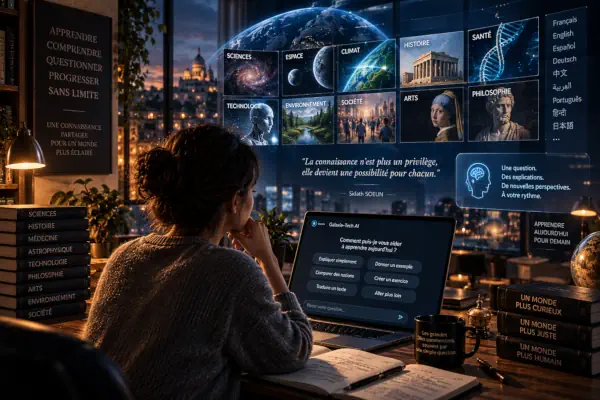
Knowledge is no longer only a privilege; it becomes a possibility for everyone.
— Sidath SOEUN
Can we “recalibrate” humanity? Better to recalibrate our systems
The idea may sound appealing: if an AI can detect inconsistency, aggression, injustice or irrationality, why not use it to correct human behaviour? The problem is that no one possesses a neutral, universal definition of “good behaviour”. A technology capable of assigning moral scores to people could very quickly become authoritarian.
A healthier path is to change the target. Instead of “reprogramming” people, AI can help recalibrate the environments that encourage harmful behaviour. An aggressive manager can be identified through objective indicators of turnover, conflict or complaints. An unfair rule can be tested across several situations. A recurring nuisance can be measured. An unnecessarily complex procedure can be identified because it continually produces the same errors.
This approach better respects human dignity. It does not assume that a machine knows a person’s moral worth. It assumes only that a machine can sometimes see statistical patterns that humans, constrained by time, interests or habits, fail to see.
The role of artificial intelligence should not be to tell us who is good or bad, but to show us more clearly what, within our systems, encourages the very behaviours we are trying to prevent.
— Sidath SOEUN
Moral progress cannot be automated. But some obstacles to moral progress can be made more visible.
The “responsibility black hole”: when everyone can blame the algorithm
The more a decision passes through an automated system, the stronger one temptation becomes: “it wasn’t me, it was the algorithm”. A recruiter can invoke a score, a manager a dashboard, a public administration an automated recommendation. AI can then create a strange space in which a decision genuinely affects someone while no one seems fully responsible for it.
The “responsibility black hole” is an editorial metaphor here. It nevertheless connects to very real questions of accountability, human oversight and contestability. Adding a human to the loop is not enough if that human has neither the time, the information nor the authority required to challenge the system.
Responsible artificial intelligence should make human responsibility more visible, never allow it to disappear behind a score.
— Sidath SOEUN
Take a concrete example. A company uses an AI system to rank several hundred job applications. A qualified candidate is automatically placed very low in the ranking and never receives an interview. When they ask why, the recruiter replies that they simply relied on the score produced by the software. The company can then argue that the recruiter did not really make the decision, while the system designer can point out that the tool merely provides a recommendation. The decision exists, its consequences are real, but responsibility begins to disperse across all the actors involved.
The same phenomenon could appear in a bank or insurance company. Imagine an algorithm recommending that a loan be refused, a premium sharply increased or a case subjected to particular restrictions. If the adviser almost always validates that recommendation because they have thirty seconds to process the case, the human intervention becomes largely theoretical. If the decision is challenged, the adviser can invoke the algorithm, the company can invoke the adviser’s validation, and the software provider can remind everyone that the final decision belonged to the company. This is precisely where the “black hole” forms: not when there is literally no responsible party, but when responsibility becomes so fragmented that the affected person can no longer tell who must genuinely answer for the decision.
Avoiding this mechanism therefore requires more than a simple “human validation” button. It must be possible to identify who designed the criteria, who chose to use the system, who has the authority to challenge its recommendation, what information the decision is based on, and who a person can genuinely appeal to. A human in the loop only has meaning if they can still say no to the machine — and take responsibility for that yes or no.
Greater efficiency does not always mean lower cost to the planet
AI promises to optimise processes, save time and sometimes reduce the energy required for a task. But economic history contains a warning known as the Jevons paradox, or rebound effect: when a resource becomes more efficient and cheaper to use, total use can increase enough to erase part of the gain achieved per unit.
A 2026 study using data from Chinese companies between 2010 and 2022 observed this kind of result: AI adoption was associated with lower carbon intensity, but also with higher total emissions, notably through productivity and revenue gains. This finding cannot simply be generalised to AI worldwide, but it highlights an essential distinction: improving the efficiency of a task and reducing the total impact of a system are two different objectives.
If producing an image, an analysis or a translation becomes one hundred times easier, we may simply produce one hundred times more of them. The environmental question surrounding AI will therefore not be limited to the efficiency of chips and data centres. It will also concern how we use these systems, the volume of that use and the actual value of what we choose to compute.
The safeguards that will determine the difference between assistance and domination
Technology alone guarantees no better society. A tool capable of helping a customer-service adviser can also monitor every word they say. A system capable of optimising traffic can also be repurposed for disproportionate surveillance. A decision-support assistant can become the de facto decision-maker if no one dares to challenge its score.
European law has already set some limits. The EU Artificial Intelligence Act notably prohibits certain forms of social scoring and, in the workplace, the use of systems intended to infer workers’ emotions, subject to specific exceptions including safety and medical purposes. This distinction matters: analysing a procedure or detecting a need for assistance is not the same as claiming to read an employee’s inner state.
Seven principles for genuinely useful AI
- transparency: knowing when AI is involved and what data it uses
- contestability: being able to correct an automated decision or analysis
- human oversight: keeping an identifiable person responsible for important decisions
- proportionality: not collecting more information than necessary
- worker protection: using analysis to help and train, not only to sanction
- audit: measuring errors, biases and unintended effects
- clear purpose: defining what AI should improve before deciding what it should monitor
There is no single vision of artificial intelligence
Talking about “artificial intelligence” can create the impression that one technology is advancing in an already determined direction. Reality is far more complex. Behind models capable of producing text, code, images or reasoning are companies, laboratories, researchers and states that do not necessarily pursue the same goals or defend the same way of building, distributing or securing these systems.
OpenAI, Anthropic, Google DeepMind, Meta, Mistral AI and other organisations are therefore developing technologies that may be comparable in some capabilities while belonging to different strategies. Some place strong emphasis on general-purpose assistants and systems able to perform increasingly complex tasks. Others focus particularly on evaluating frontier-model risks, scientific research, model openness, enterprise use or technological sovereignty.
One technology, several directions
- OpenAI: development of increasingly capable general-purpose AI systems, accompanied by frameworks intended to evaluate and govern the risks of the most advanced models.
- Anthropic: particular emphasis on the safety of advanced systems, risk evaluation and progressively adapting safeguards as capabilities increase.
- Google DeepMind: combining general-purpose models, fundamental scientific research and specific mechanisms for evaluating risks associated with frontier models.
- Meta: support for a more open ecosystem around the Llama family, enabling researchers, developers and organisations to adapt and deploy more of their own systems.
- Mistral AI: particular emphasis on open models, regional deployment and sovereignty, including the ability for companies and states to retain greater control over models, data and the infrastructure used.
These differences do not mean that each laboratory can be reduced to a single philosophy. Their strategies evolve rapidly, overlap and also respond to economic, scientific, regulatory and competitive pressures. An organisation that advocates openness can invest in safety at the same time; a company building consumer assistants can also conduct fundamental research; a laboratory concerned about risks can equally seek to increase the capabilities of its models substantially.
That is precisely why it would be dangerous to reduce the future of AI to a competition focused only on which laboratory will produce the most powerful model. Another competition, less spectacular but perhaps more important, is already under way: one involving architectures, rules, business models and values that will determine how this power is made available to society.
Power is only part of the question
Imagine two artificial intelligences with almost identical technical capabilities. The first operates mainly within a centralised infrastructure that its user does not control. The second can be deployed in an environment controlled by a company, public administration or country. Their apparent intelligence could be comparable, while their implications for privacy, technological dependence, sovereignty and responsibility would differ.
Now imagine two other systems that are equally capable. The first systematically seeks to produce an immediate answer in order to minimise the effort required from the user. The second sometimes knows how to ask a question, flag uncertainty, present a contradiction or invite the user to verify an assumption. Their performance might again look similar on a technical ranking, while their long-term influence on the way we think could be profoundly different.
This distinction is essential. We still evaluate artificial intelligence largely by what it can do: solve a problem, write a program, analyse a document, produce an image or answer a question. But we will probably also need to learn to evaluate it through the intellectual relationship it builds with the person using it.
The question may not only be which artificial intelligence will become the most powerful, but which conception of intelligence we choose to make powerful.
— Sidath SOEUN
Diversity that could become a form of protection
The coexistence of several approaches can represent more than simple commercial competition. It can become a form of intellectual and technological protection. If a single architecture, company or conception of what counts as a “good answer” became the dominant intermediary between billions of people and knowledge, its technical choices could gradually influence a considerable part of how we search, write, create and perhaps even formulate our problems.
Preserving several models, laboratories, scientific cultures and approaches to AI instead maintains a fundamental possibility: comparison. When one system asserts something, another may reach a different conclusion. When one architecture favours one method, another can explore a second. And when disagreements appear, humans recover precisely what automation can sometimes make them lose: the need to judge.
This diversity obviously guarantees neither truth nor safety. Several systems can reproduce the same errors, learn from similar sources or converge on the same reasoning. But a pluralistic ecosystem at least makes it harder for one way of thinking to become silently installed as the universal infrastructure of knowledge.
We are therefore not choosing tools alone
When a school chooses an artificial intelligence to support its pupils, when a company integrates one into the work of thousands of employees, when a public administration uses one to analyse cases, or when an individual begins entrusting part of their research and reflection to one every day, the choice is not merely about software.
It is also, sometimes without us fully realising it, about a particular conception of assistance, autonomy, privacy, safety, openness, responsibility and the place we still want to reserve for human judgement.
The future of artificial intelligence will therefore probably not be written by a single company or a single discovery. It will emerge from the confrontation between several visions, user choices, political decisions, scientific research, economic constraints and the limits that societies agree — or refuse — to impose.
Behind this technological diversity, a question ultimately appears that matters far more than the name of the model we will use tomorrow: as these systems become more capable, what do we want to continue deciding, understanding and practising ourselves?
What we choose to preserve
It is probably both. AI extends an old history: that of tools taking over part of our memory, calculation or production. But it also crosses a threshold because it now enters language, synthesis, interpretation and decision support.
For a long time, we asked machines to calculate faster than we could. We now ask them to help us understand faster. The difference is immense, because understanding directly touches authority, work, knowledge and human relationships.
The right question is therefore not “will AI replace humanity?”. It may be more concrete: will we use this new capability to increase pressure, concentrate power and automate our flaws, or to reduce unnecessary load, detect injustice more effectively and make knowledge more accessible?
The calculator allowed us to stop spending so much time on certain operations. The computer enabled us to write, simulate and organise at a new scale. AI could allow us to delegate part of research, synthesis and repetitive work. But whatever it frees will only have value if we know what to do with the time, attention and intelligence we recover.
After externalising part of our memory, calculation, information processing and now synthesis, some functions should remain deeply human: judgement, responsibility, the ability to doubt, curiosity, diversity of ideas, the possibility of challenging an answer and moral decision-making when several values come into conflict.
Perhaps we should not measure progress in artificial intelligence only by how much human work it manages to eliminate, but also by the quality of the human intelligence it leaves behind.
— Sidath SOEUN
Reference points and sources
- Computer History Museum — Revolution: The First 2000 Years of Computing
- NASA — Reliability history of the Apollo guidance computer
- Mistral AI — company overview and professional solutions
- Mistral AI — infrastructure and European sovereignty, August 2026
- European Commission — AI Act Service Desk, prohibited practices
- Frontiers in Psychology — Cognitive offloading and metacognitive calibration in generative AI-mediated doctoral learning, 2026
- Philosophy & Technology — What is Wrong With Automation Bias?, 2026
- Trends in Cognitive Sciences — The homogenizing effect of large language models on human expression and thought, 2026
- Computers in Human Behavior: Artificial Humans — Diverse AI personas can mitigate the homogenization effect, 2026
- Frontiers in Psychology — The critical-thinking paradox in generative AI-integrated learning, 2026
- Information & Management — From comparison to collaboration: human and AI in public decision making, 2026
- Economic Analysis and Policy — The Jevons Paradox in the AI era, 2026
To go further: continuing the reflection on technology
FAQ
Is a calculator artificial intelligence?
No, not in the modern sense. A calculator performs predetermined operations without interpreting a request or producing an answer in the same way as an artificial-intelligence model. It nevertheless belongs to a much older history: that of tools through which humans gradually externalise certain cognitive operations. Writing externalised part of memory, calculating instruments part of calculation, computers part of information processing, and the Internet part of access to information.
Could artificial intelligence make us less intelligent?
Not necessarily. Everything depends on how we use it. An AI that systematically replaces the effort of understanding can contribute to weakening certain skills. Conversely, an AI used to question, explain, compare, challenge or deepen can allow someone to explore subjects they would have struggled to approach alone. The real issue is therefore not only how much effort AI saves us, but the quality of the intellectual effort it still encourages us to make.
Why preserve a certain amount of “intellectual friction” if AI can give us the answer immediately?
Because some difficulties are part of learning itself. Searching for a solution, formulating a hypothesis, hesitating, making a mistake and then correcting one’s reasoning forces the brain to build more robust representations. A good AI should therefore not necessarily remove every difficulty. In some situations, it could deliberately leave part of the reasoning to the user so that it helps them progress rather than simply producing the result in their place.
Why could AI homogenise the way we think or create?
If millions of people use the same models to write, generate ideas or solve problems, some formulations, structures and associations of ideas may gradually converge. AI can increase individual creativity while sometimes reducing the collective diversity of what is produced. Preserving multiple models, sources, intellectual cultures and, above all, the human ability to challenge answers therefore becomes important if we want to prevent universal assistance from unintentionally producing overly uniform thought.
How can AI help customer-service advisers without becoming a surveillance tool?
By prioritising assistance over control: document retrieval during the call, procedural support, automatic summaries, less repetitive data entry, analysis of a representative volume of interactions and identification of recurring difficulties. It could also use objective operational indicators to identify exceptionally demanding interactions, allowing the adviser and supervisor to consider a short recovery period. The aim should be to ask “what does the adviser need to succeed more effectively?” rather than trying to monitor every second of their activity.
What is “operational fatigue” after a difficult call?
In this article, the term refers to the temporary accumulation of cognitive and emotional load that may reduce the resources available for the next interaction. A call can be over in the software while the tension it created has not yet fully disappeared. An aggressive customer, a complex case, several simultaneous searches or the need to constantly regulate one’s own emotions may make a short recovery period necessary. Two calls of the same duration therefore do not necessarily represent the same effort for the adviser.
What is the AI-related “responsibility black hole”?
It is a metaphor used in this article to describe a situation in which a decision has real consequences while responsibility for it becomes difficult to assign. A recruiter can point to a score produced by an algorithm, the company can say the recruiter was supposed to validate the recommendation, and the software provider can explain that it merely supplied a tool. Each actor then holds a small part of the decision without the affected person clearly knowing who should answer for it. Human oversight is genuinely useful only if the human has the time, information and authority required to challenge the machine’s recommendation.
Could AI make laws or public decisions fairer?
It could help compare different scenarios, detect inconsistencies, measure the consequences of a rule or show that a population is being disproportionately affected. But those capabilities do not give AI political or moral legitimacy. Determining what is fair involves values, trade-offs and responsibilities that must remain open to challenge within a democratic framework. AI can inform a public decision; it should not become the authority that decides what society must consider fair.
Why not use AI to “recalibrate” human behaviour directly?
Because no machine possesses a neutral and universal definition of “good behaviour”. A system tasked with assigning moral value to people could quickly become an instrument of control or arbitrary power. A more cautious approach is to use AI to recalibrate systems rather than individuals: identify a procedure that repeatedly produces the same errors, measure the consequences of a rule, detect organisational dysfunction or make recurring patterns visible without claiming to determine a person’s moral worth.
Why is it important to have several companies and several visions of AI?
Because artificial intelligence does not follow a single path. Organisations such as OpenAI, Anthropic, Google DeepMind, Meta and Mistral AI develop systems whose capabilities may sometimes converge, but whose strategies around openness, safety, research, deployment, sovereignty or professional use can differ. Preserving several approaches makes it possible to compare systems and reduces the risk that one conception of what counts as a “good answer” gradually becomes the dominant intermediary between a large part of humanity and knowledge.
If AI becomes extremely capable, what should we absolutely continue to do ourselves?
Probably everything that deeply engages our autonomy and responsibility: learning how to formulate a problem, exercising judgement, verifying important information, tolerating doubt, confronting several points of view, deciding our values and accepting the consequences of our choices. We may externalise a growing quantity of calculations, research and perhaps even intermediate reasoning. But externalising a capability should never mean abandoning responsibility for deciding when and why we use it.
What, then, would the real revolution of artificial intelligence be?
It may not lie only in creating an intelligence superior to human beings. It could also lie in our ability to build systems that help us make better use of the intelligence we already possess: accessing knowledge more easily, understanding complex fields, challenging our ideas, reducing repetitive cognitive tasks and devoting more attention to problems that still require our judgement. The essential question then becomes less “what will AI be able to do in our place?” than “what do we want to continue understanding, deciding and practising ourselves?”