Robots in 20 years
In the coming decades, robots could move beyond the status of specialized machines and become much more deeply integrated assistance tools in everyday life. Their presence would no longer be limited to factories or laboratories: they could gradually enter homes, hospitals, farms and warehouses.
Likely mid-term applications
- Home assistance robots
- Medical assistants and hospital logistics robots
- Agricultural monitoring and intervention robots
- Collaborative industrial robots
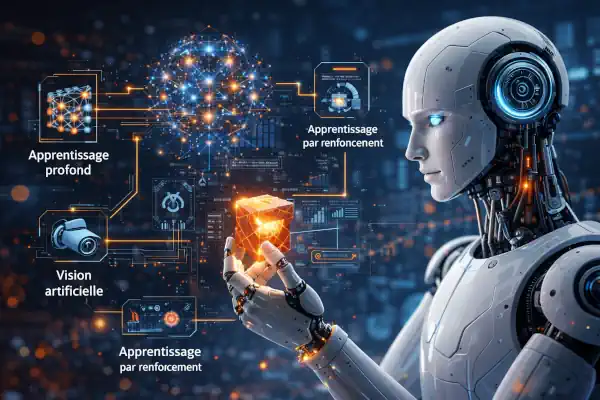
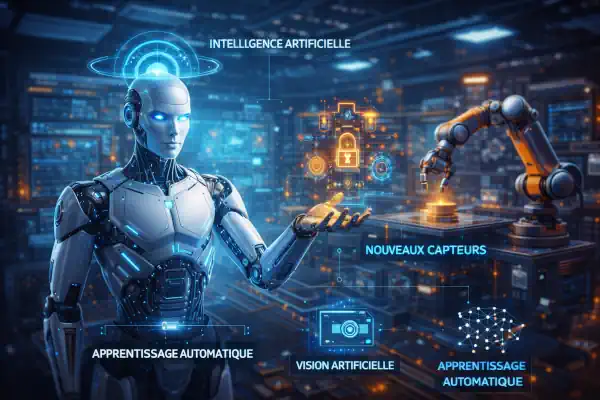
This evolution is driven by the convergence of several technologies: computer vision, autonomous navigation, embedded sensors, finer object manipulation and AI-assisted learning. Companies such as Tesla are already exploring the idea of humanoid robots capable of operating in environments designed for humans.
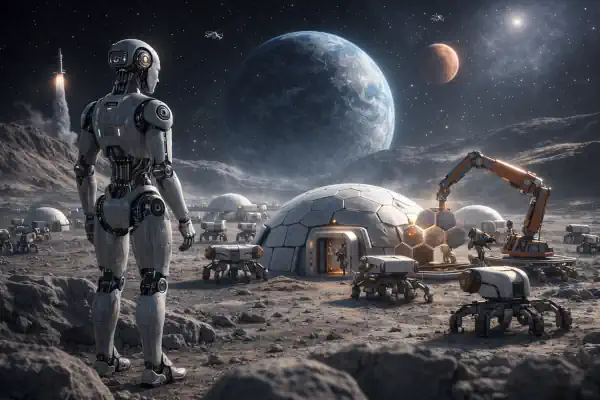
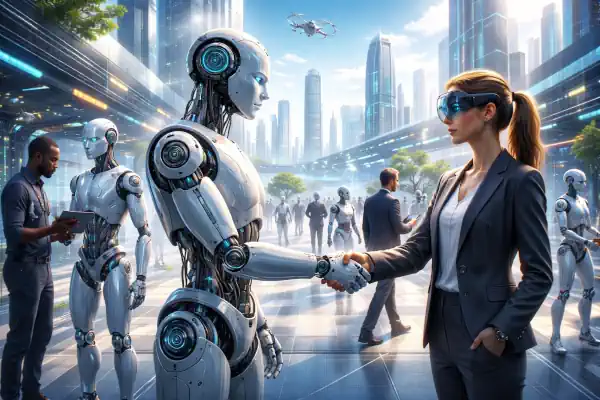
A robotic civilization would not necessarily mean replacing humans, but rather the gradual integration of machines as operational partners across an ever-growing number of sectors.
Robots in 50 years
Over the longer term, the key issue would no longer be only the automation of repetitive tasks, but the ability of robots to learn continuously, cooperate with one another and operate in uncertain environments. Such a shift would profoundly change their status: they would become less isolated tools and more active components of complex technical ecosystems.
In space exploration, fleets of robots could, for example, prepare infrastructure before human crews arrive: terrain inspection, equipment assembly, preventive maintenance and local resource use. This kind of scenario naturally interests major space agencies, because it could reduce human risk while extending the operational capabilities of missions.
On Earth, the same logic could take hold in industry, logistics and healthcare. Machines would no longer be there only to execute; they would participate in chains of decision-making, anticipation and coordination. That would require a deep rethink of work, training, safety, ethics and even how societies distribute autonomy between humans and intelligent systems.
If these trajectories are confirmed, robots will no longer be seen as simple technical tools. They could become structuring actors of technological civilization, reshaping our relationship to production, care, assistance, the environment and exploration.