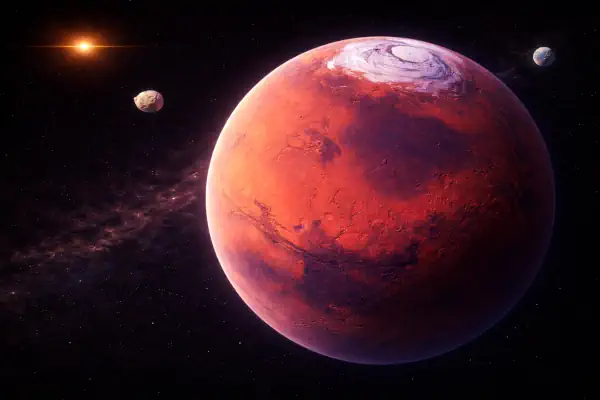
My short answer: Mars was probably habitable, but life there is still unproven
Based on current evidence, it is scientifically reasonable to say that ancient Mars once had several ingredients consistent with habitability. The planet experienced liquid water at the surface, stable sedimentary environments, long-lasting rock-water interactions and a rich enough chemistry to keep astrobiologists seriously interested.
What would go too far is claiming that this habitability automatically led to life. That is the real boundary in this debate: Mars offers favorable settings, promising clues and remarkably informative rocks, but no irrefutable biological proof has yet been validated.
In brief
- Mars once had liquid water, lakes and deltas in its early history
- several Martian rocks and sediments are considered highly promising for biosignature research
- organic molecules have been detected, but they do not prove life on their own
- the best scientific answer remains cautious: Mars may have been habitable, but life has not been demonstrated
The real question is not only whether Mars was once wet, but whether that ancient wetness allowed a Martian biology to emerge, survive and leave behind detectable traces.
Why Mars became a central target in astrobiology
Mars fascinates scientists because it combines relative proximity, a readable geological history and realistic robotic access. Unlike exoplanets, it is a world where we can send rovers, analyze rocks on site, map ancient landscapes and select samples considered high priority for future laboratory study on Earth.
That proximity changes everything. It allows researchers to test detailed hypotheses about sediment types, watery settings, local chemistry, minerals formed in water, rock alteration and the possible preservation of complex structures. Where many other worlds remain distant targets, Mars can be questioned almost stratigraphically, layer by layer.
Most importantly, the Red Planet preserves converging evidence of a past that was less hostile than the one we see today. Ancient Mars does not look like an eternal desert. It looks like a planet that went through wet phases, basins, river systems, sedimentary deposits and perhaps conditions stable enough to make microbial life at least plausible.
The evidence for an ancient wet Mars
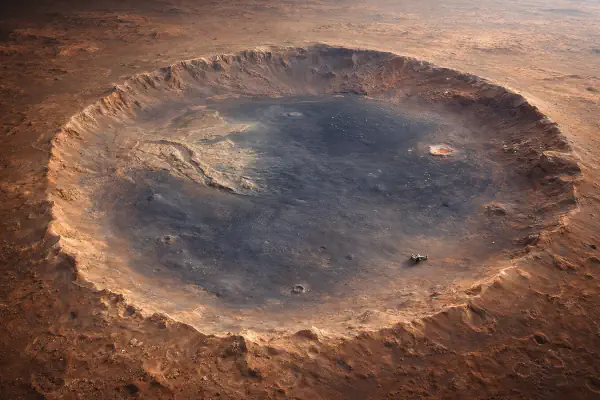
The case for ancient Martian habitability begins with water. And the clues are numerous: erosion valleys, channels, sedimentary deposits, hydrated minerals, fossil deltas and former lake basins. Far from the image of a world that was always frozen and sterile, Mars has preserved in its terrain the signatures of long-ago liquid water circulation.
That matters enormously. Water does not guarantee life, but it remains one of the strongest criteria we have when discussing habitability. A long-lived aqueous environment favors chemical exchange, the concentration of certain molecules, element transport and the formation of settings potentially friendly to prebiotic or microbial chemistry.
More than that, some Martian regions appear to have experienced not just an isolated wet episode, but a complex hydrological history. Lakes, deltas and river systems imply time, sediment transport, repeated inputs and therefore a better chance that ancient traces may have been preserved.
Jezero: an ancient lake, an ancient delta and an almost ideal target
Jezero Crater holds a very special place in this investigation. It was chosen as Perseverance’s landing site because it corresponds to an ancient lake environment fed by a delta. In astrobiology, that kind of setting is extremely valuable: deltas concentrate and deposit fine sediments that may record the chemical history of an environment and, potentially, certain signatures of life.
Jezero is not simply a visually striking Martian landscape. It is a geological archive. The local rocks, sedimentary layers and minerals allow researchers to probe Mars’s former climate, the past presence of stable water and the preservation quality of ancient clues.
It is no accident that so much scientific attention is focused on this region. If Mars truly offered conditions suitable for microbial life at some point in the distant past, an ancient lake delta like Jezero ranks among the most plausible places to recover indirect traces of it.
Why Jezero attracts so much scientific attention
- presence of an ancient Martian lake
- fossil delta favorable to sedimentary deposition
- rocks and minerals useful for reconstructing the past environment
- potential preservation of biosignatures or complex chemical clues
Organic molecules: an important clue, not a proof
Whenever ancient life on Mars is discussed, organic molecules quickly move to the center of the conversation. That is understandable, because on Earth they are part of the chemistry of life. But one distinction is absolutely essential: organic does not automatically mean biological.
An organic molecule can be produced without any living system. It may result from geochemical processes, atmospheric chemistry or even the delivery of carbon-rich material by meteorites. In other words, their presence makes the question more compelling, but it does not by itself prove that a Martian biosphere once existed.
The real challenge is context. Where are these molecules found? In what type of rock? Associated with which textures, minerals, structures and chemical patterns? Only when a signal is embedded within a convincing overall framework does it become more persuasive.
Perseverance and intriguing rocks: scientific promise, not a final verdict
Some of the most widely discussed discoveries of recent years have strengthened Mars’s astrobiological appeal without turning the story into a certainty. Certain rocks studied by Perseverance have displayed textures, chemical signatures and mineral configurations that researchers consider compatible with the idea of an ancient environment favorable to life.
That kind of announcement should always be read calmly. An “intriguing” rock is not the same thing as a “biological” rock. The scientific process requires repeated checks, the elimination of non-biological explanations and constant awareness of the limits of instruments operating aboard a rover. What seems suggestive in the field can remain ambiguous after deeper analysis.
Still, that caution does not diminish the importance of the work. Every relevant sample, every carefully chosen sedimentary rock and every mineralogical context compatible with long-term preservation moves the investigation closer to a better grounded answer.
What Curiosity changed in our understanding of Mars
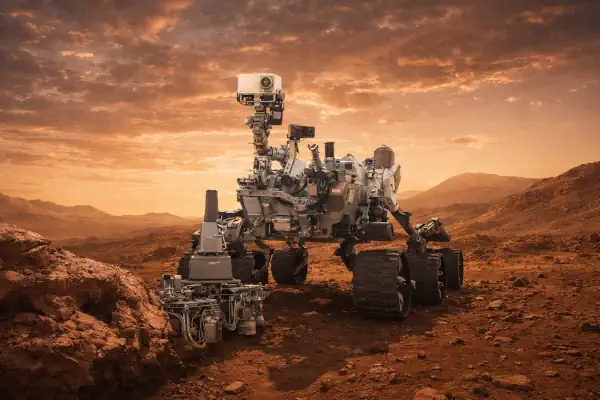
Even before Perseverance, Curiosity had already transformed our view of Mars. By exploring Gale Crater, the rover gathered strong evidence for ancient environments where water persisted, lakes existed and some chemical conditions appeared compatible with microbial life.
Curiosity also helped show that Mars should not be imagined as a world that was uniformly sterile at all times. Its history is layered. Some periods were probably more hospitable than others. That nuance matters: the search is not for “life on Mars” in an absolute sense, but for windows in time and place where life may have been possible.
This makes the research far more rigorous. It avoids simplistic slogans and places the question back into planetary chronology: when was Mars warmer, wetter and more chemically active, and did those conditions last long enough to make biology plausible?
The problem of biosignatures and false positives
In such a high-profile topic, the word biosignature can easily create false expectations. A convincing biosignature would ideally belong to a coherent set of clues: texture, composition, sedimentary context, mineralogy, associated chemistry and a low probability that purely abiotic mechanisms could explain the signal.
Mars, however, is exactly the kind of planet where false positives are possible. Geological processes can mimic certain structures, chemical reactions can produce unsettling signals and billions of years of alteration can blur the oldest traces. The evidentiary bar therefore has to remain extremely high.
That is why the decisive next step will probably not come from a single dramatic announcement, but from convergence: robust samples, cross-checked analyses, well-understood context and the patient elimination of non-biological scenarios.
Comparing the main hypotheses about ancient life on Mars
A comparison of plausible scenarios
- Mars never hosted life: still a possible scenario, even if the planet once had habitable environments
- Mars was habitable but sterile: a strong hypothesis if the origin of life requires rarer conditions than we often assume
- Microbial life once existed and later vanished: a heavily studied scenario consistent with a wetter ancient Mars
- Traces remain but are still ambiguous: probably the scenario closest to our current scientific situation
This perspective shows why the Martian case remains so compelling. We are neither in pure speculation nor in certainty. We are in a rare middle zone where past habitability is strongly supported, yet biological proof still has to be built.
Why this question changes how we think about life and rocky planets
Searching for ancient life on Mars is not only an investigation into a neighboring planet. It tests a much deeper idea: does life emerge readily once a few minimum conditions are in place, or is it an extraordinarily rare event even when water, energy and chemistry all seem available?
Mars acts here as a natural experiment. If the Red Planet was habitable but never hosted life, that would tell us something profound about the difficulty of crossing the boundary between complex chemistry and biology. If, on the other hand, Mars really did support an independent microbial life, then life would no longer look like a purely terrestrial accident, but like a more general possibility of planetary matter.
In both cases, the implications would extend far beyond Mars itself. They would reshape how we think about exoplanets, ocean worlds, the evolution of rocky planets and our place in the cosmos.
So, did Mars really host ancient life?
The most honest answer in 2026 is still an open one. Mars has unquestionably strengthened its scientific credibility as a once-habitable world. Traces of water, lake environments, sediments, minerals and organic compounds make the Red Planet an exceptionally serious candidate in the search for the remains of an ancient microbial biosphere.
And yet, no discovery has crossed the threshold of definitive proof. We have compatible contexts, intriguing signals and promising rocks, but not yet the decisive argument that would allow us to say unambiguously: yes, Mars once hosted life.
That is precisely why the subject remains so powerful. Mars sits at the frontier between planetary geology, the chemistry of life, Solar System history and the philosophy of biological solitude. The answer may not be here yet, but the Red Planet remains one of the places where humanity has the best chance of getting closer to it.
FAQ
Has ancient life on Mars already been proven?
No. As of 2026, no direct and universally validated proof of ancient Martian life has been obtained. The clues are serious, but they do not yet amount to a definitive biological demonstration.
Why is Jezero considered a major site?
Because it is an ancient crater lake containing a fossilized delta. That type of environment is especially interesting for preserving sedimentary deposits and possible ancient chemical traces.
Do the organic molecules found on Mars prove life?
No. Organic molecules may be linked to life, but they can also be produced without biology. They are important clues, not absolute proof.
What kind of life would be most plausible on Mars?
If Mars truly hosted life, the most plausible form would be simple microbial life, emerging in ancient environments rich in liquid water and favorable chemistry.
What could change the course of the research?
A coherent combination of clues in carefully selected samples, analyzed with higher precision, especially if purely geological or abiotic explanations can be robustly ruled out.