In short
An event can cease to exist without all of its consequences ceasing with it. Light can continue on its way, matter can be displaced, an atmosphere can retain a chemical signature, a wave can propagate, and a decision can alter an entire chain of events.
But a physical trace is not necessarily an archive. It can be absorbed, transformed, dispersed, or become so difficult to distinguish from the rest of the Universe that no observer could reconstruct what produced it. The question is therefore not only whether the Universe preserves traces. It is when a trace stops being an accessible history.
At a glance
- To look far away is to receive the past: light takes time to travel. The sky therefore shows us past states of distant objects.
- A trace is not a readable memory: an event can leave consequences while becoming impossible to reconstruct precisely.
- There is no simple absolute now: relativity connects time, motion, and causality.
- Travel requires navigating through time as well as space: a complete cosmic destination must specify both where and when.
- Voyager did not send a fixed address: the Voyager Golden Record provides reference points from which our origin can be reconstructed, not an immutable coordinate.
- Information and meaning are not the same: a signal can be physically present even if its recipient does not understand what it means.
In this article
- Can a lamp leave a trace that outlives us?
- Why the sky is a moving archive.
- What a light cone really is.
- Why our idea of now begins to break down on a cosmic scale.
- Two spacecraft, two histories of the same world.
- Why GPS is already a relativistic technology.
- How to navigate a galaxy in which everything moves.
- What Voyager actually told any strangers who might find it.
- The difference between trace, information, and meaning.
- What entropy and black holes change about the question of memory.
- Why traveling more miles does not mean aging more.
- What a physical memory of the Universe might really mean.
Switch on a lamp, then watch the trace leave us

Imagine an almost ordinary experiment. You are standing in a dark room and switch on a lamp for one second. For you, the event is over almost immediately. Yet the light that was produced does not disappear when you turn the switch off.
Some of the photons reach the walls, furniture, or your body and are absorbed or scattered there. Some may escape through a window. Photons are the smallest packets of energy with which quantum physics describes light. They do not form a compact photograph traveling intact through the vacuum. Radiation spreads through space, interacts with matter, and becomes increasingly difficult to detect.
A few yards away, someone may see the lamp. At a much greater distance, an instrument would have to be sensitive enough and favorably positioned. If some of that light could travel without being absorbed to an observer one light-year away, it would reach that observer only about one year later.
“An event may be over for the person who experienced it while some of its consequences have not yet begun for those they will reach farther away.”
— Sidath SOEUN
The switch has returned to its initial position, but the event is no longer confined to the room. Its photons have encountered matter, imperceptibly warmed some surfaces, been absorbed elsewhere, or continued on their way. An event can end locally while continuing to exist through its consequences. This is a very ordinary property of causality, the physical connection through which one event can affect another.
Light is not the only messenger from the past
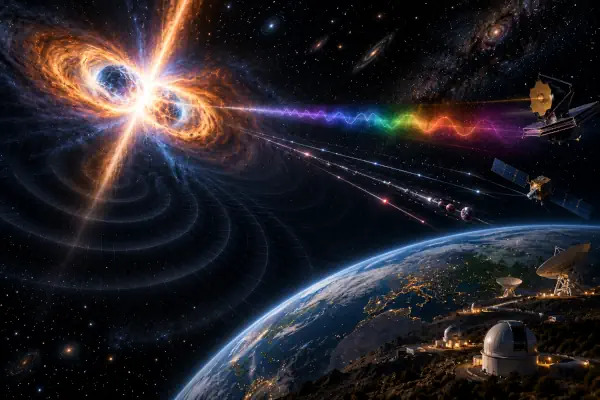
Astronomers do not receive visible light alone. NASA now groups several kinds of information carriers under the term multimessenger astronomy. The principle is to study the same phenomenon through several physical messengers.
Light includes radio waves, microwaves, infrared, visible light, ultraviolet, X-rays, and gamma rays. Particles can also cross space, including neutrinos and cosmic rays. Finally, some extremely violent events produce gravitational waves, tiny distortions ofspacetime that propagate outward from their source. The term spacetime comes from relativity: instead of describing three dimensions of space, where an event occurs, separately from time, when it occurs, relativistic physics brings them together in a single four-coordinate description. An event is therefore not merely “somewhere”; it is “somewhere, at a certain time.” Albert Einstein established special relativity in 1905, then extended this description to gravitation with general relativity in 1915.
A neutron-star collision can therefore leave several physical accounts of the same event. Light reveals some aspects, neutrinos may reveal others, and gravitational waves provide direct information about the motion of compact masses.
Why call it a “messenger”?
The word does not mean that nature deliberately writes a message. It means that a physical phenomenon carries properties linked to an earlier event to us. By measuring them, we try to reconstruct what happened at the source.
“The Universe does not send us its present. It lets us receive the consequences of what has happened to it.”
— Sidath SOEUN
The sky is not a window onto the Universe; it is a moving archive
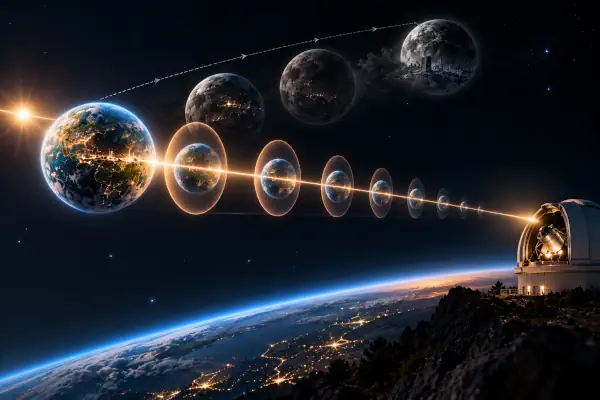
When we look at the Sun, we do not see it exactly as it is at the same instant as us. Its light takes about eight minutes to reach us. For a star one hundred light-years away, we receive light that left roughly one hundred years ago. A light-year is therefore not a duration: it is the distance light travels through a vacuum in one year.
As distance increases, our observation reaches farther back into the object’s luminous history. That does not mean we are traveling into its past. We remain here, in our own present situation, while old information is only now completing its journey to us.
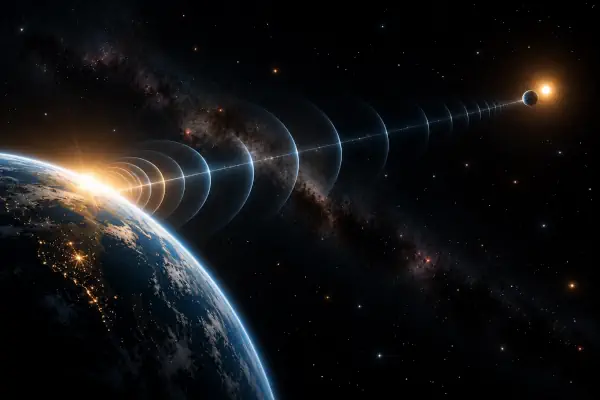
A civilization ten thousand light-years away could therefore receive today light that left Earth roughly ten thousand years ago. Even if it possessed an unrealistically powerful telescope capable of resolving Earth’s surface perfectly, it would see neither the Internet, nor our modern cities, nor our current satellites.
Conversely, if that civilization exists today in its own local environment, we cannot see it as it is “now” in the everyday sense. We receive its luminous history delayed by distance.
“Two civilizations can belong to the same cosmic history without ever sharing the same observable present.”
— Sidath SOEUN
The light cone: why do we call it a cone if light propagates as a sphere?
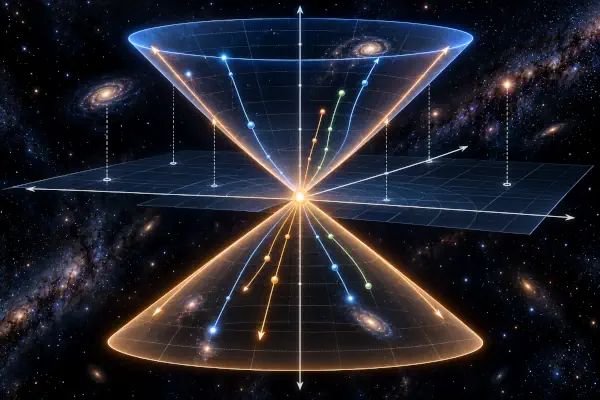
The term light cone can seem strange at first. If we switch on a small lamp in space, its light does not naturally spread out in the shape of a cone. In the ideal case of a point source emitting uniformly in every direction, light moves away from the source in all directions at once. At any given moment, the boundary reached by that light therefore forms a sphere around the source.
One second after the light is emitted, this sphere has a radius of about 300,000 kilometers. Two seconds later, its radius approaches 600,000 kilometers. After one year, its radius reaches one light-year. The size of this sphere therefore does depend on elapsed time: the longer we wait, the farther the boundary reached by the light lies from the event that produced it.
Why, then, do physicists speak of a cone rather than a sphere of light? Because they are no longer trying to represent only the shape of the light in space at one particular moment. They want to represent its entire evolution through space and time.
Consider a specific event: a lamp is switched on at a particular place and time. In physics, an event simply means something that happens at a precise location and moment. At the instant the lamp is switched on, the light front is still at the source. A little later, it forms a small sphere around it. Later still, a larger sphere. Then another, larger one, continuing to expand.
If we could represent all three dimensions of space together with time, we would have to imagine an entire succession of expanding spheres, each corresponding to a different moment. But four dimensions cannot be represented easily on a page. Spacetime diagrams used to explain relativity therefore simplify the problem: they generally keep only one dimension of space on the horizontal axis and place time on the vertical axis.
In this simplified representation, the sphere no longer appears as a sphere. If we keep only one spatial direction, light has two possible directions of travel: one way or the other from the event. As time passes, these two light fronts move farther away at the speed of light. When plotted on the diagram, they form two sloping lines that spread apart progressively. Together, these boundaries create the shape we call the light cone.
A sphere in space, a cone in spacetime
At a given moment: light emitted uniformly by an ideal point source has reached a spherical boundary around that source.
As time passes: the radius of that sphere continuously increases at the speed of light.
In a simplified spacetime diagram: this evolution is represented using one dimension of space and one dimension of time. The boundaries that light can reach then form the familiar light cone.
The cone is therefore not the shape of a luminous object physically expanding around the lamp. It is a geometric representation of the propagation of light and of causality through spacetime. The sphere answers the question, “How far has the light traveled by this moment?” The cone answers a broader question: “Which events can be connected by a signal that does not travel faster than light?”
Why does the sphere grow?
r = c × Δtr is the radius reached by the light front from the point where it was emitted. Δt, pronounced “delta t,” is the amount of time that has elapsed since the emission. c is the speed of light in a vacuum, exactly 299,792,458 meters per second.
The relationship simply means that the radius of the expanding sphere increases with time: distance reached by light = speed of light × elapsed time. After one year of propagation through a vacuum, this boundary lies one light-year from the source.
This geometry helps explain why light plays a much deeper role than simply allowing us to see. An event sufficiently far away from us can already have occurred without its information having had enough time to reach us. Conversely, events in our own past may already have produced consequences that are now traveling through regions of space far beyond us.
The future light cone of an event therefore contains all the events that could, in principle, be influenced by what happens there. Its past light cone contains the events from which a signal traveling no faster than light could have reached it. Between them lie regions that are too far apart in space and too close together in time for a light signal to have established a causal connection between them.
The light cone does not replace the sphere of light: it tells the sphere’s story through spacetime. And that representation reveals something essential for what follows. The speed of light does not merely determine how quickly an image or signal can reach us. It also draws the boundary between events that could already have affected one another and those that, for now, remain causally separated.
A formula connecting space, time, and causality
Special relativity goes further by combining spatial separation and temporal separation into a quantity called the spacetime interval. In one spatial direction, using a common sign convention, it can be written as:
Δs² = c²Δt² − Δx²Δs² is the squared spacetime interval between two events. c²Δt² converts the time separation into a quantity comparable to a squared distance. Δx² represents the squared spatial separation.
For light, the interval is zero:
Δs² = 0We then obtain c²Δt² = Δx², and, for positive values, Δx = cΔt. This is the boundary of the light cone.
This equality gives a physical boundary to the word “accessible.” Two events are not connected only by a distance or a duration: their separation in space and their separation in time jointly determine whether a light signal, particle, or causal influence can travel from one to the other. The light cone is therefore not a diagram added onto relativity; it represents the geometry of what can still affect what.
On a cosmic scale, our idea of now begins to break down
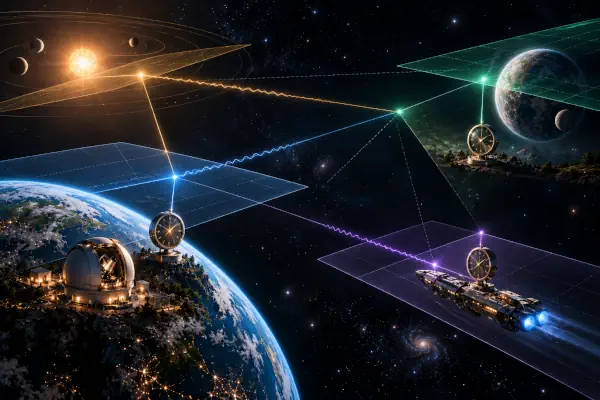
In everyday life, we can talk about “now” without difficulty. A conversation in a room seems to unfold within a shared present. The propagation delays of light are so tiny at our scale that they almost never affect our intuition.
On a cosmic scale, that approximation becomes inadequate. Relativity also shows that simultaneity, the claim that two distant events occur at the same time, depends on the reference frame used to describe them.
A reference frame is not a calendar. Our Gregorian calendar is used to name dates. A reference frame is a coherent way of assigning coordinates of place and time to events. Two observers in relative motion can use different reference frames and divide distant events differently into categories they call “simultaneous.”
Cosmology nevertheless uses a cosmic time that is extremely useful for describing the average evolution of a Universe assumed to be homogeneous and isotropic on very large scales. This allows us to speak of the age of the Universe within the cosmological model. But this practical time coordinate does not turn all distant events into an absolute “now” that every observer would measure in the same way.
“The Universe contains our clocks, our reference frames, and our light cones. It is not simply another clock placed above them.”
— Sidath SOEUN
Two spacecraft, the same home planet, but two histories
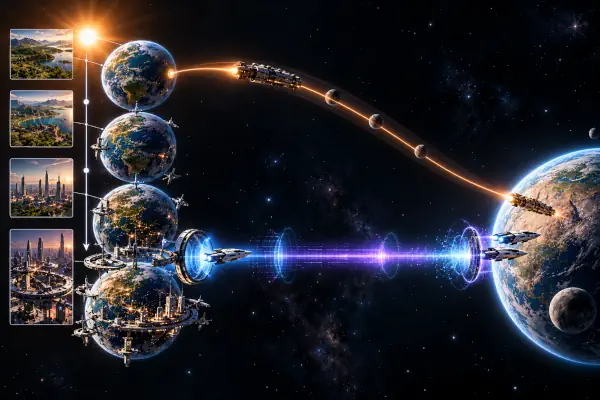
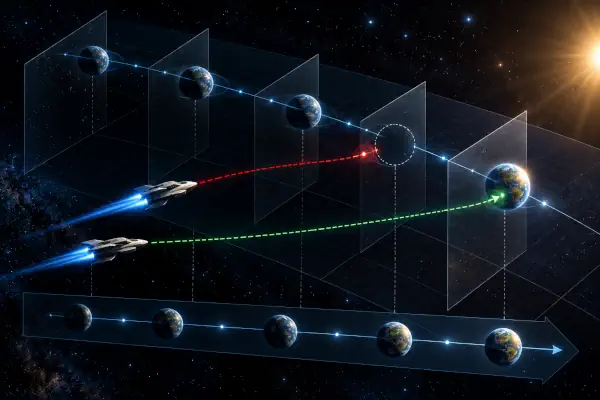
Two planets, P and T, are separated by an immense distance. Spacecraft 1 leaves P using conventional propulsion. During its journey, P does not wait for it: children are born, generations age, knowledge emerges, cities change. In the reference frame chosen to tell the experiment, one hundred twenty years might, for example, pass on P before spacecraft 1 reaches T.
At the exact moment spacecraft 1 reaches T, a second craft appears beside it. Spacecraft 2 comes from the same planet P, but left it one hundred twenty years later and supposedly crossed the distance instantaneously. This teleportation is not a known technology: controllable faster-than-light transmission would conflict with the causal structure of relativity. The experiment is therefore deliberately hypothetical. Its interest lies elsewhere: the two crews can share the same arrival location without carrying the same era of their home world with them.
Diagram of the thought experiment
P, year 0       V1 ───────────────▶ T, arrival
│                                   ▲
│ 120 years of P’s history          │ same local meeting
▼                                   │
P, year 120     V2 ═ teleportation ═╝
V1 knows P as it was when V1 departed. V2 carries the state of P one hundred twenty years later. On T, their worldlines meet at the same event, but the information they carry about P is separated by one hundred twenty years of history.
To V1’s crew, V2 looks almost like a capsule from their future: it can bring news of people who had not yet been born, discoveries not yet made, and memories of events that had not occurred when V1 departed. Yet this does not demonstrate the existence of an “absolute future.” Hermann Minkowski, the mathematician who in 1908 gave special-relativistic spacetime its modern geometric form, showed that an object can be represented by a trajectory through space and time. That trajectory is now called a worldline.
The worldline: an object’s physical history
A worldline connects all the successive events experienced by an object: its departure, every intermediate position, and its arrival. Saying that a spacecraft “carries its present with it” is a suggestive image, but relativity says something more precise: the spacecraft accumulates its own history along its trajectory through spacetime. Different trajectories can therefore bring together, at the same place, travelers who have accumulated different durations and experiences.
Instantaneous teleportation then adds a formidable difficulty. In special relativity, the simultaneity of two distant events depends on the reference frame. Saying that V2 leaves P and appears on T “at the same instant” therefore already requires us to specify which clocks and coordinate system define that phrase. Eliminating a distance without any delay would not merely create a spatial shortcut: it would affect the boundary separating events that can causally influence one another.
“Can we abolish a distance without overturning our definition of time?”
— Sidath SOEUN
An object does not age because it travels more miles: it accumulates its proper time
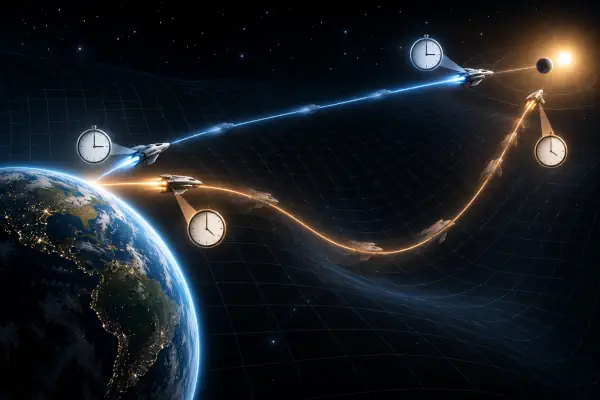
Another intuition needs correcting. Traveling a great distance does not automatically mean aging more. Relativity uses the concept of proper time, the duration measured by a clock traveling directly with the object being considered.
For uniform motion in flat spacetime
Δτ = Δt × √(1 − v²/c²)Δτ, pronounced “delta tau,” is the proper time experienced by the traveler. Δt is the duration measured in the reference frame chosen to compare the journey. v is the traveler’s speed and c the speed of light.
When v becomes very large relative to c, the factor under the square root decreases. The traveler can then accumulate less proper time than observers following another trajectory. This simple formula does not cover every gravitational or accelerated situation, but it shows why “distance traveled” and “aging” are not synonymous.
A spacecraft therefore does not move through layers of age. Its temporal history depends on its trajectory through spacetime.
GPS: when our technology already has to correct time
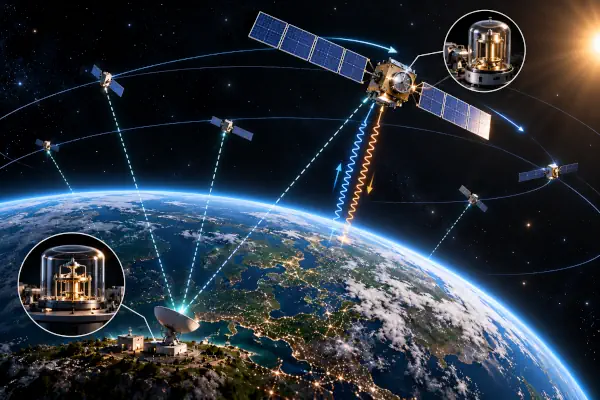
The blue dot on a phone seems to belong to the ordinary world of maps. Yet behind it lies a direct consequence of Einstein’s theories. The GPS, or Global Positioning System, is a U.S. satellite-navigation system developed beginning in the 1970s by the United States Department of Defense. Its satellites carry atomic clocks, clocks whose frequency is regulated by an extremely stable atomic transition. They make it possible to compare durations with a precision ordinary mechanisms cannot achieve.
To calculate a position, a receiver compares the transmission time of several signals with their arrival time. Because radio waves propagate at the speed of light in a vacuum, even a tiny delay corresponds to a measurable distance. But clocks in orbit and clocks on the ground do not age at exactly the same rate. The National Institute of Standards and Technology, NIST, the U.S. reference institute for metrology, the science of measurement, notes that two relativistic effects work in opposite directions.
Two effects, one satellite
Orbital velocity          →  − 7 µs / day
Weaker gravity            →  +45 µs / day
                           ─────────────
Net effect                →  +38 µs / day
µs means microsecond, or one millionth of a second. Special relativity predicts that the satellite’s motion slows its clock by about 7 microseconds per day relative to the ground. General relativity predicts the opposite effect: higher in Earth’s gravitational field, the clock gains about 45 additional microseconds per day. The net result is therefore about +38 microseconds per day.
Thirty-eight millionths of a second sounds insignificant. Yet light travels nearly 300 meters in one microsecond. If that offset were allowed to accumulate without correction, the system would quickly lose the precision required for navigation. GPS has therefore become, without ever having been designed as a philosophical experiment, an everyday demonstration of something profoundly counterintuitive: to know exactly where we are, our technology already has to know that all clocks do not naturally measure time at the same rate.
“Synchronizing clocks is not discovering the clock of the Universe. It is building a common rule precise enough to let multiple trajectories work together.”
— Sidath SOEUN
On a galactic scale, a map also has to know when
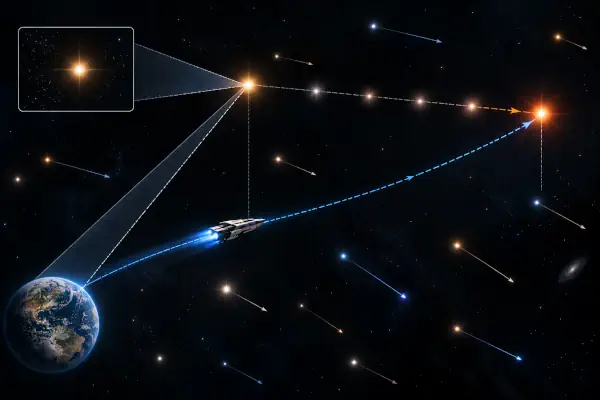
An encyclopedia that listed stellar positions as eternal addresses would necessarily be incomplete. Stars move. The Sun orbits the center of the Milky Way. Galaxies have relative motions. Cosmic space is not a motionless stage on which objects keep the same coordinates forever.
Interstellar navigation would therefore require dynamic models. Instead of simply writing “the star is at this position,” we can express the idea as:
position = f(t)The letterf means “a function,” that is, a rule for calculation. t represents time in the chosen coordinate system. The formula therefore simply means: the position we assign to the object depends on the moment at which we want to know it.
And another difficulty appears: when we observe a star one thousand light-years away, we receive a luminous position that is about one thousand years old. A navigator cannot simply aim at the image they see. They must estimate the star’s motion and calculate where it should be when the spacecraft arrives.
A complete cosmic address then looks less like a place than an event. In a simple model, we can write it as:
E = (t, x, y, z)E denotes an event. t indicates when. x, y, and z are three coordinates used to describe where in space. Two spacecraft knowing only x, y, and z could reach the same location a thousand years apart and never meet.
“In a dynamic Universe, a complete destination may not be a place. It is an event.”
— Sidath SOEUN
Voyager: did we really leave our address ?
In 1977, the Voyager 1 and Voyager 2 probes left Earth carrying an object that became iconic: the Golden Record, a record containing images, natural sounds, music, and human greetings. Its cover also includes instructions intended, in principle, for any nonhuman discoverer.
It is sometimes said that Voyager carries “Earth’s address.” The reality is subtler and more ingenious. The map engraved on the record shows the position of the Solar System relative to fourteen pulsars. A pulsar is the extremely dense remnant of a massive star, a rotating neutron star whose radiation can produce highly regular pulses observed from space.
The lines on the map give the directions of these pulsars, and their periods are encoded. A fundamental transition of the hydrogen atom provides a shared time reference. Hydrogen is particularly useful because it is the most abundant element in the observable Universe and its physical properties do not depend on an Earth calendar.
NASA also notes that a small source of uranium-238 deposited on the cover acts as a radioactive clock. Because uranium decays at a statistically known rate, a recipient able to measure what remains could estimate the time elapsed since it was placed there and check the approximate era of launch.
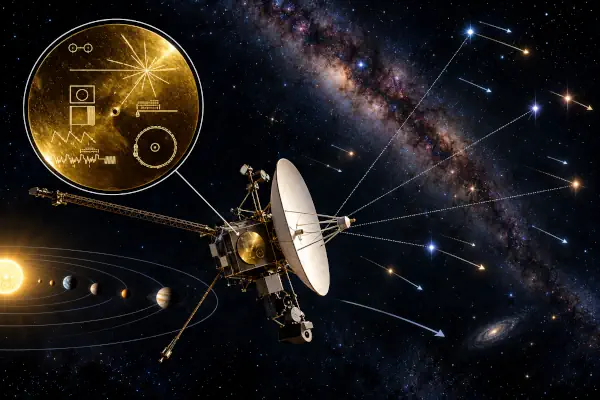
That is why the absence of a “recalculated cosmic GPS” does not necessarily make the map useless. A sufficiently advanced civilization would probably not search for fourteen pulsars exactly where the drawing places them as if reading a road map. It could compare their current periods, directions, evolution, and the radioactive aging of the record to try to determine where and when that configuration corresponded to the Sun’s neighborhood.
But the more time passes, the harder the reconstruction becomes. Pulsars evolve, stars move, and uncertainties accumulate. Voyager therefore illustrates our problem perfectly: a durable cosmic address cannot describe space alone. It must contain a way to reconstruct time.
Physical trace, information, and meaning: three things we must not confuse
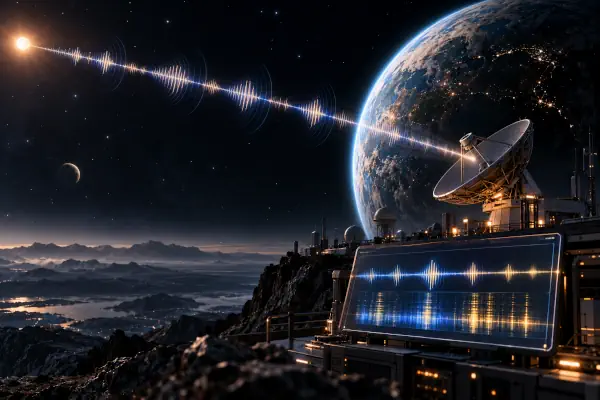
Imagine a human radio transmission carrying a conversation. To us, variations in the signal can represent sounds, words, and ideas. A thousand years later, an alien civilization intercepts a tiny fraction of that wave.
The first level is the physical trace. A measurable electromagnetic field has certain variations.
The second level isstructured information. Those variations may not be random. They may contain regularities, repetitions, modulation, or organization that could have been produced intentionally.
The third level is meaning. To understand a sentence in French, one must recognize the signal encoding, reconstruct the sounds or symbols, identify the language, and know enough of its cultural context.
A message can survive without its translation
The signal can genuinely be present while its meaning remains inaccessible. A civilization may detect an artificial structure without knowing that it corresponds to a joke, a declaration of love, or a weather report.
“The Universe can carry information without carrying the dictionary needed to understand it.”
— Sidath SOEUN
Can an event truly disappear from the Universe ?

A sentence spoken in a room seems to die when silence returns, but it really did move air molecules. A footprint disappears from soft ground, but the energy of the motion was transferred, dissipated as heat, and transmitted into matter. A civilization can disappear after already changing the composition of its atmosphere, moving billions of tons of material, sending machines beyond its planet, and allowing radiation to escape. The visible disappearance of a cause does not automatically erase the chain of transformations it set in motion.
But we must avoid too strong a conclusion: the original photon is not guaranteed to travel forever. It can be absorbed. A signal can be scattered. Its energy can be transformed. Successive interactions can redistribute what we initially called the trace.
The question then becomes more interesting. If the original form disappears, has the information been destroyed, or merely mixed into so many other degrees of freedom that reconstructing it becomes practically impossible?
This is where the metaphor of memory has to change. The Universe may not resemble a library in which every event is preserved intact on a shelf. Its present state is better understood as the result of countless transformations of its earlier states.
“Perhaps the Universe does not remember the past by preserving it somewhere. Perhaps its present state is itself what the past has become.”
— Sidath SOEUN
When light arrives, its journey is already written into it
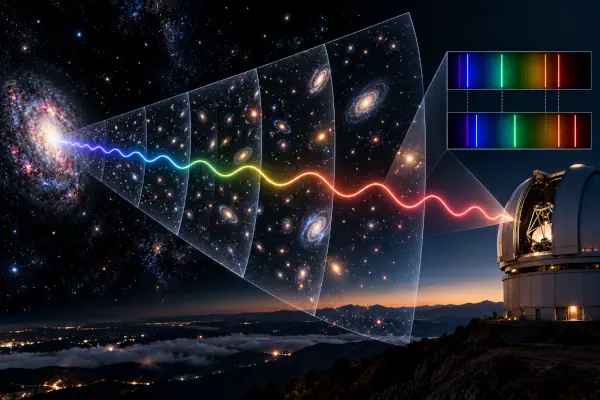
Light arriving from a distant galaxy is not merely a delayed image. It also carries physical marks of its journey. When its spectral lines, the distinctive signatures of atoms that emitted or absorbed the light, are observed at longer wavelengths than expected, astronomers measure a cosmological redshift, or simply cosmological redshift.
Wavelength is the distance between two successive repeating features of a wave, such as two crests. In the standard cosmological model, the expansion of space between sufficiently distant galaxies also stretches the wavelengths of light during its journey.
1 + z = λobserved / λemittedz measures the redshift. The Greek letter λ, pronounced “lambda,” represents wavelength. If the observed wavelength is greater than the emitted wavelength, z is positive.
In an expanding cosmological model, this shift can also be related to the scale factor a(t), a mathematical quantity describing how cosmological distances between points following the expansion evolve over time:
1 + z = a(tobserved) / a(temitted)These relationships are fascinating because the light we receive contains information about the cosmological history it crossed. But no observation shows that it counts invisible “time cells.” The temporal-grid hypothesis must therefore remain an abandoned intuition, replaced by a better-established idea: the geometry of the Universe affects the signal that reaches us.
When information may still exist but becomes inaccessible

Thermodynamics introduces an essential concept:entropy. In this context, it can describe how many different microscopic configurations may correspond to the same macroscopic state we observe.
A simple example is perfume released into a room. At first, the molecules are concentrated near the bottle. Later, they are dispersed through a much larger volume. The microscopic laws do not need to suddenly erase the perfume’s history for exact reconstruction of every molecular trajectory to become practically impossible.
This is a fundamental distinction for our question. Losing practical access to information is not necessarily the same as demonstrating its fundamental destruction.
Quantum mechanics makes the question even deeper. In its standard formulation, the evolution of an isolated quantum system is described as unitary. Without entering into the formalism, this means that evolution preserves the structure of quantum information in a fundamentally reversible way.
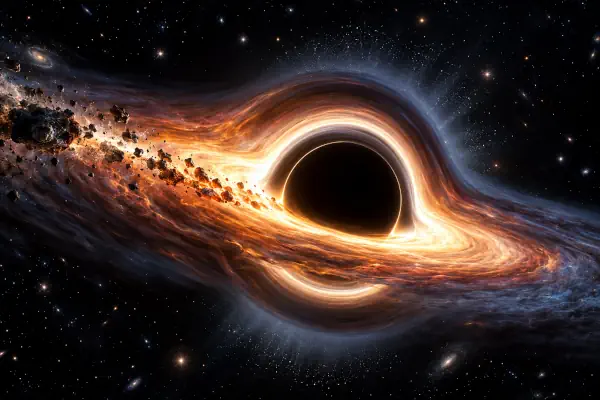
Black holes made this issue famous through the black hole information problem. Stephen Hawking showed that black holes can emit thermal radiation. If a black hole evaporated completely and left only perfectly thermal radiation containing no information about what fell into it, that would appear to conflict with the unitary evolution of quantum mechanics. Decades of research have profoundly reshaped this problem, but it remains an area of theoretical physics in which the fundamental details of quantum gravity are not all established.
We should therefore not use black holes to claim that “the Universe necessarily remembers everything.” Instead, they show just how seriously the conservation of information is taken even in our most fundamental theories.
What will remain of us when our civilization has disappeared ?
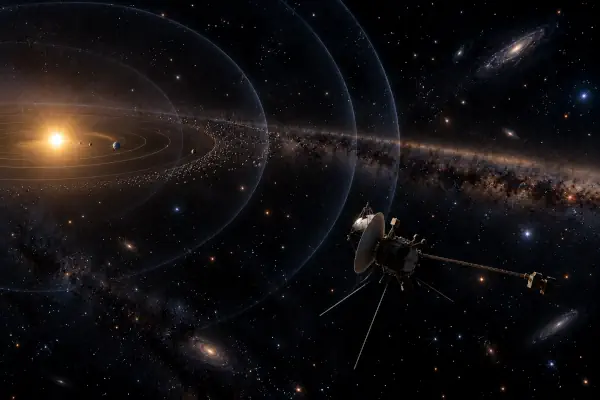
Artificial objects can survive for a long time in space. Probes can continue along their trajectories long after their creators are gone. Chemical or geological changes can persist. Electromagnetic emissions already on their way will continue their history until they are absorbed, scattered, or diluted into an environment where they become undetectable.
But “something remains” does not mean “someone will be able to tell our story.” A metal fragment does not contain the French language by itself. A modified molecule does not explain why a war began. A radio wave does not automatically provide the cultural context needed to understand what it encodes.
Now imagine two fictional Universes. In the first, humanity existed. In the second, it never appeared. Billions of years pass. Cities vanish, Earth itself may cease to exist, and the traces become extraordinarily dispersed.
Could they eventually end up in two physically absolutely indistinguishable states? The question goes beyond what we can demonstrate here, but it reveals the real issue. If some difference must necessarily remain somewhere in the physical state, our existence would have left a distinction even if it had become unreadable. If no distinction remained, there would be a stronger sense in which a history could truly lose every accessible physical signature.
“We may disappear one day. But our disappearance and the disappearance of every consequence of our existence are two very different events.”
— Sidath SOEUN
So, does the Universe really remember everything ?
We can now answer more precisely than we could at the beginning.
A physical event does not occur in absolute isolation. It changes fields, matter, radiation, or other systems with which it interacts. Some consequences can travel extremely far. Others are absorbed almost immediately. Some remain detectable. Others become buried in a complexity we no longer know how to reverse.
Physics therefore does not allow us to naively imagine a cosmic archive in which every second of history remains recorded like an intact video. But neither does it allow us to confuse “I can no longer reconstruct this event” with “this event left no consequences.”
The word memory has limits here. Human memory selects, encodes, and sometimes allows recall. The Universe does not need to be a mind for its current state to depend on its history.
what is the difference between a vanished past and a past whose consequences are still present, but which no observer will ever be able to recognize again?
“Somewhere in the immensity of the cosmos, part of our present may already have become someone else’s past. And somewhere in our present, we may be receiving the final traces of worlds that no longer exist.”
— Sidath SOEUN
The sky may not be the memory of the Universe in the human sense. But every ancient photon, every gravitational wave, every particle, and every traveling object reminds us of one thing: what no longer exists can still participate in what exists.
Sources and scientific references
NASA, multimessenger astronomy
NASA presents light, particles, and gravitational waves as different messengers that can be used to study the Universe and combine several kinds of information about the same phenomenon.
NASA, Voyager Golden Record
The Golden Record cover notably describes the map of fourteen pulsars, their periods, the hydrogen transition used as a reference, and a uranium-238 source that can be used to estimate the time elapsed since launch.
NIST, relativity and GPS
The National Institute of Standards and Technology explains why orbital speed and differences in gravity make GPS clocks run differently from clocks on Earth, and why these relativistic effects must be corrected.
NIST, Putting Einstein to the Test With the World’s Most Accurate Clocks
NASA, cosmological redshift
NASA explains that cosmic expansion stretches the wavelength of light traveling through space, allowing redshift to be related to the history of expansion.
Physics review, black hole information
A review published in Reviews of Modern Physics presents modern progress on the entropy of Hawking radiation and efforts to reconcile it with unitary black hole evaporation.
Frequently asked questions
Does the Universe really preserve everything that happens in it?
We know that an event can change the physical state of its environment and leave traces. We cannot say that every detail remains eternally available in a reconstructible form. A trace can be transformed, dispersed, or become practically inaccessible.
Does seeing a distant planet mean seeing its past?
Yes. Because light has a finite speed, we receive a distant object as it was when the light we observe left it. Looking farther away therefore means receiving older information.
What is a light cone?
It is a representation of the causal structure around an event. The past light cone contains what could have influenced it. The future light cone contains what it could influence without any signal exceeding the speed of light.
Is there a universal now?
Relativity does not provide a simple absolute present shared by all observers. Cosmology can define a useful cosmic time to describe the average evolution of the Universe without making simultaneity absolute for every reference frame.
Can the Voyager Golden Record be used to find Earth?
It provides reference points from which the origin of the Solar System can be reconstructed: fourteen pulsars and their periods, a hydrogen-based reference, and a radioactive marker. It is not a fixed GPS address. A recipient would have to interpret this information and account for the time elapsed.
Is incomprehensible information still information?
A signal can retain physical structure even if its meaning is inaccessible to the recipient. That is why this article distinguishes between physical trace, structured information, and interpreted meaning.
Does wavelength reveal an invisible temporal grid?
No evidence establishes that. Cosmological redshift is explained by the expansion of space in the standard cosmological model. The idea of a temporal grid is therefore an intuitive thought experiment that we set aside in favor of a better-established physical description.
Share this exploration
If this exploration has given you another way to think about light, the present, or what might survive a civilization, you can share it and continue the conversation.