My short answer: yes, Europa is one of the best candidates for hiding a habitable ocean
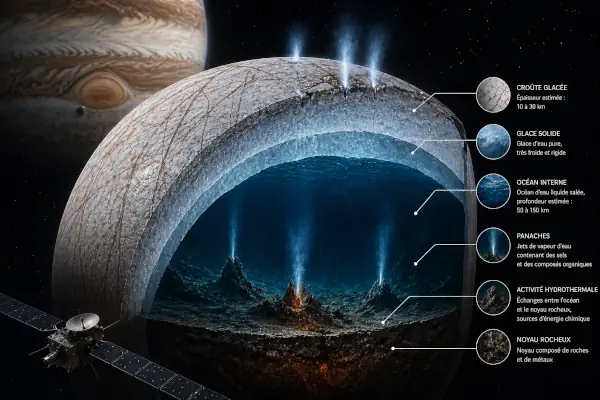
Based on current knowledge, it is scientifically credible to consider that Europa holds a vast reservoir of liquid water beneath its icy crust. This hypothesis is not built on a seductive science-fiction image alone, but on a convergence of geophysical clues, interior models and surface evidence pointing toward a deep ocean.
That said, the essential nuance must remain clear from the start: talking about an ocean beneath the ice does not mean life necessarily exists there. Europa may combine several ingredients favorable to habitability without automatically giving rise to a biosphere. The strength of the topic lies precisely in that tension between enormous potential and scientific caution.
In brief
- Europa is an icy moon of Jupiter strongly suspected of harboring a liquid internal ocean
- its fractured surface and glacial dynamics suggest exchanges between the deep interior and the exterior
- that ocean may combine water, salts, active chemistry and internal energy sources
- this makes Europa a prime target for studying habitability, not direct proof of life
Europa fascinates because it overturns our intuition: a frozen, dark and distant world may still be one of the best places in the Solar System to ask whether life can exist elsewhere.
Why Europa became a central target in astrobiology
For a long time, the search for habitable worlds focused on planets broadly similar to Earth or on regions where liquid water might exist at the surface. Europa changed that perspective. It reminds us that habitability does not necessarily depend on a mild climate visible from the outside, but can also rely on internal heat, subsurface chemistry and an ocean protected beneath a thick shell of ice.
That idea changes the rules of the game. It expands the map of what may be possible in the Solar System: life would not necessarily need a blue sky, an accessible rocky surface or an open sea. In theory, it could emerge or persist in an enclosed, dark world shaped by gravitational tides and powered by internal energy.
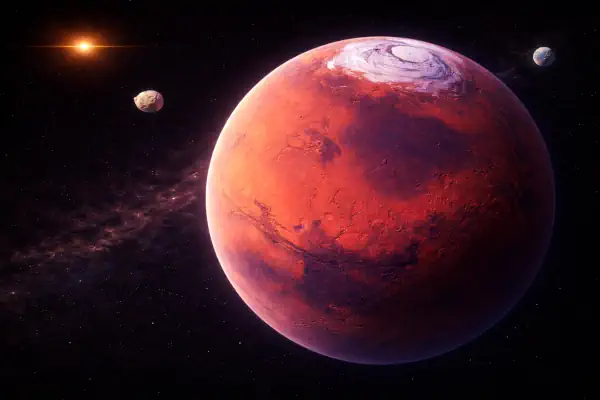
Europa matters to scientists because it offers a radically different laboratory from Mars. Where the red planet tells the story of past surface habitability exposed to the open environment, Europa embodies the idea of hidden, protected and perhaps still active habitability today.
The evidence for a subsurface ocean beneath Europa’s icy crust
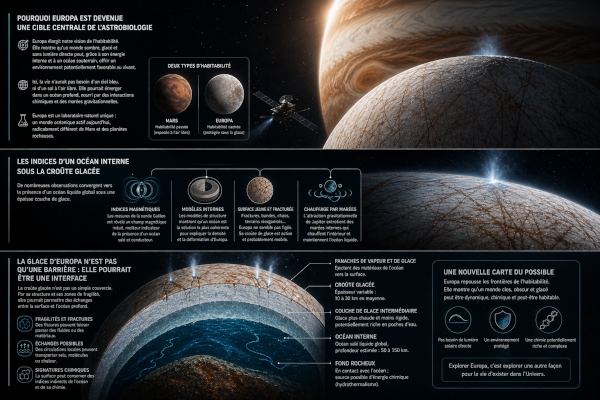
The idea of an ocean under Europa’s ice does not come out of nowhere. It rests on several families of clues: the moon’s magnetic behavior within Jupiter’s environment, interior structure models, the nature of its surface and the broader idea that the outer ice does not behave like a simple rigid shell all the way through.
Europa’s surface is especially revealing. It does not look like a motionless world, but like a crust marked by fractures, bands, breaks, displacements and regions that seem to have been reshaped. That appearance suggests mobile ice, under stress and perhaps regularly reorganized, interacting with processes unfolding below.
If that reading is correct, then Europa does not merely have ice: it has a system. And within that system, the idea of a global or near-global ocean becomes the most coherent explanation for how such a relatively small world can display this degree of geological complexity.
Europa’s ice is not just a barrier: it could be an interface
This is one of the most important points in the entire case. Ice is often imagined as a simple lid—uniform, sealed and insulating. On Europa, however, it may play a far more subtle role. Depending on its thickness, structure and zones of weakness, it may allow partial exchanges between the surface, intermediate layers and the deep ocean.
That possibility is enormously important to astrobiology. A completely isolated ocean world would be harder to probe and perhaps more chemically cut off. By contrast, a crust that fractures, reforms, allows certain materials to rise or supports localized circulation opens the prospect of a far more dynamic moon than a simple frozen block.
It also means Europa’s surface may preserve indirect clues about what is happening below. If salty materials, chemical compounds or distinctive signatures reach the surface from the ocean or from internal water pockets, then the surface itself becomes a privileged field of investigation.
Plumes, fractures and rising material: why these clues matter so much
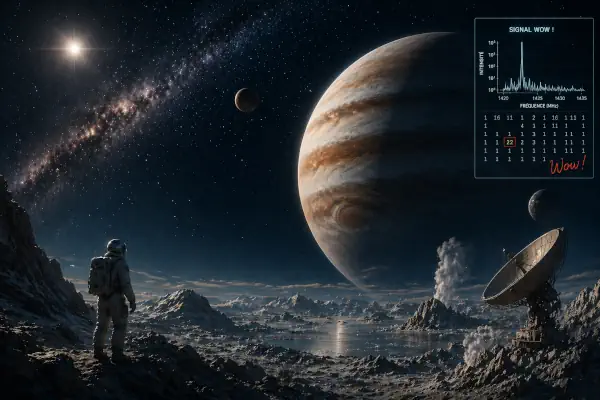
One of the most compelling ideas associated with Europa concerns the possible existence of plumes—jets of material or vapor expelled from active regions. Even if such phenomena remain difficult to confirm with absolute certainty in every reported case, they remain an exceptionally stimulating scientific hypothesis.
Why? Because a plume would offer an extraordinary opportunity: access to material from the interior without drilling through the entire ice shell. A space mission could then analyze, at least in part, the composition of what escapes from Europa and look for salts, interesting molecules or chemical signatures consistent with a habitable environment.
Even beyond plumes, Europa’s fractures and chaotic terrains suggest the surface is not a passive layer. They reinforce the idea of a world whose ice records internal processes and where exchanges, even limited ones, may play a decisive role in understanding the hidden ocean.
Why these clues matter
- they suggest Europa is not a static world
- they may reveal exchanges between the deep interior and the surface
- they offer ways to analyze the internal ocean indirectly
- they strengthen Europa’s importance as a habitability target rather than a simple icy object
An ocean alone is not enough: what scientists are really looking for is habitability
The idea of liquid water is immediately appealing, but it does not solve everything. For an environment to be truly interesting from the perspective of life, more is needed than a simple volume of water. There must also be workable chemistry, available elements, some degree of stability and, above all, energy sources capable of sustaining complex processes over time.
This is where Europa becomes genuinely fascinating. Researchers ask about the composition of its ocean, the presence of salts, possible exchanges with a rocky interior, the effects of Jupiter’s gravitational tides and the ability of this system to maintain long-term chemical activity.
In other words, the right question is not only, “Is there water?” but “Does this ocean possess an energetic and chemical architecture rich enough to do more than simply remain liquid?” That nuance separates a spectacular setting from a world that is truly promising for astrobiology.
Europa Clipper: understanding the moon, not rushing to announce extraterrestrial life
The role of modern space missions is often misunderstood by the general public. When a spacecraft is sent toward a world as compelling as Europa, many people imagine a direct search for organisms or an imminent proof of life. The reality is more demanding—and more interesting—than that.
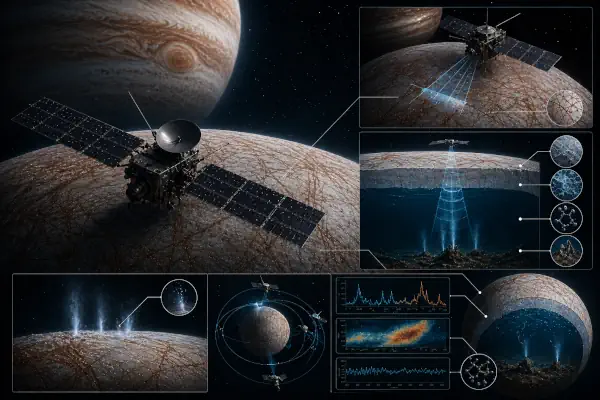
The top priority is not to proclaim a biological discovery, but to characterize the Europa system in far greater detail: the structure of the ice, the composition of the surface, the nature of internal exchanges, salt signatures, geological activity, fracture dynamics and the overall quality of its habitability potential. That step is indispensable.
A serious mission builds a solid foundation for what comes next. It allows us to move from a world that is simply “very promising” to one whose habitability can be described, debated, ranked and compared. That is exactly the kind of work that could make Europa one of the major turning points in contemporary planetary exploration.
The challenge of biosignatures on an icy world
Even if Europa possesses a habitable ocean, demonstrating that it hosts or once hosted life would remain extraordinarily difficult. The problem is not only technical; it is also methodological. On such a distant world, beneath potentially thick ice, scientists must distinguish signs of life from effects produced by abiotic chemistry and complex geophysical processes.
A real biosignature cannot be a single isolated anomaly. It would have to fit into a coherent whole: a well-understood geological context, a credible composition, a low probability of a purely non-biological explanation and repeated lines of evidence. The more indirect our access to the environment, the higher the standard of proof must be.
Europa therefore teaches an essential lesson: the most exciting worlds are not always the ones that provide quick and simple answers. Sometimes they are the ones that force science to sharpen its rigor, patience and instruments before even approaching a robust conclusion.
Comparing the major hypotheses about Europa and its hidden ocean
Comparison of plausible scenarios
- Europa has a liquid ocean but limited activity: a possible scenario if chemical exchanges remain restricted
- Europa is habitable but sterile: a robust hypothesis if the ingredients for life are not sufficient on their own
- Europa sustains long-term favorable conditions: a closely studied scenario that would make it a top astrobiology target
- Promising clues exist but remain indirect: probably the scenario closest to our current scientific situation
Why Europa could reshape our view of life in the Universe
Europa matters not only for itself. It forces us to rethink the diversity of worlds where life might theoretically become possible. If an ocean buried beneath the ice of a Jovian moon can sustain durable and complex chemistry, then the boundaries of habitability become much broader than the surface-based model suggested by Earth alone.
The implications are immense. Icy moons, ocean worlds, certain distant objects and even some exoplanets covered in water or ice stop being mere curiosities. They become legitimate places to think about the emergence of life at different distances from a star and within very different planetary architectures.
Europa therefore acts as an intellectual revealer. It reminds us that the question “Where should we look for life?” depends less on our visual intuitions than on a world’s ability to sustain water, energy, chemistry and stability over time.
So, does Europa really hide an ocean beneath the ice?
The strongest answer in 2026 is that everything points to Europa fully deserving its reputation as a likely ocean world. Its icy crust, fractures, suspected activity and the consistency of interior models all converge toward the idea of an immense liquid reservoir hidden beneath the surface.
But as strong as that conclusion may be, it does not settle everything. Scientists still need to understand the exact structure of the ice, the depth of internal exchanges, the chemical nature of the ocean and this world’s real ability to support more than a simple liquid environment. That is the difference between a fascinating world and a biologically confirmed one.
That is precisely what makes Europa so powerful in the contemporary scientific imagination. It is not merely a distant moon of Jupiter. It is one of modern astrobiology’s greatest promises, standing at the boundary between methodological caution and a profound possibility: that a hidden ocean, far from the Sun, may have become a refuge for another story of life.
FAQ
Has an ocean beneath Europa’s ice already been confirmed?
Current evidence strongly supports the existence of a vast liquid ocean beneath Europa’s icy crust. However, its precise structure and the exact thickness of the ice shell are still active areas of study.
Why is Europa considered a potentially habitable world?
Because it may bring together several essential elements: liquid water, salts, internal activity, exchanges between the ice and the deep interior, and chemistry capable of sustaining complex processes.
Do the plumes observed on Europa prove that the ocean communicates with the outside?
Not definitively in every case. But the idea of plumes or material ejections remains extremely important because it could reveal exchanges between Europa’s interior and its surface.
Will Europa Clipper discover life?
Its main role is not to directly detect life, but to determine whether Europa hosts environments genuinely favorable to living systems and to better understand its ice-ocean system.
Why is Europa different from Mars in the search for life?
Mars mostly points to past surface habitability, while Europa represents the idea of hidden habitability—protected beneath the ice and potentially still active today.