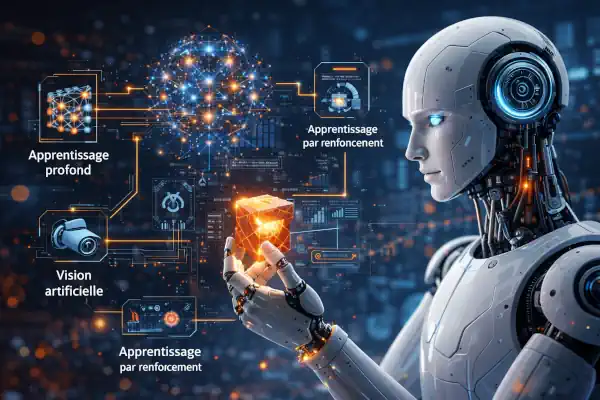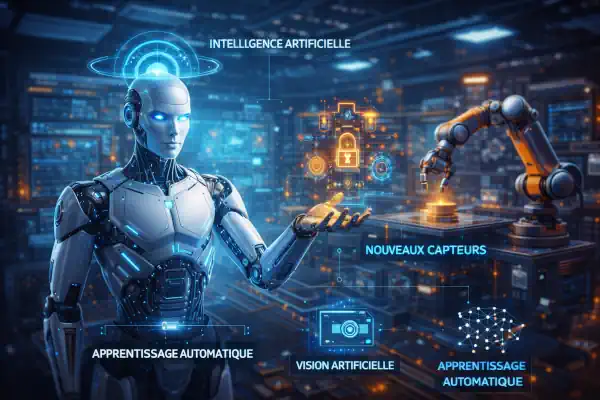
A convergence between robotics and artificial intelligence
Contemporary robotics stands at the intersection of several disciplines: mechanics, computer science, neuroscience, embedded electronics and autonomous systems engineering.
In many laboratories, researchers are now working to give machines cognitive abilities inspired, in part, by the way the human brain functions.
Several major institutions are playing a central role in this momentum:
- Massachusetts Institute of Technology
- Carnegie Mellon University
- NASA
- Google DeepMind
Their ambition is clear: to design robots capable of understanding their environment, anticipating certain situations and interacting with the physical world more autonomously.
The technologies that make autonomous machines possible are no longer limited to science fiction: they already exist, both in research labs and in highly practical real-world uses.
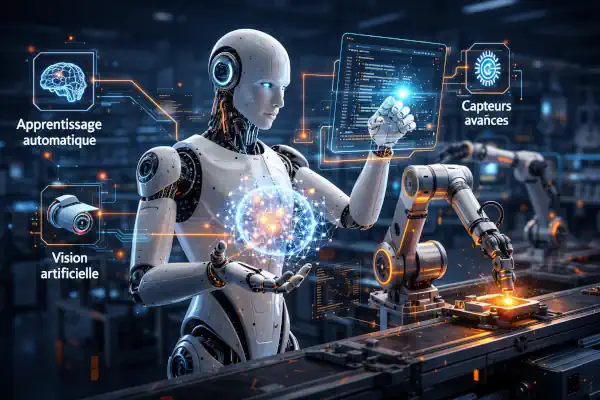
Intelligent robots are already present across many sectors:
Concrete robotics applications today
- Collaborative industrial robots (cobots)
- Surgical robots
- Warehouse logistics robots
- Autonomous drones
- Space exploration robots
The humanoid robot Atlas, developed by Boston Dynamics, illustrates the remarkable advances made in locomotion, balance and adaptation to real-world environments.
In space, the Martian rover Perseverance already relies on advanced systems to analyze terrain, optimize certain navigation choices and support exploration missions.
Robotics powered by artificial intelligence no longer belongs only to the imagination of science fiction. The technological building blocks needed for the rise of more autonomous machines are already in place.
These breakthroughs, however, depend on major scientific advances, especially in machine learning, artificial perception and embedded decision-making.