The revolution of deep learning
The contemporary transformation of robotics is first and foremost a software revolution. For a long time, robots mainly relied on explicit rules, rigid programs and predictable action sequences. Today, artificial intelligence allows machines to extract patterns from data instead of following only instructions defined in advance.
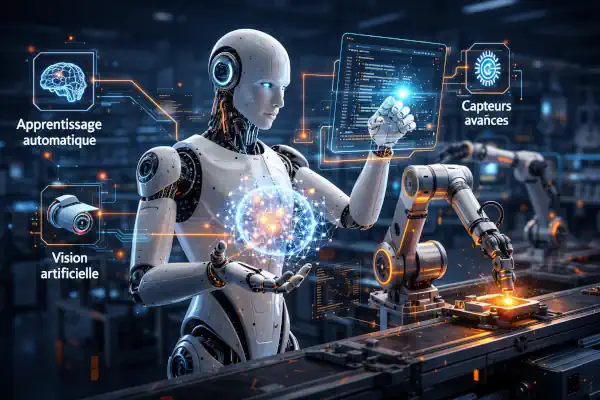
One of the major turning points has been the rise of deep learning. Thanks to deep neural networks, machines can analyze vast amounts of images, signals and situations in order to identify objects, recognize patterns and detect complex configurations in their environment.
For a robot, this capability is decisive. It allows it not only to “see,” but above all to interpret what it perceives: distinguish an obstacle from a clear path, recognize a tool, estimate a position, or adapt its action to a changing context.
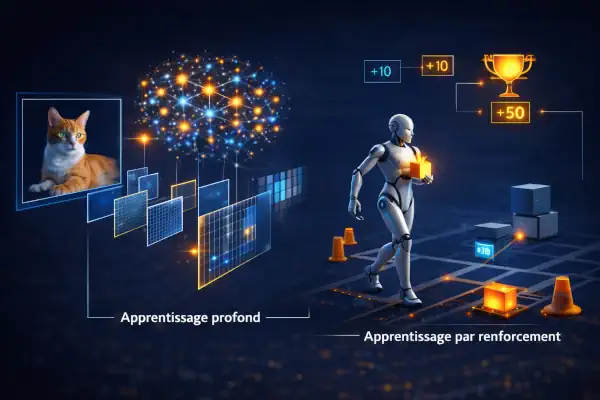
What makes robots more intelligent today is not a single innovation, but the meeting point between perception, learning, embedded computing and action in the real world.
Reinforcement learning
Another decisive advance lies in reinforcement learning. In this approach, an artificial intelligence improves through repeated trials, receiving rewards when it adopts an effective strategy. It therefore learns not only to recognize, but to act.
This method is especially powerful for robotics because it allows machines to experiment, virtually or physically, with new behaviors. Walking, grasping an object, stabilizing a movement, avoiding an obstacle or optimizing a route become skills acquired through interaction with the environment.
This kind of learning notably allows robots to
- learn to walk
- manipulate objects
- navigate through unfamiliar environments
The major advantage is that the robot no longer follows only an imposed procedure: it develops action strategies, sometimes unexpected ones, adapted to goals and constraints.
New intelligent sensors
Advances in robotics do not rely only on algorithms. They also depend on a rapid evolution in physical perception. A robot does not need only to compute; it must first capture, measure and locate what surrounds it.
Among the key perception technologies
- 3D cameras
- lidar
- tactile sensors
- force sensors
These tools allow robots to build an increasingly refined representation of the real world. Where an older machine executed a task in a perfectly controlled framework, a modern robot can begin to detect the texture of an object, estimate distance, anticipate a collision or adjust its grip force.
It is this rise of robotic perception that is gradually bringing machines closer to a form of functional autonomy. They do not “understand” the world like humans do, but they extract enough information from it to act in more flexible, safer and more effective ways.
Toward more autonomous and adaptive robots
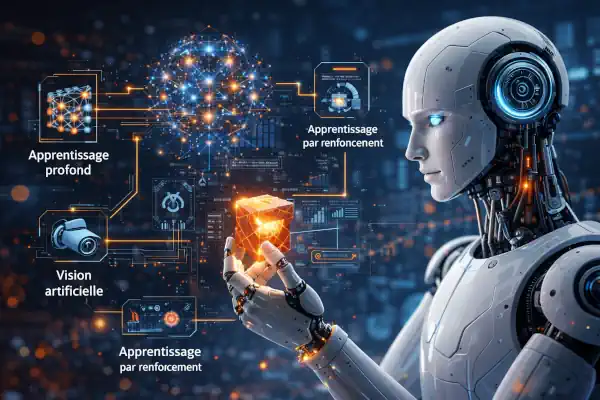
When deep learning, reinforcement learning and advanced sensors are combined, robots stop being simple executors. They become systems capable of linking perception, decision-making and action in less predictable environments.
This evolution marks a change of direction for robotics: moving from a logic of strict automation to a logic of adaptation. The real technological leap is not only to make a machine move, but to enable it to respond appropriately to new situations.
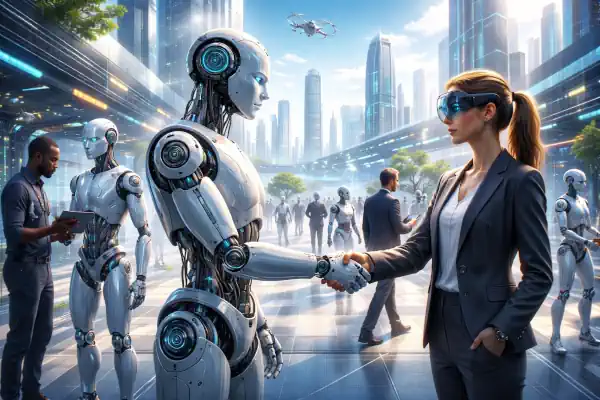
That is why the technologies transforming robots today are not only impressive; they are structuring. They define the scientific foundation on which, in the coming decades, machines far more present in work, services, care and exploration could emerge.