Why Jupiter dominates the solar system far beyond its size
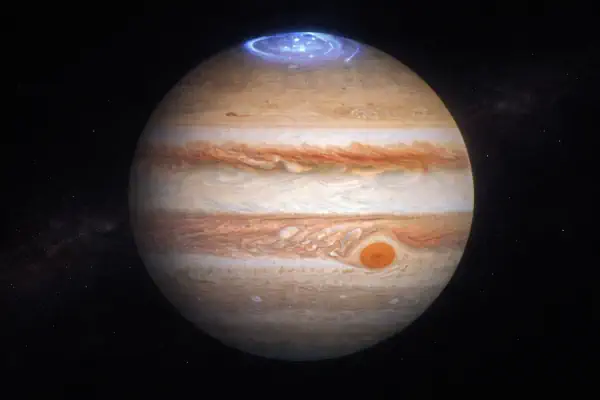
Reducing Jupiter to an “enormous” planet would miss its true importance. Its mass exceeds that of all the other planets combined. This means it is not merely one world among others: it is a central actor in the gravitational balance of the solar system. Its presence influences trajectories, stabilizes some dynamical regimes, disturbs others, and contributes to the way the space near the Sun has been organized over time.
In planetary science, Jupiter occupies a strategic position because it connects two levels of analysis. On one hand, it is an extreme physical object with its own meteorology, internal structure, and magnetic environment. On the other hand, it acts on the scale of the entire system. Studying Jupiter therefore means understanding both a planet and an architecture.
This dual importance explains why it has fascinated observers for so long. Its size first impresses the imagination, but its real power lies in its ability to structure a system far larger than itself.
Understanding Jupiter means moving from the image of a spectacular giant to the reading of a gravitational and physical power that shapes part of the order of the solar system.
A gravitational power that protects, perturbs, and organizes
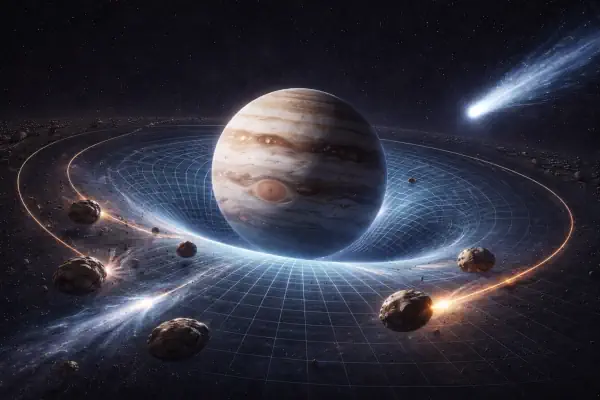
Jupiter’s gravity plays a major role in the history and current functioning of the solar system. It is often described as a shield capable of attracting or deflecting wandering bodies, especially comets and asteroids. That idea contains a share of truth, but it must be understood with nuance. Jupiter does not simply protect. It also redistributes trajectories, modifies balances, and may, depending on the case, move objects away from or toward the inner regions.
Its gravity is therefore less a simple defense than a structuring force. It acts as a dynamic authority over populations of small bodies, over certain orbital resonances, and over the long-term configuration of the planetary neighborhood. Without Jupiter, the inner solar system would probably not have experienced the same collisional history or the same relative stability.
Why its gravitational role is decisive
- it alters the trajectories of many small bodies
- it influences the architecture of orbital resonances
- it contributes to the stability of certain dynamical regimes
- it likely weighed on the history of impacts in the inner solar system
In that sense, Jupiter is not merely a massive outer planet. It acts as a hinge between local planetary science and the global mechanics of the solar system.
The Great Red Spot and meteorology without a surface
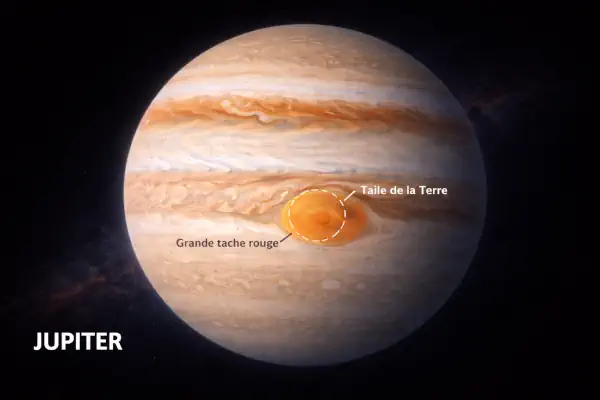
The Great Red Spot remains one of Jupiter’s most iconic symbols, but it deserves to be understood beyond its famous image. It is not a simple aesthetic detail: this atmospheric structure is a giant storm observed for centuries, a sign of fluid dynamics of exceptional intensity and duration.
This durability can only be understood by recalling that Jupiter has no solid surface in the terrestrial sense. Its cloud bands, jets, vortices, and large disturbances evolve within a deep envelope of gas and compressed fluids. There are no continents or reliefs to break large circulations as on Earth. The physics of the Jovian atmosphere is therefore expressed in a different regime, where scale, depth, and energy redefine what planetary weather means.
Jupiter thus becomes a unique laboratory for understanding turbulent flows, the longevity of storms, the relative stability of certain major vortices, and the relationship between visible layers and deep internal dynamics. The Great Red Spot is not merely spectacular. It is an open question of physics in a world of extreme fluids.
An interior where matter changes regime
One of Jupiter’s most fascinating aspects lies in its interior. Beneath the visible layers of clouds and aerosols, pressure rises until the dominant elements, especially hydrogen, enter physical states that are entirely unintuitive on a human scale. In Jupiter’s depths, hydrogen is no longer merely a gas: it enters a metallic regime, conductive and decisive for generating the magnetic field.
This transition is crucial because it makes Jupiter a frontier object between meteorology, condensed matter physics, and planetary magnetism. Studying its interior means exploring conditions impossible to reproduce durably in the laboratory at large scale, and therefore using the planet itself as a natural experiment.
For a long time, relatively simple internal models were imagined. Modern data demand greater caution. The boundaries between layers, the exact nature of the core, and the degree of mixing of materials all appear more complex than expected. Jupiter does not offer a perfectly ordered interior; it presents a stratified, dynamic depth that remains partly enigmatic.
The most powerful magnetic field in the planetary solar system
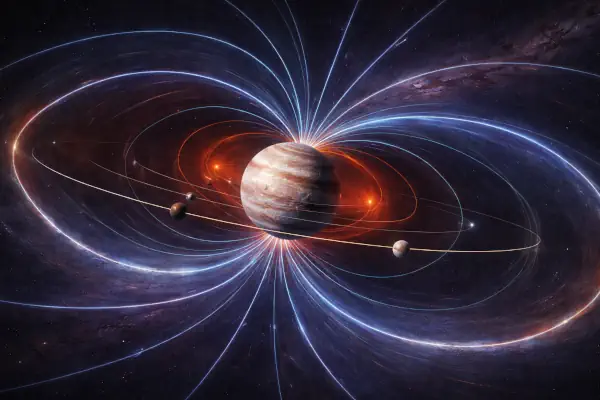
Jupiter’s magnetism ranks among the most impressive phenomena in the entire solar neighborhood. Its magnetic field far exceeds Earth’s in both intensity and extent. It shapes an immense magnetosphere, traps energetic particles, produces extreme radiation environments, and organizes gigantic polar auroras.
This magnetism must not be isolated from the rest of the planet. It is the result of deep internal physics, linked to conduction in layers of metallic hydrogen and to the global dynamics of Jupiter’s interior. It also helps us understand how a gas giant interacts with surrounding space, with the solar wind, and with its own moons.
In practice, this field turns Jupiter into a natural laboratory of space physics. It allows the study of interactions among plasma, radiation, fields, and particles on a scale inaccessible around rocky planets. The planet does not merely possess a gigantic atmosphere; it generates around itself a true energetic domain.
Juno transformed the scientific portrait of Jupiter
The Juno mission marks a turning point in modern knowledge of Jupiter. By entering orbit around the planet, it made it possible to refine the study of its gravitational field, magnetism, polar regions, and the probable structure of its interior. Its contribution is major because it did not merely confirm existing models: it shifted several of them.
Measurements suggested a less sharply defined core than expected, possibly more diffuse or diluted within the internal layers. Polar observations revealed groups of cyclones organized in a surprising way. The image of Jupiter that emerges is that of an internal and atmospheric system more complex, more nuanced, and less “cleanly stratified” than had been imagined.
What Juno changed most
- a finer reading of Jupiter’s gravitational field
- a better understanding of the organization of the poles and their cyclones
- a more complex vision of the internal structure and the core
- a more detailed magnetic portrait of the planet
Juno therefore reinforced one essential lesson: the more precisely Jupiter is measured, the less it resembles a simple machine.
Why Jupiter matters for all planetary formation
Jupiter’s importance extends far beyond its own case. As a major gas giant, it informs us about large-scale planetary formation mechanisms. Understanding when and how such a world assembled helps illuminate the chronology of the early solar system, the possible migration of giant planets, and the final organization of the inner and outer regions.
Jupiter acts as a dynamic archive of the solar system’s youth. Its mass may have influenced the distribution of materials, the growth of other bodies, and the long-term stability of many orbital systems. In that sense, the study of Jupiter is inseparable from a broader question: how does a planetary system become durably structured?
It also serves as a comparison point for the study of giant exoplanets observed around other stars. The more we understand Jupiter, the better we refine our reading of the massive worlds discovered elsewhere in the galaxy.
What Jupiter changes in our way of thinking about cosmic power
Jupiter forces us to move beyond our terrestrial intuitions. It shows that a planet can be almost without an apparent solid surface while still possessing gigantic meteorology, an interior of transformed matter, structuring gravity, and magnetism on an almost disproportionate scale. It does not resemble a bigger Earth. It obeys another regime of the planetary world.
That is precisely what makes it a first-rate editorial and scientific object. Looking at it, we contemplate spectacular beauty; studying it, we encounter extreme physics. Jupiter’s real lesson may lie there: some worlds do not merely expand our map of the solar system. They expand our very definition of what a planet can be.
Jupiter thus remains one of the great proofs that the cosmos never simply repeats our categories. It always pushes them further.