
A sky infinitely denser than ours: the night as a total experience
To understand the prehistoric perception of the galaxy, one must first grasp the gap between their sky and ours. In ancient societies, the night was not pierced by urban lighting, storefronts, roads, or industrial glow. The heavens appeared with a sharpness and abundance of stars that contemporary societies can now perceive only in a few extremely well-preserved regions.
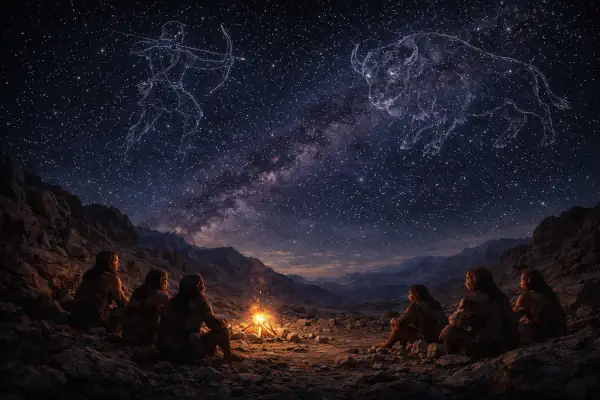
That density changes everything. Where our modern gaze distinguishes a handful of isolated stars, the prehistoric eye could read a far richer celestial architecture. The Milky Way was not a faint decorative streak: it could appear as an immense river of light crossing the night, structuring the nocturnal landscape almost as much as the earthly horizon itself.
In such a context, the sky was not a matter of aesthetic distraction. It participated directly in concrete life. It provided reference points for orientation, for the passage of the seasons, for animal cycles, for anticipating movement, and for organizing time. In that sense, prehistoric night was a lived space, not a mere background.

For prehistoric humans, the sky was not simply scenery above their heads. It was a reference point, a living memory, and a language of time.
The birth of constellations: mapping the invisible in order to transmit
Connecting points of light is never trivial. The act reveals a fundamental property of the human mind: we spontaneously seek forms, structures, and narratives. In societies without writing, that ability became even more important, because to remember often meant to tell a story.
Constellations must therefore not be understood as mere fantasies. They are also cognitive tools. By giving a narrative face to a group of stars, human societies stabilize celestial landmarks that they can transmit, recognize, and reuse. A hunter, an animal, a cluster of aligned stars, or a sacred figure becomes an anchor point for collective memory.
This logic helps explain why certain striking patterns inspired powerful and recurring interpretations in cultures far removed from one another. What we now call a constellation rests less on a “drawing written in the sky” than on a meeting point between visual perception, the need for orientation, and oral transmission.
The Milky Way: celestial river, path of souls, or pillar of the world
The Milky Way, observed without the framework of modern science, naturally called forth broad symbolic interpretations. Its elongated shape, its spectacular presence, and its apparent continuity made it different from other stars. It seemed less like a point than like a path, a flow, or a structure linking regions of the sky together.
Many traditions therefore saw in this luminous band a celestial river, a road traveled by souls, a boundary, an axis of the world, or a bridge between different layers of reality. What is striking is not only the variety of these interpretations, but their deep coherence: the Milky Way is almost everywhere associated with passage, transition, or circulation between two orders of the real.
This symbolic reading was not a naïve error; it was a coherent way of organizing a massive visual phenomenon through the human experience available at the time. In the absence of astrophysical explanation, prehistoric societies translated the observed grandeur of the sky into the most powerful categories they possessed: journey, the world of the dead, cosmic verticality, and continuity between the visible and the invisible.

The sky as a calendar, memory, and system of orientation
In societies dependent on the seasons, animal migrations, climatic cycles, and natural rhythms, observing the sky could play a decisive role. Certain stellar appearances, alignments, or visual recurrences became signals. The sky then participated in the organization of lived time.
It would be reductive to think that prehistory belonged only to myth. Regularly observing the Moon, identifying solstices, and recognizing the seasonal return of certain celestial patterns requires sustained attention and a form of empirical rigor. Without clocks, paper, or optical instruments, ancient societies developed a remarkable intelligence of the sky’s regularities.
What the sky could represent in practical terms
- a seasonal reference point for travel and vital activities
- a calendar based on the visible cycles of the sky
- a collective memory transmitted through storytelling and observation
- a system of orientation across vast and sparsely marked spaces
This practical function reinforces the essential idea: the sky was not observed from a distance as a mere spectacle. It was integrated into the daily order of the world, at once useful, symbolic, and structuring.
Signs engraved in stone: could the sky already have been fixed?
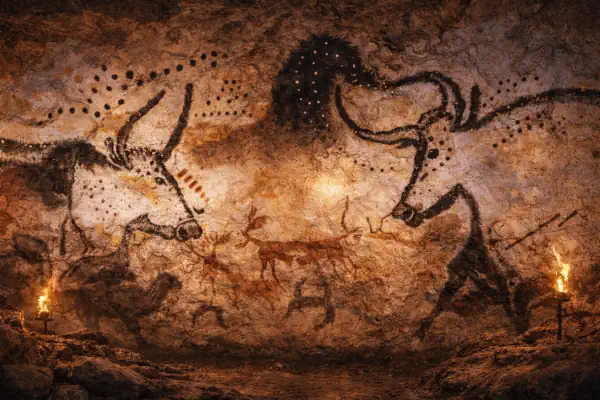
Some fascinating hypotheses suggest that clusters of points observed in cave art may correspond to naked-eye stellar configurations, such as the Pleiades. The idea remains debated, and it must be approached with caution. Yet it has strong intellectual value, because it reminds us that prehistoric humans can no longer be regarded as strangers to any formalization of the sky.
If some painted or engraved signs do indeed have an astronomical dimension, then the relationship with the cosmos did not remain limited to oral observation. It may already have taken on a durable visual form, inscribed in stone, uniting memory, ritual, and a representation of the world.
Even when proof is not definitive, the hypothesis opens an essential perspective: human astronomy may have roots far older than the learned traditions of classical Antiquity. The desire to fix the sky, to order it, or to reread it would then not be a late gesture, but a very ancient movement of the human mind.
Understanding without instruments: an intelligence of the sky before modern science
It would be mistaken to oppose myth and intelligence too sharply. Prehistoric societies had neither modern physics nor instrumental astronomy, but they were not therefore deprived of method. Observing regularities, comparing recurrences, stabilizing landmarks, and transmitting knowledge from one generation to the next already constitutes an elaborate relationship to reality.
They did not know, of course, that the Milky Way was a galaxy composed of hundreds of billions of stars, nor that the Solar System occupied only a peripheral position within it. But they did perceive that the sky contained cycles, structures, and forms of logic. In that context, myth did not replace reality: it translated it through the categories available.
This nuance is essential for any serious and non-condescending reading of prehistory. The point is not to project onto those societies a science they did not possess, but to recognize that they developed a coherent, demanding, and deeply human form of cosmic intelligence.

The sky as a mirror of humanity: what prehistory projected into the night
One of the deepest lessons of this reflection is that humanity has never simply looked at the stars: it has also projected itself into them. Celestial figures reflected the structures of human life, its fears, its hopes, its social rhythms, and its ways of organizing the world. The celestial hunter spoke to hunting societies; stellar cycles accompanied agricultural societies; luminous paths of the dead translated the universal question of finitude.
In that sense, the prehistoric vision of the galaxy tells us as much about the human mind as about the cosmos itself. It shows how an immense and difficult-to-explain visual reality becomes a symbolic, practical, and existential matrix. The sky is at once map, story, calendar, and metaphysics.
This is precisely what gives the question strong editorial value today: to understand the prehistory of the astronomical gaze is to grasp the moment when humanity learned to give form to immensity. Long before equations, there was already an ordered attempt to read the world.