Quick answer
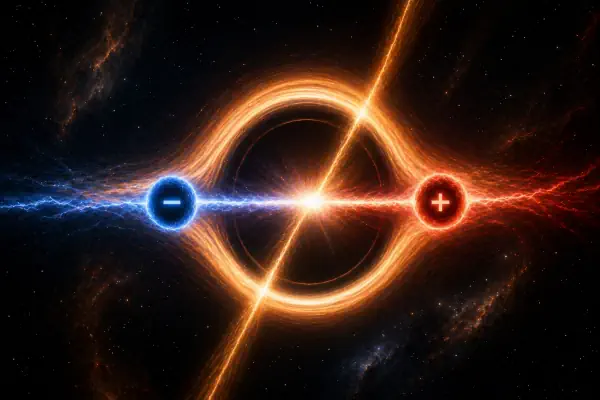
A positron is the antiparticle of the electron. It has the same mass and spin, but it carries a positive electric charge instead of a negative one. In other words, it is the antimatter version of the electron.
Across the Universe, positrons appear in highly energetic environments: certain stellar reactions, some supernovae, regions around pulsars, processes linked to black holes, cosmic rays, and the center of the Milky Way. When a positron meets an electron, the two annihilate and produce gamma radiation.
In brief
Positrons matter to astronomers because they make otherwise invisible processes detectable. They connect particle physics with astrophysics and help researchers better understand antimatter, compact objects, and the way energy moves through the Galaxy.
Main question: what is a positron, and why are astronomers so interested in this particle?
The positron is the antiparticle of the electron. That means it is extremely similar to the electron: same mass, same spin, but the opposite electric charge. If the electron is negative, the positron is positive.
At first glance, that may sound like a small detail from particle physics. In reality, this symmetry opens the door to one of the biggest topics in modern science: antimatter. The positron is not an abstract concept confined to laboratories. The cosmos produces it naturally, and that is exactly what makes this particle so valuable in astrophysics.
As soon as we look at highly energetic regions, dying stars, supernovae, pulsars, cosmic radiation, or the galactic center, we enter environments where the birth, motion, and disappearance of positrons reveal something profound about how the Universe works.
Key reading points: how positrons move through the cosmos
The big ideas to keep in mind
- Definition: a positron is the antiparticle of the electron.
- Birth: it can be produced in nuclear reactions or in very energetic environments.
- Path: it may travel through astrophysical matter before meeting an electron.
- Most familiar end: the electron and positron annihilate and produce gamma radiation.
- Key signature: the famous value of 511 keV is linked to that annihilation.
So the story of a positron can be summarized in four stages: production, travel, encounter, and annihilation. That sequence is what makes positrons such useful tracers of extreme regions in the Universe.
The positron is fascinating because it turns a highly abstract idea from particle physics into something observable across an entire galaxy.
Why the positron is the antimatter version of the electron
In physics, an antiparticle is a matter particle’s counterpart with very similar properties, but with some quantities carrying the opposite sign. For the positron, the easiest property to remember is electric charge: it is positive, while the electron’s is negative.
This matters because we are not talking about “another kind of electron” in a vague sense. We are talking about the antimatter version of the electron. That symmetry is one of the foundations of our modern understanding of the microscopic world.
Why this idea matters so much
Because it directly connects particle physics to astrophysics. Studying positrons is not just about studying one particle. It is also about studying the places where nature concentrates huge amounts of energy, and therefore the places where its deepest mechanisms become visible.
The positron is also historically important: its detection confirmed that antimatter was not just an elegant theoretical prediction, but a physical reality. Since then, it has become a major subject of study, both in laboratories and in astronomy.
Around stars and supernovae: the Universe naturally produces positrons
Stars are not just glowing spheres. They are environments where intense nuclear reactions happen continuously. In some stellar settings, and even more during explosive events such as supernovae, nature can produce positrons.
To follow the logic clearly, it helps to separate two ideas. First, a star is constantly transforming matter and energy. Second, when a star ends its life violently, the conditions become even more extreme. Temperature, density, radiation, and radioactive by-products can all favor positron production.
Some radioactive decays linked to these events are strong candidates for explaining part of the positron population injected into the galactic medium. This is an important idea because it directly connects the life cycle of stars to the gamma signature observed in the sky.
Why this is important
Because by tracing where those positrons later disappear, astronomers can work backward toward the environments that created them. In other words, the positron acts as an indirect clue to especially energetic cosmic events.
Pulsars and black holes: when energy can create electron-positron pairs
Pulsars are among the best candidates when scientists look for positron sources. A pulsar is a neutron star that spins rapidly and has an extreme magnetic field. In that kind of environment, particles can be accelerated to speeds close to the speed of light.
This idea is essential. It means the positron is not produced only in diffuse or distant reactions. It can also be born in compact, violent environments where fields and energy become so intense that they can trigger the creation of matter-antimatter pairs.
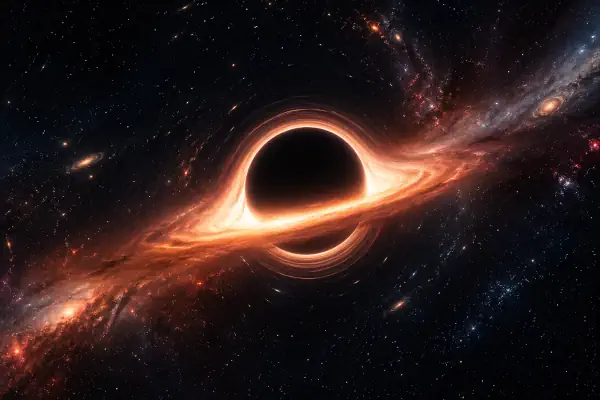
Regions near certain black holes, especially where matter is falling inward, where accretion disks form, where jets emerge, and where energetic radiation is present, are also environments in which positron production or acceleration is discussed. The main principle is simple: when the Universe concentrates enormous amounts of energy, it becomes capable of producing phenomena that everyday experience never reveals.
Why pulsars come up so often in this topic
- extreme magnetic fields
- very efficient particle acceleration
- possible electron-positron pair creation
- a link to several observed astrophysical signatures
- a clear bridge between microphysics and the cosmos
Cosmic rays: positrons produced during the particles’ long journey
Cosmic rays are highly energetic particles that travel through space. When they collide with matter in the interstellar medium, they can trigger cascades of secondary particles, including positrons.
This is important because it prevents an overly simple interpretation: a positron detected indirectly today was not necessarily created exactly where scientists observe the consequences of its presence. It may have been produced elsewhere, transported, slowed down, scattered, and then destroyed farther away.
In astrophysics, that is what makes the subject both exciting and complex. Researchers are not only looking for “positron factories.” They are also trying to understand how these particles move through the Galaxy, how they lose energy, and in which environments they eventually annihilate.
The center of the Milky Way: a region where many positrons seem to annihilate
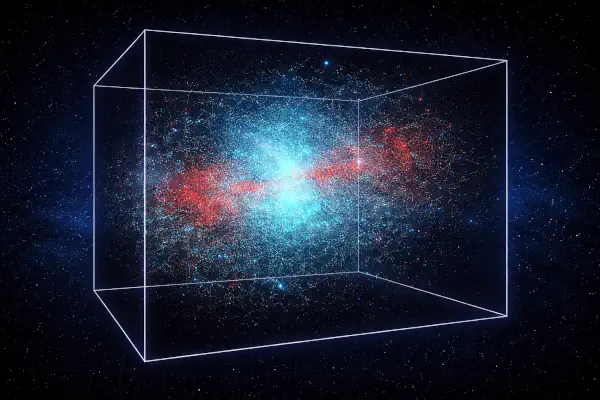
The center of the Milky Way is one of the best-known regions in this story. Instruments that map the sky in gamma rays have long shown a remarkable emission around 511 keV concentrated toward the inner Galaxy.
That means something quite simple: astronomers do not observe positrons one by one the way we observe stars through a telescope. Instead, they detect the energy signature of their disappearance when they meet electrons. And that signature is especially strong toward the central region of our Galaxy.
Why this region still raises questions
Because this emission leads to a major question: where exactly do all of these positrons come from? Their detailed origin is still an active subject of research. The leading candidates include several stellar processes, compact objects such as pulsars, some binary sources, and other energetic mechanisms.
This scientific uncertainty is not a weakness. On the contrary, it is what makes the topic so rich. Here, the positron becomes a guiding thread linking observation, modeling, and fundamental physics.
Annihilation and 511 keV: the key scientific idea to understand
When a positron meets an electron, the two particles can annihilate. That means they disappear as matter and antimatter particles, and their energy is converted into gamma photons. It is one of the most striking processes in physics.
The value 511 keV appears constantly in scientific discussions of this topic. To understand it properly, it helps to know that an electronvolt is a unit of energy used in physics. A keV is a kiloelectronvolt, or one thousand electronvolts. So 511 keV means 511,000 electronvolts.
A simple way to think about it is this: 511 keV is an energy fingerprint. When instruments detect that signature in the sky, astronomers know they have strong reason to suspect electron-positron annihilation. So it is not a mysterious number chosen at random, but a fundamental clue for reading antimatter in the Universe.
This signature is also valuable because it provides a common language between theory and observation: physicists describe the mechanism, while astronomers track its trace in the sky. It is one of the clearest examples of a direct bridge between the quantum world and galactic-scale phenomena.
What to remember about 511 keV
- it is a unit of energy, not a distance or a speed
- keV means kiloelectronvolt
- 511 keV is the typical signature of electron-positron annihilation
- astronomers use it to indirectly trace the presence of positrons
Why positrons are so important for understanding the Universe
Positrons help scientists work on several major topics at once: antimatter, pulsars, supernovae, cosmic rays, some regions near black holes, and the energetic structure of the Milky Way.
They matter because they sit at the boundary between two worlds. On one side, they belong to particle physics. On the other, they become observable astrophysical tracers on a galactic scale through gamma radiation.
Why this topic is so powerful for science communication
The positron is an excellent subject for science communication because it starts from a very simple definition, the antiparticle of the electron, and opens onto huge questions: why does antimatter exist, how can energy produce particles, how do scientists read invisible phenomena through radiation, and why does the center of the Milky Way emit that famous 511 keV signature?
A single particle can help explain the logic of supernovae, the violence of pulsars, the role of gamma radiation, and the way astronomers reconstruct the history of events that nobody can observe directly with the naked eye.
Conclusion: the positron is tiny, but it opens a huge window onto the cosmos
The positron may seem like a small detail in physics. In reality, it links the infinitely small to the infinitely large. It tells us about the symmetry between matter and antimatter, the violence of compact objects, the power of cosmic rays, and the activity of the galactic center.
When it meets an electron, it annihilates and leaves behind a gamma signature that astronomers know how to detect. That is how an almost invisible particle becomes a true astrophysical messenger.
That is why positrons are so compelling: they do not speak only about theoretical physics. They also reveal how the Universe produces, transports, and transforms energy in its most extreme regions.
Go further: three related reads on this topic
Quick glossary so the topic stays easy to follow
- antiparticle: a particle associated with an ordinary particle, but with some opposite properties.
- antimatter: matter made of antiparticles.
- annihilation: the mutual disappearance of matter and antimatter, with conversion into energy.
- gamma photon: a very energetic particle of light.
- electronvolt: a unit of energy used in physics.
- 511 keV: a characteristic energy often associated with electron-positron annihilation.
- pulsar: a rapidly rotating neutron star with an extreme magnetic field.
FAQ
What is a positron?
A positron is the antiparticle of the electron. It has the same mass and spin as the electron, but it carries a positive electric charge.
Why is it called antimatter?
Because it is the electron’s “mirror” counterpart in the physics of antiparticles. That makes it part of antimatter.
What exactly does 511 keV mean?
It is an energy value. “keV” stands for kiloelectronvolt, or one thousand electronvolts. The value 511 keV is famous because it corresponds to the characteristic energy signature of annihilation between an electron and a positron.
Where do positrons appear in the Universe?
They appear in some stellar environments, in certain supernovae, around pulsars, in processes linked to cosmic rays, and in the central region of the Milky Way.
Why are positrons so important to astronomers?
Because they serve as tracers for studying antimatter, compact objects, gamma-ray emission, and the most energetic regions of our Galaxy.