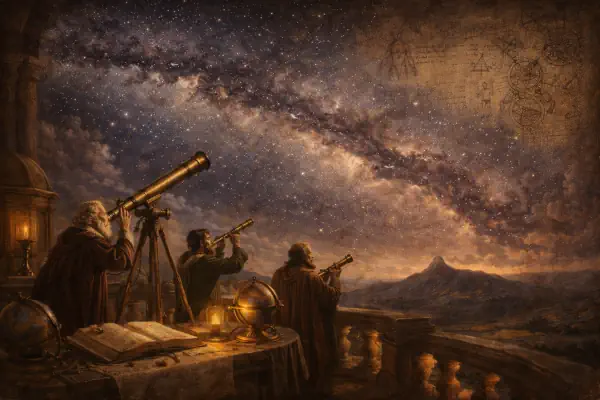
Antiquity marks a turning point in the human gaze
Prehistory looked at the sky as a sacred territory, dense with signs and stories. Antiquity adds a new dimension: the will to identify recurring patterns, pass on reliable reference points and organize society according to celestial cycles. The Milky Way is not yet understood as a galaxy, but it already stands out as a coherent structure worthy of interpretation.
This shift is fundamental. It rests not only on sharper observation, but on a new intellectual ambition: to make the sky into a system, a calendar, a language or a principle of order. That ambition is what links civilizations that were nevertheless far apart from one another.
Ancient Egypt: the sky as a divine body and living calendar

In ancient Egypt, the sky is embodied by the goddess Nut, a vast star-filled vault that arches over the world. The Milky Way may be related to a celestial river, symbolically resonating with the Nile. This reading is not decorative: it directly links the cosmos to the survival of the kingdom.
The stars were used to set religious and agricultural rhythms. The heliacal rising of Sirius announced the annual flood, and therefore the fertility of the land. Observing the sky meant securing time, stabilizing power and preserving Ma’at, the just order of the world. Egyptian cosmic awareness was not theoretical: it was political, agricultural and sacred all at once.
Mesopotamia: reading the sky as a script of reality

In Mesopotamia, observing the sky becomes methodical. Babylonian scholars recorded planetary positions, lunar cycles and eclipses on clay tablets. The sky is no longer only interpreted: it is archived.
This changes everything. By accumulating observations, scholars begin to see that celestial phenomena follow predictable regularities. The Milky Way thus takes its place within an ordered cosmos, where repeated cycles become a tool of anticipation. This is one of the great roots of mathematical astronomy.
Antiquity does not yet know what a galaxy is, but it already understands one essential thing: the sky is neither arbitrary nor silent.
Ancient Greece: explaining the sky instead of merely enduring or venerating it

With the Greek philosophers, another rupture appears: the cosmos becomes an object of reasoning. Aristotle imagines an ordered universe made of perfect spheres around an immobile Earth and interprets the Milky Way as an atmospheric phenomenon. The explanation is wrong, but the method is new: seeking a physical cause rather than relying only on sacred storytelling.
Later, Ptolemy systematizes that gesture in the Almagest, combining star catalogs, geometry and models of celestial motion. Myth does not disappear, but it now coexists with demonstration. Ancient Greece does not yet provide the correct image of the cosmos; what it truly invents is a decisive demand: making the sky intelligible.
The Maya: the sky as an architecture of time and the city

In the Maya world, the sky was studied with remarkable precision. The cycles of the Sun, the Moon and especially Venus were tracked with a rigor that still impresses today. Celestial phenomena were not only used to understand the world: they structured ritual orientation, the calendar and political authority.
Sites such as Chichén Itzá show that architecture itself was aligned with the equinoxes and the seasons. The Milky Way was conceived as a cosmic axis linking several levels of reality. Where the Greeks tend toward abstraction, the Maya embody. The sky is not only observed: it is built into the city, the ritual and the shared memory.
Different civilizations, one shared intuition: the sky has a logic
Egypt, Mesopotamia, Greece and the Maya civilization do not provide the same answers. They do not use the same symbols, the same tools or the same goals. And yet they all share one major intuition: the sky forms a coherent whole, capable of being read, interpreted and connected to the organization of human life.
That is the true legacy of antiquity. The Milky Way may be a divine river, a cosmic sign, a physical phenomenon or an axis of the world, but it is never treated as meaningless chaos. Instead, it becomes proof that above human societies there exists an order that must be recognized in order to inhabit the world more wisely.
The true ancient revolution: the idea that the universe can be understood
No ancient civilization yet knows that the Milky Way is a vast spiral galaxy. None measures its real dimensions. But that in no way diminishes their historical importance. Their decisive contribution lies elsewhere: they establish the idea that the sky follows cycles, that those cycles carry meaning, and that human beings can recognize them.
From that point on, a quiet revolution is underway. The cosmos is no longer only endured or celebrated; it gradually becomes an object of knowledge. And it is in this transition, between myth, calendar, geometry and observation, that one of humanity’s greatest intellectual achievements is born: the conviction that the universe can be thought.