Why Earth is more exceptional than it seems
The terrestrial paradox lies in its familiarity. Because it is our immediate environment, we perceive it as a self-evident setting. Yet as soon as we adopt a cosmic perspective, that obviousness collapses. A rocky planet capable of maintaining liquid water at the surface over long periods, an atmosphere dense enough to regulate thermal extremes without tipping into runaway instability, internal activity strong enough to recycle the surface over deep time, and a magnetic field robust enough to limit direct erosion by the solar wind: such a combination is not a banality, but a complex balance.
Earth is neither the largest nor the most massive of the planets. Its singularity does not come from excess, but from a rare adjustment between several parameters. That is precisely what makes it a major object for contemporary science. To understand Earth is to question the very possibility of a world that remains habitable over the long term.
This singularity also sheds light on the search for exoplanets. When astronomers look elsewhere for potentially livable worlds, they are searching less for an “Earth twin” in a visual sense than for a set of conditions physically compatible with the stability of living systems. Our planet then becomes both a biological home and a comparative model.
To understand Earth is to recognize that a habitable world is not merely a planet at the right distance from a star, but a rare combination of geology, climate, magnetism, water and deep time.
The habitable zone does not explain everything, but it changes everything
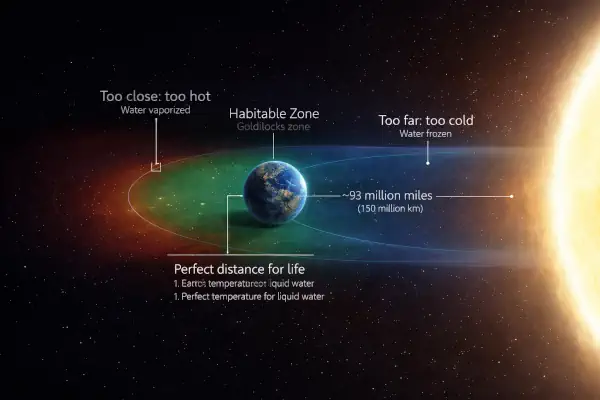
Earth lies at an average distance of about 149.6 million kilometers from the Sun, or one astronomical unit. This position places it in a region where the received energy allows, under certain atmospheric conditions, the persistence of liquid water at the surface. This fact is crucial, because liquid water is one of the great physicochemical supports of life as we know it.
However, the habitable zone alone is not enough. Two worlds placed in an energetically favorable region can evolve in radically different ways. Earth reminds us that habitability also depends on atmospheric composition, pressure, albedo, ocean circulation, geological activity and orbital stability. Being at the right distance from the Sun does not guarantee life; it merely opens the possibility of a regime compatible with it.
What Earth brings together in a decisive way
- a surface temperature compatible with liquid water
- an atmosphere capable of moderating extreme variations
- internal activity that renews and regulates the Earth system
- overall stability lasting long enough to allow the evolution of life
The scientific interest of Earth therefore lies in this articulation between a favorable orbital position and long-lasting internal regulation.
A long, violent and decisive geological history
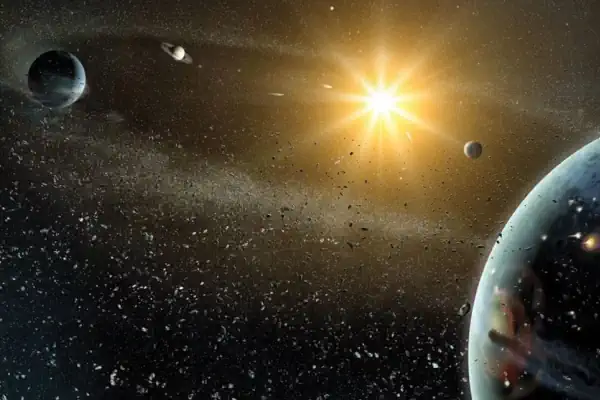
Earth formed about 4.54 billion years ago within the disk of matter surrounding the young Sun. Its beginnings were anything but peaceful: rapid accretion, numerous collisions, internal differentiation, a magma ocean and intense bombardment shaped the planet’s earliest ages. This initial phase fixed an essential part of its structure: metallic core, mantle, crust and internal dynamics.
What makes Earth particularly remarkable is that this history did not freeze. The planet remained active. Plate tectonics, volcanism, erosion, sedimentation and geochemical cycles progressively built a system in which the surface, the atmosphere and the interior interact across immense timescales. Earth is not a motionless archive; it is a planet in continuous transformation.
This historical depth also explains why Earth is so precious to science. Within it overlap billions of years of mineral, climatic and biological evolution. Studying Earth means reading a cosmic document whose geological layers tell both the story of a planet and that of the conditions that made life possible.
The magnetic field: an invisible but fundamental protection
Among the parameters that make Earth particularly stable over the long term, the magnetic field plays a role that is often underestimated. Generated by motions within the metallic outer core, it forms a magnetosphere that interacts with the solar wind and limits the direct erosion of the atmosphere by energetic particles.
This protection is not a detail. It contributes to preserving surface conditions compatible with life over deep time. Without it, the relationship between the Sun and the atmosphere would probably have been far harsher. Earth therefore owes its habitability not only to its distance from the Sun, but also to internal mechanisms capable of prolonging that habitability.
The magnetic field reminds us of an important truth: what protects life is not always visible from the surface. A habitable planet is not only a landscape; it is also a deep physical infrastructure.
Liquid water as the infrastructure of life
Earth possesses an immediately visible singularity on the scale of the solar system: the lasting abundance of liquid water at the surface. About 71% of its surface is covered by oceans. This massive presence is not merely a blue setting. It shapes the climate, redistributes heat, contributes to major chemical cycles and provides an environment extremely favorable to the complex reactions that allowed life to flourish.
The oceans play the role of thermal buffer, chemical reservoir and interface between atmosphere, lithosphere and biosphere. They make the planet both more stable and more dynamic. Earth’s water should therefore not be thought of as a simple resource: it is a central structure of planetary balance.
This is also what makes Earth so precious for cosmic comparison. When we search elsewhere for potentially habitable worlds, the question of liquid water returns again and again because it summarizes a large part of the conditions required for a durable living chemistry.
The Moon: a discreet yet structuring companion
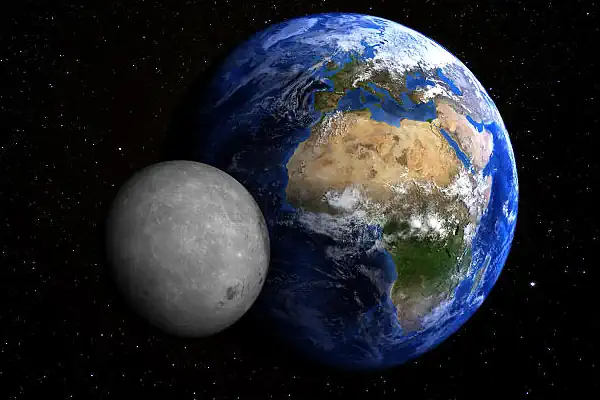
The Earth-Moon system adds an additional dimension to Earth’s singularity. Compared with the size of our planet, the Moon is a remarkably significant satellite. Its influence on tides is obvious, but its role goes further. It contributes to the stability of Earth’s axial tilt and thus to a certain climatic regularity over the long term.
This stability is far from anecdotal for a habitable planet. Variations that were too chaotic in the axial tilt could have made the climate much more unstable on large scales. The Moon does not create Earth’s habitability by itself, but it contributes to the overall coherence of a system favorable to the persistence of complex life.
Once again, Earth reminds us that a habitable planet is not always intelligible when viewed alone. We must also consider its dynamic relationships with its immediate environment.
The emergence of life: the great problem still open
Life appeared very early in Earth’s history, probably more than 3.5 billion years ago. This fact is impressive, but it does not solve the essential question: how did matter cross the threshold between complex chemistry and durable biological dynamics? Earth is, to date, the only known example where this transition certainly took place.
That is what makes our planet an object of research far deeper than a simple inhabited world. Earth is the only accessible laboratory where geology, chemistry, biology, climatology and astronomy can be brought together to reconstruct the conditions for the emergence of life. Every reflection on biosignatures, habitable exoplanets or life elsewhere passes, in one way or another, through the rigorous study of the terrestrial case.
Earth therefore confronts us with a double lesson. On the one hand, life is not an abstraction: it truly emerged within a specific planetary framework. On the other hand, we still do not fully understand the steps that made this transition possible.
A planet of active cycles, not a frozen world
Earth’s resources, whether mineral, biological or energetic, cannot be separated from its internal dynamics. Volcanism, mantle convection, tectonic recycling, chemical weathering, ocean circulation and atmospheric cycles together participate in a global system undergoing continuous transformation. This activity explains the richness of deposits, the diversity of environments and the planet’s ability to evolve.
Earth is therefore not only a living world; it is an operating world. Its balance results from permanent processes, not from a fixed state established once and for all. This idea is fundamental to understanding the extent to which habitability is a dynamic condition rather than a simple snapshot.
What Earth changes in the way we think about the cosmos
Earth is not the center of the universe, nor even an exceptional world by its size or raw power. Yet it remains a major case because it is, until proven otherwise, the only known place where matter has produced stable oceans, ecosystems, a long biological memory and an intelligence capable of observing the cosmos.
This observation should neither nourish an illusion of centrality nor be trivialized. It imposes a form of scientific humility. The more we understand Earth, the more we see that it rests upon a rare convergence of physical, geological and temporal conditions. This world we thought ordinary then becomes one of the most demanding to explain.
The true terrestrial enigma may not be only that of life. It may be that of a world that allowed life not only to appear, but to endure long enough to question its own origin.