Quick answer
In 2026, black holes are better understood than at any previous point in history. Astronomers know they exist in several forms, that they can range from a few solar masses to several billion times the mass of the Sun, that they strongly warp spacetime, that they grow through accretion and mergers, and that they can be studied through imaging, X-rays, radio astronomy, and gravitational waves.
But several central questions remain open: what really happens near the singularity, how intermediate-mass black holes form in detail, how general relativity and quantum mechanics fit together at a deeper level, and what ultimately happens to information. In other words, we have crossed the threshold of observation, but not yet that of full understanding.
In brief
Black holes are no longer just mysterious objects. They have become major reference points for testing gravity, extreme matter, galaxy formation, the limits of our mathematics, and the future bridges between quantum physics and relativity.
In this article
- What a black hole really is
- Key reading markers
- What we have seen and measured
- Which institutions are working on black holes in 2026
- What decades of observation have taught us
- What this could mean for humanity
- What if a black hole approached the Solar System
- Relativity, quantum physics, and major limits
- Could black holes create new elements?
- Full FAQ
Main question: what exactly is a black hole, and why does it fascinate scientists so much?
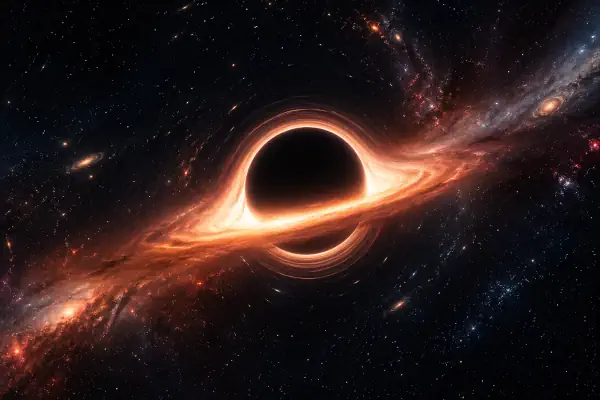
A black hole is not an empty void that magically sucks in everything around it. It is a region of space where a large amount of mass is concentrated into an extremely small volume. Its gravity becomes so intense that beyond a certain boundary — the event horizon — nothing can come back, not even light.
That simple definition hides enormous depth. A black hole forces physicists to bring together the two great pillars of modern science: general relativity, which describes gravity and the curvature of spacetime, and quantum physics, which governs particles and microscopic phenomena.
That is why black holes are so compelling. They are not just spectacular. They sit precisely where our knowledge becomes most fragile, most ambitious, and most promising.
Key reading markers: how to think about black holes without getting lost
The essential ideas to remember
- They are not holes in the everyday sense, but extreme gravitational objects.
- The event horizon is the point of no return.
- We do not see the black hole directly, but its surroundings: hot gas, X-rays, jets, stellar orbits, and gravitational waves.
- They exist on several scales: stellar, intermediate, and supermassive.
- Studying them illuminates cosmology, galaxies, gravity, and fundamental physics at the same time.
To keep the reading simple, remember this sequence: formation, accretion, interaction, merger, observation. Those five words organize most of modern black hole science.
Black holes are no longer just theoretical monsters: they have become observed objects that test the very limits of our understanding of reality.
What we have already seen, measured, and confirmed
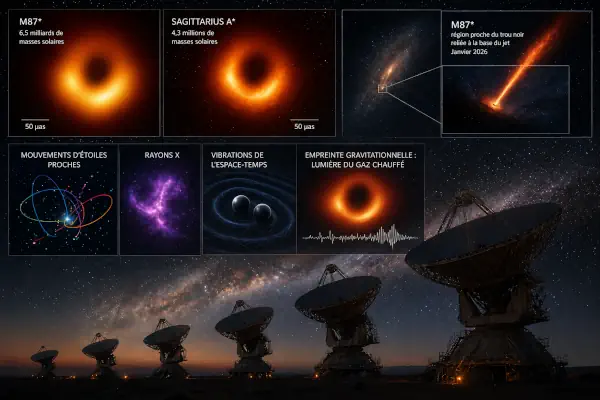
One of the great turning points in contemporary science is that black holes are now documented through direct observations. The Event Horizon Telescope, a global network of radio telescopes, delivered in 2019 the first image of the immediate environment of M87*, the supermassive black hole at the center of galaxy M87. In 2022, the same network released the image of Sagittarius A*, the central black hole of our own galaxy.
Those two results changed the scientific landscape. They revealed a bright ring of hot gas around a dark region shaped by the horizon and extreme gravitational effects. Sagittarius A* is estimated at about 4.3 million solar masses and lies roughly 26,000 light-years away. M87*, by contrast, is a giant of about 6.5 billion solar masses.
In January 2026, the EHT strengthened this field even further by connecting the region near M87* more precisely to the base of its jet, an important step toward understanding how these objects launch energetic structures across enormous distances.
What this means in practical terms
We do not look at a black hole the way we would photograph a planet. We read a signature: the gravitational shadow, the light from gas heated to extremes, the motion of nearby stars, X-rays, or the ripples of spacetime generated by a collision.
Which institutions are working on black holes in 2026?
Black hole research now relies on a constellation of international institutions. The Event Horizon Telescope coordinates horizon-scale imaging. The LIGO-Virgo-KAGRA network detects black hole mergers through gravitational waves. NASA contributes through several missions and observatories, including Chandra, IXPE, and major high-energy astrophysics programs. The ESA contributes through XMM-Newton, future projects such as LISA, and major European space programs. The ESO, together with the ELT, is preparing a new generation of observations of the galactic center and intermediate-mass black holes.
Added to this are major university hubs and research institutes: Caltech, MIT, the Max Planck Institute for Gravitational Physics, laboratories within the CNRS, teams at Harvard, Penn State, Leibniz University Hannover, and many other centers across Europe, Japan, and the United States.
Why this science is necessarily global
- the signals are weak and require extremely sensitive instruments
- the observations must span multiple wavelengths
- the calculations are massive and require supercomputers
- black holes connect several disciplines: physics, mathematics, instrumentation, computing, and signal processing
What decades of observation have already taught us
The first major lesson is simple: black holes are found wherever the Universe strongly concentrates mass and gravity. Some come from the collapse of massive stars, an intermediate population is still difficult to map with precision, and we now know that most large galaxies host a supermassive black hole at their center.
The second lesson is dynamic: a black hole does not live in isolation. It interacts with its surroundings. It can swallow gas, form an extremely hot accretion disk, emit indirectly in X-rays, or launch high-energy jets of particles. It is also an actor in galaxy evolution because, by heating and redistributing matter, it influences star formation.
The third lesson came from gravitational waves. The GWTC-4 catalog, published in 2026, adds 128 new candidates from the fourth observing run, more than doubling the previous total. In 2025, LIGO-Virgo-KAGRA also announced the most massive merger ever observed by this method: a signal that produced a final object of about 225 solar masses, from two black holes of roughly 103 and 137 solar masses.
Finally, another major advance concerns the growth of supermassive black holes. In 2026, an analysis based on roughly 1.3 million galaxies and 8,000 growing supermassive black holes showed in greater detail why their activity is slowing today: the Universe is aging, the available supply of cold gas is shrinking, and their most intense growth phase mostly belongs to the cosmic past.
What our knowledge of black holes could bring to humanity
When people hear “black hole,” the imagination often jumps to a new energy source or an immediate futuristic technology. The honest answer is more restrained: in 2026, black holes are not a practical energy source for humanity. But they are already a vast source of knowledge, and that knowledge can transform far more than astronomy.
First, they push the mathematics of gravitation, geometry, and differential equations to an extreme level. Second, they drive the development of instrumentation, signal processing, ultra-precise synchronization, large-scale data analysis, and high-performance computing. That entire technical culture then feeds into other digital and scientific fields.
Black holes also impose a rare kind of intellectual rigor: to understand a few milliseconds of a gravitational merger, researchers must master modeling, simulations, statistics, and software engineering. It is no coincidence that black hole science has become a training ground for excellence in modern scientific computing.
A new energy source?
Not in any practical sense for our current civilization. Scenarios involving energy extraction around black holes remain theoretical. The real benefit today lies elsewhere: in a deeper understanding of gravity, extreme matter, galaxy formation, and perhaps, one day, a more complete unified theory.
What would happen if a black hole approached the Solar System?
The first thing to understand is that a black hole with the same mass as the Sun would not magically swallow the planets if it replaced our star. They would continue orbiting, but in darkness and within a completely transformed environment. The real danger would come from the loss of light and heat, or from a very close passage that violently altered orbital paths.
If a massive black hole truly passed near the Solar System, the consequences could be severe: disrupted planetary orbits, destabilized comets and distant objects, strong gravitational tides, and large-scale dynamical chaos. But it should not be imagined as a cosmic vacuum instantly swallowing the entire system. Gravity acts with distance, as it does everywhere in astrophysics.
The simplest summary is this: at large distances, a black hole behaves gravitationally like any object of the same mass. What becomes extreme is what happens very close to it.
Will black holes replace our current laws of physics?
So far, no new mathematical law has replaced general relativity because of black holes. On the contrary, these objects have spectacularly confirmed many of its predictions, especially through imaging near the horizon and through the gravitational waves produced by mergers.
But they also reveal a major limit: at the heart of the problem lies the question of the singularity. A singularity is the point where our known equations no longer describe physical reality correctly. That does not mean nature itself breaks down, but that our theory becomes incomplete.
This is precisely where the dream of quantum gravity enters the picture: a theory capable of bringing general relativity and quantum physics together into a single framework. Black holes do not destroy our current laws. They reveal where those laws are no longer sufficient on their own.
And what about quantum physics?
It is not overturned in the sense of becoming false. But black holes place quantum mechanics under enormous tension. They raise formidable questions about information, entropy, theoretical Hawking radiation, and the ultimate description of spacetime. They do not invalidate quantum physics; they show where it must engage more deeply with gravity.
Can black holes, through their gravitational pressure, create new elements?
It is a fascinating question, but it has to be answered carefully. Nothing currently allows us to say that an isolated black hole is, by itself, a factory for new chemical elements. The known heavy elements are mainly associated with other extreme environments: supernovae, neutron stars, and compact-object collisions.
Black holes do, however, contribute indirectly to environments in which matter reaches extreme states, where temperature, density, magnetic fields, and energy flows become enormous. They influence the physical theater around them, but that does not mean they directly produce a new periodic table.
The most rigorous answer in 2026 is therefore this: black holes are natural accelerators of physical questions, not established proof of new elements. They force science to remain disciplined precisely where imagination might run too far ahead.
Conclusion: black holes are no longer just myths, but real laboratories of reality
In 2026, we already know a great deal about black holes. We know they exist, that they can be observed indirectly with impressive precision, that they grow, merge, shape their environments, and play a profound role in the history of galaxies.
We also know that some of the most massive objects in the Universe can now be studied through complementary methods: radio imaging, X-rays, polarimetry, stellar tracking, cosmological statistics, and gravitational waves. This convergence is one of the great achievements of modern science.
But black holes still retain their power to unsettle and inspire. They mark the frontier between what we can calculate well and what we still need to learn how to think through. That is why they fascinate us so deeply: they are already understood in part, and yet still far from giving up all their secrets.
Go further: three related reads on this topic
Quick glossary to keep things clear
- event horizon: the boundary beyond which nothing can escape.
- singularity: the zone where current equations stop describing physical reality correctly.
- accretion disk: very hot matter orbiting a black hole before falling inward.
- gravitational waves: ripples in spacetime produced by extremely violent events, such as the merger of two black holes.
- general relativity: Einstein’s theory describing gravity as the curvature of spacetime.
- supermassive black hole: a black hole containing millions or billions of solar masses.
- accretion: the process by which a black hole gains matter.
FAQ
Does a black hole suck in everything around it like a cosmic vacuum cleaner?
No. At large distances, it pulls just like any object of the same mass. What makes it extreme is what happens near the event horizon.
Have we really photographed a black hole?
We have obtained images of its immediate surroundings, especially the bright ring of hot gas around the dark region associated with the horizon and intense gravitational curvature.
What is the difference between M87* and Sagittarius A*?
M87* is a supermassive black hole of about 6.5 billion solar masses at the center of galaxy M87. Sagittarius A* is the central black hole of our Milky Way, with about 4.3 million solar masses.
What do we know about black hole mergers in 2026?
Gravitational-wave detectors have observed a very large number of them. The GWTC-4 catalog published in 2026 adds 128 new candidates, and some mergers have revealed objects of exceptional mass.
Could black holes revolutionize physics?
Yes, especially at the fundamental level. They could help bring general relativity and quantum physics closer together, and improve our understanding of information, spacetime, and the limits of our current models.
Do black holes create new elements?
Nothing currently allows us to claim that for an isolated black hole. Known heavy elements are more closely associated with other extreme environments such as some stellar explosions and compact collisions.