The heliopause is not a geometric edge, but a physical boundary
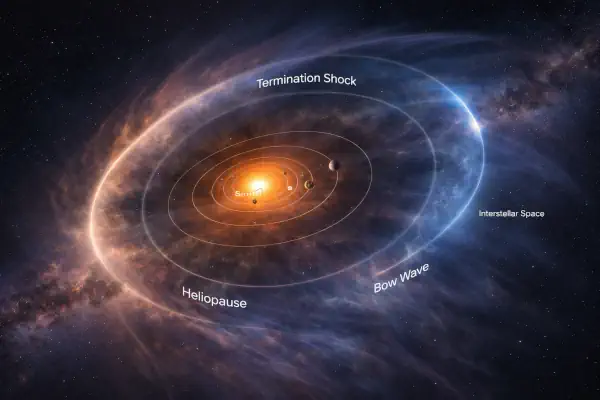
The Sun does not emit only light. It continuously releases a flow of charged particles known as the solar wind. This flow inflates a vast magnetic bubble around the Solar System: the heliosphere. As long as an object remains inside that bubble, it moves through an environment still dominated by particles and magnetic fields linked to our star.
The heliopause corresponds to the region where that influence stops being dominant. It is neither a wall nor a perfectly regular shell. It is a transition zone where the pressure of the solar wind meets that of the interstellar medium. From that point on, the plasma coming from the Sun no longer imposes its rule as it once did.
This idea matters because it redefines what we mean by the “boundary of the Solar System.” The planets do not mark that limit. Even the Kuiper Belt is not its end. The heliopause is a frontier of space physics, not simply a frontier of planetary cartography.
Crossing the heliopause does not mean leaving the Sun’s orbit. It means leaving the bubble of particles that the Sun maintains around itself.
Voyager 1 and Voyager 2: the longest journey ever sustained
When NASA launched Voyager 1 and Voyager 2 in 1977, their primary mission was not to reach interstellar space. They were designed to study the gas giants during an exceptional planetary alignment. Thanks to this rare opportunity, the probes could use planetary gravity as a cosmic slingshot and gain tremendous speed without consuming extra fuel.
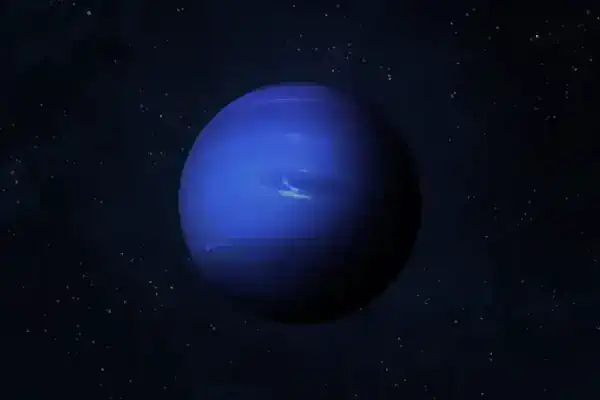
Their first success was already historic: they transformed our understanding of Jupiter, Saturn, Uranus, and Neptune. But their second life is even more vertiginous. After the planetary flybys, they continued their path far beyond the familiar regions of the classical planetary system.
What makes their adventure unique is not only the distance they have traveled. It is also its duration. These probes have been operating for decades, billions of kilometers from Earth, in an environment where communication delays are measured in hours and every watt of energy becomes precious.
Why their mission remains exceptional
- they studied several major planets within a single mission architecture
- they used gravitational assist on a spectacular scale
- they are still transmitting data after nearly half a century
- they are exploring a region humanity had never directly probed before
Why Voyager goes so far without really slowing down
On Earth, we instinctively associate motion with a gradual loss of speed. A car slows down if you stop accelerating, an aircraft encounters air resistance, and a projectile eventually falls. In deep space, the situation is radically different. The vacuum offers almost no friction.
Once accelerated by their initial launch and then by the gravitational assists of Jupiter and Saturn, the Voyager probes keep most of their speed. They are not constantly propelled; they simply continue their trajectory by inertia, following the fundamental laws of mechanics.
This is where Voyager’s journey becomes philosophically fascinating: it reminds us that deep space is not just an empty void, but a domain where Newton’s laws unfold almost in their purest form. A probe launched correctly can continue on its path for tens of thousands of years.
Beyond the planets: the Kuiper Belt and the outer regions
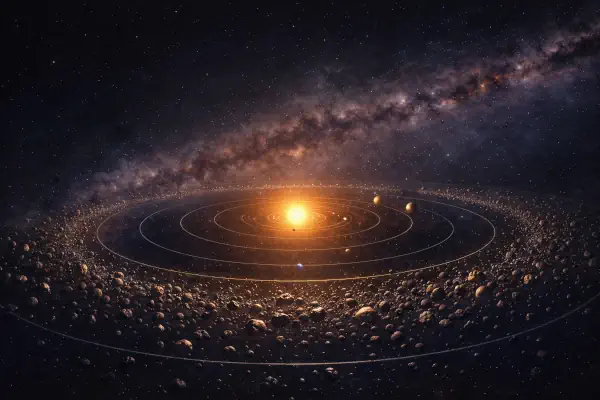
After Neptune, the Solar System does not end abruptly. It extends into regions that are more diffuse, colder, and harder to observe. The Kuiper Belt is one of these major zones. It contains icy bodies, leftovers from the formation of the Solar System, including Pluto, Haumea, and Makemake.
This region plays an important role in understanding planetary architectures. It preserves an ancient memory of the protoplanetary disk. It also reminds us that the visible planets alone do not summarize our cosmic neighborhood.
And yet even this outer “suburb” of the Solar System is not the heliopause. The boundary of the Sun’s influence lies farther away, in a region that cannot be reduced to a simple list of celestial bodies. This reinforces the idea that the true exit from the solar domain is not merely a matter of distance, but of physical environment.
What it really means to enter interstellar space
Saying that Voyager 1 and Voyager 2 are in interstellar space does not mean they have escaped all solar influence in the gravitational sense. They still remain tied to the Sun by their extremely long-term trajectories. But they are now moving through a medium where the solar wind is no longer dominant as it once was.
The interstellar medium is extremely tenuous, but it is not empty. It contains gas, plasma, energetic particles, and low-density magnetic fields. One of Voyager’s major contributions has been precisely to measure this change of environment by detecting the drop in solar particles and the relative rise in galactic cosmic rays.
In other words, these probes are not simply “moving farther away.” They are documenting a transition between two distinct physical regimes: that of the heliosphere and that of the local interstellar medium.
Why the heliopause is a major scientific question
The heliopause matters to astrophysicists because it reveals how a star interacts with its galactic environment. By observing the limit of the solar domain, we also learn how other stars may shape comparable particle bubbles around themselves.
This boundary also helps us better understand how cosmic rays penetrate our neighborhood, how the Sun’s magnetic field partly shields the inner system, and how the outer regions respond to the cycles of solar activity.
In that sense, the heliopause is not merely the final setting of the Voyager missions. It is a natural laboratory of space physics, a place where stellar dynamics, plasma, magnetism, and galactic environment meet.
What the study of this boundary helps clarify
- the true extent of the solar wind’s influence
- the structure and shape of the heliosphere
- the entry of galactic cosmic rays into our neighborhood
- the interactions between a star and the interstellar medium
Two probes, scientific reach, and a uniquely human dimension
Voyager fascinates not only because of its technical performance. These probes also embody a deeply human ambition: to send instruments into the cosmos that can survive across several generations. They are proof that a civilization can think beyond the short term, build for the unknown, and accept that some of its most valuable results will arrive far from the point of departure.
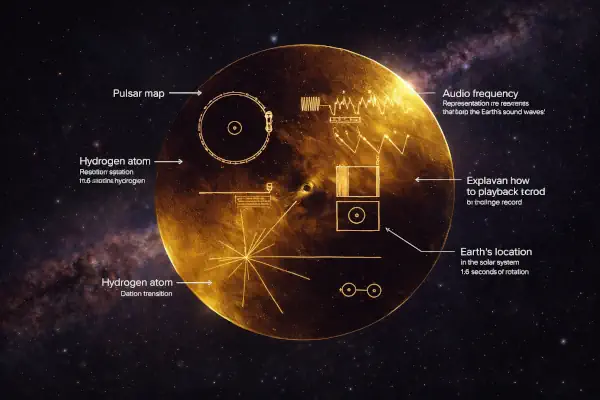
The Golden Record carried onboard gives the mission an additional symbolic dimension. It is not a scientific program in the strict sense, but a cultural gesture. Humanity deposited sounds, images, and messages there as a fragile trace of its existence, a minimal archive entrusted to cosmic deep time.
That symbolic aspect does not replace science. It accompanies it. It reminds us that space exploration is not only about data: it also involves the way we represent ourselves before immensity.
The heliopause: a local ending, not an absolute one
The heliopause does not mark the end of the known universe, nor even a final escape from all solar influence. It marks something subtler and scientifically more important: the limit of the solar wind’s domination over the surrounding environment. It is a boundary of physical conditions, an environmental shift, a change of regime.
Voyager 1 and Voyager 2 therefore continue well beyond this invisible line, not as lost machines, but as late scouts of a civilization still young on the cosmic scale. They extend our gaze to places no human will reach for a very long time.
And that may be the true power of their voyage: they prove that human intelligence can move beyond its natural horizon, transform the invisible into a territory of inquiry, and keep listening even at the edge of silence.