Why Saturn goes far beyond the postcard image
Saturn is often reduced to its rings, as though its scientific interest were identical to its visual power. That is a frequent mistake. Certainly, no other planet presents such an immediately legible ring architecture from Earth. But this visibility should not conceal the object’s complexity. Saturn is a gas giant whose study sheds light at once on planetary formation, the dynamics of deep atmospheres, and the evolution of complex gravitational systems.
It also forces us to think differently about time. The rings seem stable, almost eternal, even though they may correspond to a transitory state on the cosmic scale. What we behold today may not be an immutable structure, but a remarkable phase in the planet’s history. It is precisely this tension between timeless appearance and evolving reality that gives Saturn such a singular place in both the imagination and scientific research.
To understand Saturn, then, is not merely to admire a setting. It is to learn how to read a physical system in which visual beauty results from fragile balances, collisions, orbital resonances, and an immense dynamic history.
Saturn fascinates because it turns beauty into a scientific question: its rings enchant the eye, but above all they point toward a gravitational and temporal history still not fully understood.
The rings of Saturn: spectacular beauty turned scientific enigma
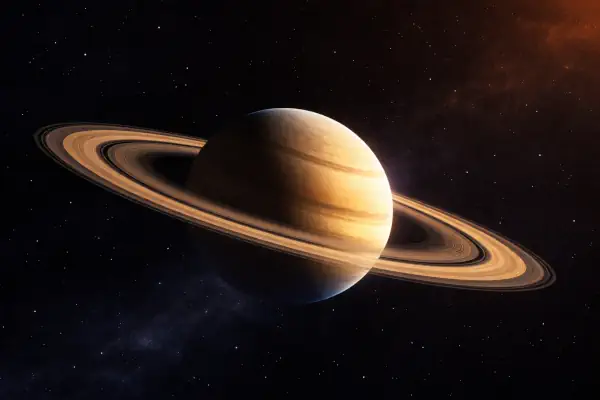
Saturn’s rings form one of the Solar System’s most famous ensembles, yet their notoriety can make us forget their true importance. They do not constitute a solid surface or a uniform object. They are made up of countless particles of varying sizes, mostly rich in ice, organized into bands, divisions, discontinuities, and fine structures shaped by gravity.
This organization is anything but anecdotal. It reflects an extremely precise mechanics in which interactions with moons, orbital resonances, and local collisions continually sculpt the visible form of the ring system. The rings thus appear as a delicate disk, when in reality they are a dynamic medium, alive, and in constant adjustment.
The great question remains their age and their destiny. Are they ancient, inherited from the earliest phases of the Solar System, or more recent than long believed? Their brightness and certain analyses have nourished the idea that they may not be eternal. That possibility changes the reading of Saturn: the icon we admire would then be a privileged moment rather than a permanent state.
Cassini-Huygens changed our view of Saturn
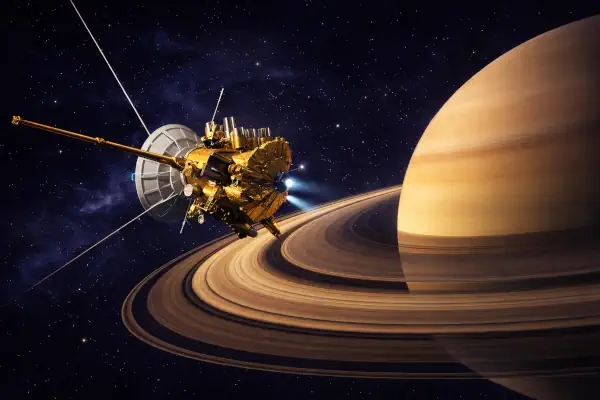
The Cassini-Huygens mission stands as one of the great milestones of modern space exploration. Launched in 1997, it transformed Saturn from a distant icon into a system studied with unprecedented richness of detail. Its contribution goes far beyond an accumulation of beautiful images: it allowed a much finer understanding of the planet’s atmosphere, the structure of its rings, the interactions with its moons, and the internal diversity of the Saturnian system.
Cassini’s data revealed a planet more active, more subtle, and more complex than previously imagined. They brought to light exchanges of matter, dynamic signatures within the rings, massive meteorological phenomena, and lunar environments of exceptional scientific interest. Saturn no longer appears as a simple giant surrounded by ornaments, but as the center of an entire system—coherent, hierarchical, and scientifically fertile.
What Cassini-Huygens made possible
- fine study of the structure and evolution of the rings
- detailed observation of large-scale atmospheric phenomena
- a better understanding of the interactions between Saturn and its moons
- the creation of a lasting scientific legacy for the planetary science of gas giants
The mission’s finale, with Cassini’s deliberate plunge into Saturn’s atmosphere in 2017, gave this scientific adventure a powerful symbolic dimension. The gesture was not merely spectacular: it marked the completion of a program designed to the very end to maximize knowledge while protecting nearby worlds from accidental contamination.
A violent gas giant behind its majestic silhouette
Judging only by its appearance, Saturn seems almost serene. That impression is misleading. Like the other great giants of the Solar System, it harbors a powerful, deep, and restless atmosphere. Its winds can reach considerable speeds, its cloud bands reflect intense internal dynamics, and some meteorological structures endure far beyond anything known on Earth.
Among its most famous phenomena is the gigantic hexagon at Saturn’s north pole. This astonishing form, stable on the scale of human observation, reminds us that gas giants should not be read through overly terrestrial atmospheric categories. Their meteorology results from interactions between rapid rotation, convection, thermal gradients, and deep circulation of fluids under high pressure.
Beneath the visible layers, the difficulty increases still further. The transition between atmosphere, deep envelopes, and internal regions does not offer the simple landmarks of a rocky planet. Saturn therefore demands a gradual reading, one in which the idea of a surface is replaced by that of structured depth and complex physical continuity.
The density of Saturn: a simple fact, a profound lesson
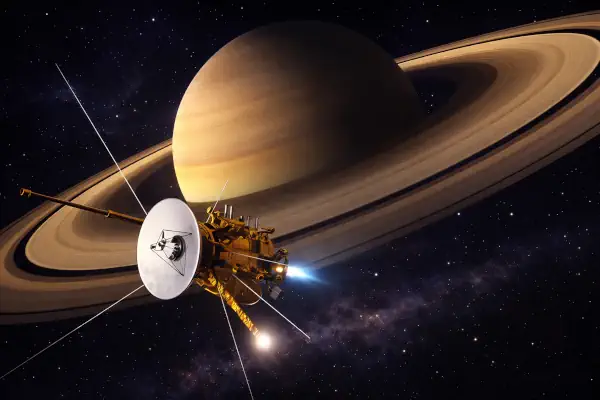
One of the facts most often mentioned about Saturn is its average density, lower than that of water. This formula is sometimes presented as an amusing curiosity, but it deserves better than a popularization effect. It first reminds us that a planet’s mass does not say everything: the distribution of that mass, its composition, and its internal organization matter just as much.
Saturn is immense, massive, and yet relatively low in density on the planetary scale. That points back to its nature as a giant dominated by light elements, structured into deep envelopes subjected to extreme pressures. The image of a planet that “could float” should be understood as a pedagogical illustration, not as a realistic physical scenario. What truly matters is what it reveals: Saturn is a colossal world whose architecture defies ordinary intuition.
This fact also opens a broader reflection on planetary categories. Through Saturn, one understands that the notion of a gas giant does not simply designate a very large planet, but a different way of existing physically in the cosmos.
Saturn as a system rather than a simple planet
One of Saturn’s great scientific strengths is that it can never be reduced to itself alone. It must be thought of together with its rings, its magnetosphere, its many moons, and the permanent exchanges that structure this whole. This systemic vision is essential. It prevents the planet from being reduced to an isolated silhouette and restores its true astrophysical depth.
Some Saturnian moons have in fact reinforced the system’s overall importance by opening major perspectives on habitability, internal oceans, and cryogeological activity. Even when an article concentrates on Saturn itself, it is difficult to ignore that its immediate environment considerably extends the scientific reach of the subject.
In this way, Saturn acts as a bridge between classical planetary science and the integrated study of systems. It shows that a world is never merely a central body, but often a set of relationships, influences, and circulations across several scales.
Why Saturn remains essential for thinking about cosmic time
The theme of time returns constantly when one speaks of Saturn. This is not merely a cultural or mythological echo. The planet truly compels us to think in long durations. The rings themselves raise questions of age, erosion, and renewal. Atmospheric structures remind us that some forms may last far longer than our terrestrial meteorological reference points. The great exploration missions also show how science advances through patience, accumulation, and reinterpretation.
Saturn thus teaches a form of scientific maturity. It invites us to distinguish what seems stable from what truly is, not to confuse visual evidence with theoretical evidence, and to accept that the most beautiful objects in the sky are often those that resist complete explanation the longest.
That is perhaps where its enduring power lies. Saturn is not merely an impressive planet. It is a lesson in method: looking beyond appearance, linking beauty to dynamics, and recognizing that a famous world may still bear some of the Solar System’s deepest mysteries.