Why Mars intrigues more than any other rocky planet
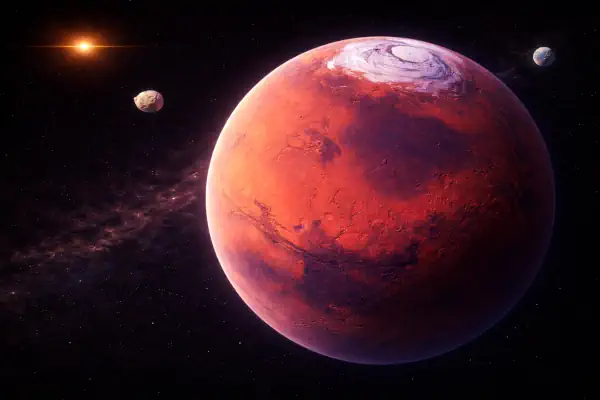
Mars is not merely a red planet visible to the naked eye since antiquity. It has become a scientific problem of great density. Its importance lies in the fact that it seems to have changed its nature over time. The cold, dry, dusty world we observe today bears traces of a wetter, more active past, and perhaps one more favorable to certain complex chemistries.
This tension between a hostile present and a potentially habitable past explains its lasting power. Mars is close enough to be studied in detail, different enough that it cannot be understood by simple analogy with Earth, and rich enough in geological clues to sustain an open investigation into the history of water, atmosphere, and possible life.
In other words, Mars is not merely an exploration target. It acts as a test. If a neighboring planet could, even temporarily, gather certain conditions favorable to life without preserving them until today, then the emergence of life in the universe becomes a subtler, more comparative, and more demanding question than a simple opposition between a living world and a dead one.
Mars fascinates because it looks less like an absolute desert than like a world that lost part of its hospitality without entirely erasing the archives of what it once was.
Traces of water profoundly change the reading of the planet
The question of water is the central entry point in the modern study of Mars. Orbital images, the geomorphology of certain regions, the identification of minerals formed in the presence of water, and the structure of many sedimentary deposits all converge toward the same idea: Mars experienced hydrological episodes far more significant than its current appearance would suggest.
This observation immediately changes the planet’s scientific status. Liquid water is never a mere environmental detail; it changes the biological relevance of a world. Where water settles durably, even intermittently, the possibility of prebiotic or microbial chemistry becomes a legitimate hypothesis to test.
This does not mean projecting Earth’s model onto Mars too quickly. But it is impossible to ignore the significance of these clues. Martian valleys, deltas, and sedimentary structures do not merely tell the story of ancient weather; they outline the contours of a once more active planet, capable of offering environments where matter, water, and deep time could interact.
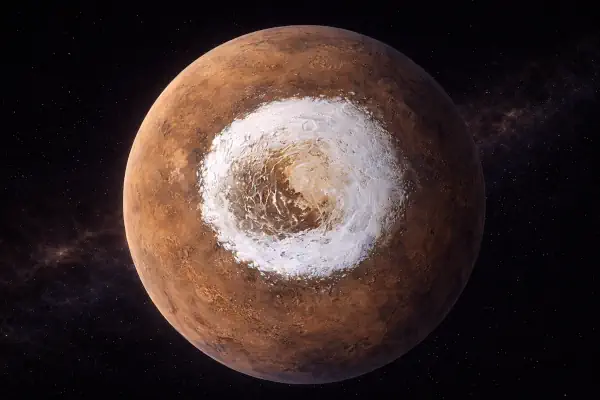
Jezero Crater: a key site for reading Martian history
Among the many Martian sites under study, Jezero occupies a strategic place. This crater was not chosen by chance. Accumulated data indicate that it once hosted a lake and received sedimentary inputs related to an ancient delta. This makes it especially valuable, because deltas and lacustrine deposits are, on Earth, environments capable of preserving fine geochemical signatures and sometimes traces of biological activity.
Jezero therefore concentrates several interests in one place: memory of water, sedimentation, mineralogical diversity, and preservation potential. In a rigorous scientific logic, that makes it a more relevant field of investigation than a merely spectacular landscape. Researchers do not seek only to see what Mars once was there; they seek the conditions under which certain traces could have been preserved.
This type of site transforms Martian exploration. We move from a logic of general observation to one of reasoned targeting, guided by geology, chemistry, and the precise question of ancient habitability.
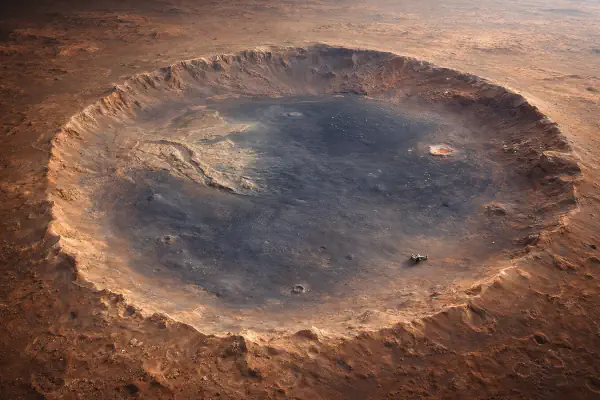
Perseverance embodies a new method of Martian exploration
With Perseverance, the exploration of Mars crosses a methodological threshold. The rover is not merely a mobile observer; it acts as a field laboratory designed to select, analyze, and document samples of high scientific value. Its work is part of a broader chain: identifying relevant rocks, reading their geological context, characterizing their chemistry, and preparing for the possible return of samples to Earth.
This approach is decisive. As long as analysis remains only remote or robotically in situ, certain ambiguities remain. Sample return promises, in time, to move Martian science to an even higher level of rigor by allowing the use of terrestrial instruments far more powerful and diverse than those carried by a rover.
Perseverance therefore materializes a central idea: research on Mars is entering a phase where exploration is no longer merely cartographic or photographic. It becomes stratigraphic, geochemical, and archival. The goal is less to “see Mars” than to make its mineral memory speak.
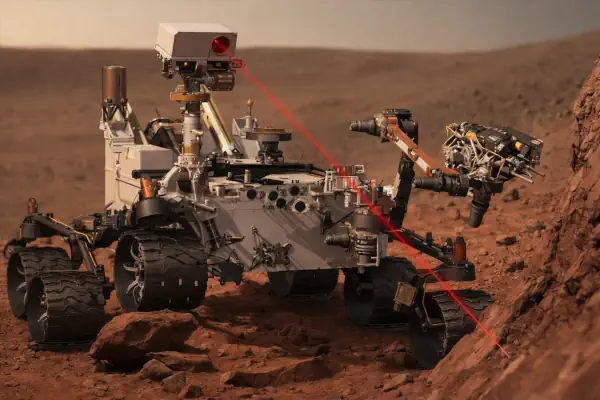
Biosignatures are the right question, but the answer remains difficult
The search for biosignatures is undoubtedly the intellectual core of the mission. A biosignature is not an “immediate proof of life”; it is a clue, a chemical, mineralogical, or textural pattern that may be compatible with past biological activity. The whole difficulty lies in the possible ambiguity of these signatures. Some may be produced by non-biological processes. Others may be erased or altered over time.
This difficulty does not weaken the approach; on the contrary, it reveals its rigor. Serious Martian science does not seek spectacular effects. It patiently accumulates contexts, correlations, and cross-analyses. The goal is not to conclude too quickly, but to progressively reduce the field of plausible interpretations.
Why the search for biosignatures requires so much caution
- a chemical signature may have several possible origins
- rocks may have been modified by alteration, impacts, or oxidation
- the geological context matters as much as the signal itself
- a solid conclusion requires multiple converging analyses
Mars therefore imposes exemplary interpretive discipline. It forces us to distinguish the plausible from the proven, the clue from the demonstration, and enthusiasm from scientific validation.
Mars as a first-rate planetary archive
One of Mars’s major interests lies in its ability to preserve. Unlike Earth, whose active tectonics, intense hydrology, and biosphere constantly rework the surface, Mars preserves certain ancient strata more effectively. What has disappeared more radically on our own planet may sometimes survive more clearly on Martian ground.
This relative stability makes Mars a precious archive for studying not only its own history, but also planetary states that may have existed elsewhere in the universe. Reading Mars means studying one possible branching of the destiny of rocky worlds: why do some preserve a thick atmosphere, stable liquid water, and durable activity, while others tip toward cold, dryness, and atmospheric thinning?
The red planet thus becomes a major comparative tool. It helps us understand what Earth preserved, what it transformed, and what a neighboring world may have lost.
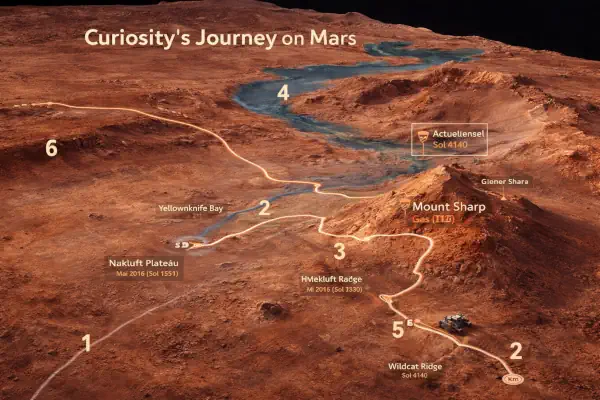
Mars also engages the future of human exploration
Interest in Mars is not limited to ancient life. The planet also plays a central role in projections of crewed exploration. This perspective should not be treated as a simple science-fiction dream: it involves very concrete questions of survival, resource production, radiation protection, logistics, physiology, and technological autonomy.
Understanding Mars today therefore means working at several scales at once. On one side, the geological and biological investigation questions the planet’s past. On the other, space programs see it as a possible ground for testing humanity’s ability to live durably beyond Earth. This dual dimension further strengthens the strategic significance of the subject.
Mars then appears as both a scientific and operational mirror. It points us at once toward our possible biological origins in the universe and toward our technical future beyond Earth.
What Mars changes in the way we ask the question of life
The true scientific power of Mars may lie in this: it prevents simple answers. If life never emerged there despite the ancient presence of water, that forces us to better understand what is still missing to move from habitability to biology. If life once existed there and then disappeared, that compels us to think about the fragility of worlds. And if ambiguous traces persist without ever becoming fully decisive, Mars will still remain a privileged field for refining our criteria for recognizing life elsewhere.
In every case, the red planet raises our level of rigor. It teaches us that exploration is not merely a physical movement through space, but an intellectual discipline made of patience, method, and the permanent revision of hypotheses.
That is why Mars retains such force. It does not merely nourish the human imagination. It compels science to become better.