Why Neptune holds a singular place in the Solar System
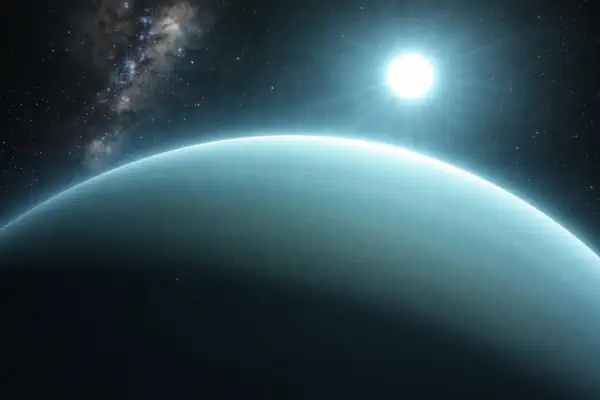
Neptune is not merely the most distant planet in the great classical order of the Solar System. It represents an intellectual frontier. Its distance from the Sun, the rarity of missions that have approached it, and the difficulty of observing it in detail long made it a world more inferred than truly known. Where Jupiter and Saturn benefited from a rich tradition of observations, Neptune remains partly wrapped in a shortage of direct information.
That situation explains its editorial and scientific power. Neptune does not reveal itself easily. It resists simplification. Its deep blue, often placed in the foreground, is only the entry point to a far larger dossier: internal structure, energy circulation, atmospheric dynamics, magnetism, gravitational role at great distance, and complex relationship with its remote environment.
In other words, Neptune is not merely a planetary terminus. It is a threshold. A point at which astronomy confronts, in a very concrete way, what it still struggles to measure properly.
Neptune fascinates because it combines the elegance of theory, the violence of physical phenomena, and the persistence of a scientific ignorance that remains very real.
A planet first discovered through mathematical insight
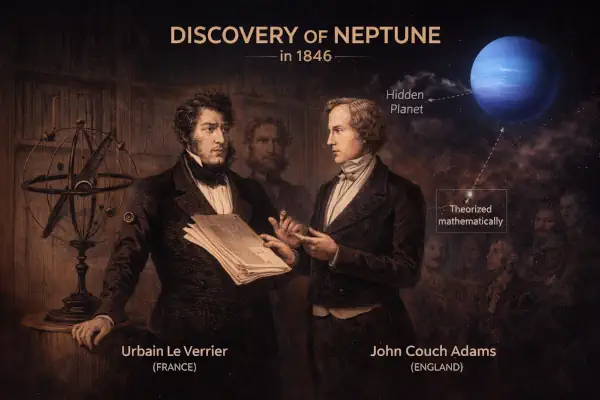
Neptune’s story carries an almost exemplary dimension in the history of science. Before it was directly observed, it was deduced. Anomalies in Uranus’s motion suggested that an as-yet-unknown body was exerting a measurable gravitational influence. That perturbation, far from being a minor technical detail, became the starting point of a remarkable demonstration: mathematics could lead to the existence of a world still invisible.
Neptune’s discovery in 1846 gave celestial mechanics a spectacular authority. It showed that the universe could be anticipated before it was even seen. Few objects in the Solar System bear so strongly the mark of an intellectual victory of theory over the immediacy of observation.
This episode remains fundamental to understanding Neptune’s prestige. The planet is not merely distant; it is historically tied to the human ability to infer reality from traces, calculations, and apparent discrepancies.
Neptune’s deep blue is not just a visual effect
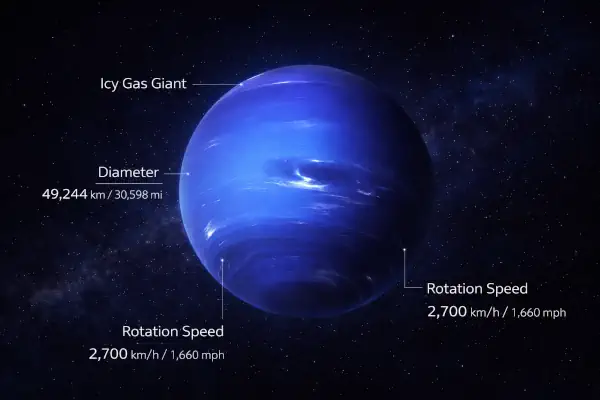
Neptune first strikes the eye through its color. Its intense blue sets it apart visually in the collective imagination and in popular scientific culture. That hue is linked to the presence of methane in its atmosphere, which absorbs certain wavelengths of the solar spectrum. But stopping at that chemical explanation would impoverish the subject.
Neptune’s blue also acts as a marker of distance, apparent coldness, and depth. In a single image, it condenses the idea of a distant, alien world, difficult to reach. That is undoubtedly why Neptune exerts a particular fascination: its appearance feels less familiar than emblematic of a cosmic elsewhere.
In a premium editorial logic, that color should therefore not be treated as a mere decorative detail. It belongs to the planet’s physical and symbolic identity, directly linking observation to the perception of the unknown.
An atmosphere shaped by the most extreme winds
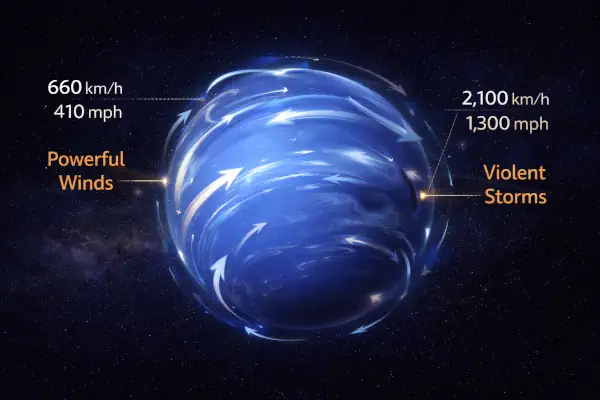
One of Neptune’s most striking traits is the violence of its atmospheric dynamics. The winds measured there rank among the fastest observed in the Solar System. That fact is all the more surprising given that the planet receives very little solar energy compared with worlds closer to the Sun.
This contrast opens one of the strongest questions in the Neptunian dossier: how can a world so distant generate such intense meteorological activity? The answer points toward a central reality of planetary science: a planet’s energy does not depend solely on the radiation it receives from its star. Neptune seems to possess significant internal heat, still imperfectly explained, which contributes to its overall dynamics.
This combination of external cold and internal power makes Neptune a particularly instructive planet. It reminds us that ice giants are not inert worlds frozen in darkness, but physically active systems structured by complex circulations of energy.
Voyager 2 revealed Neptune without exhausting it
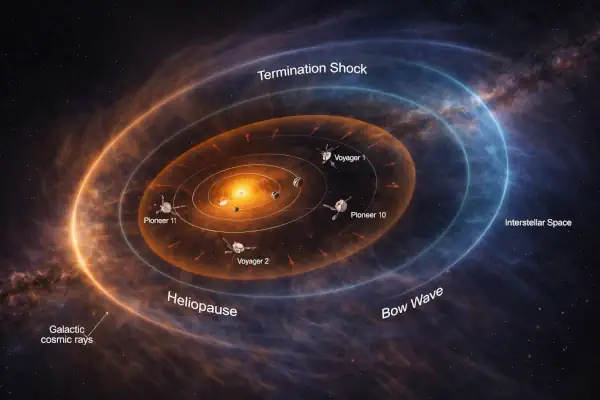
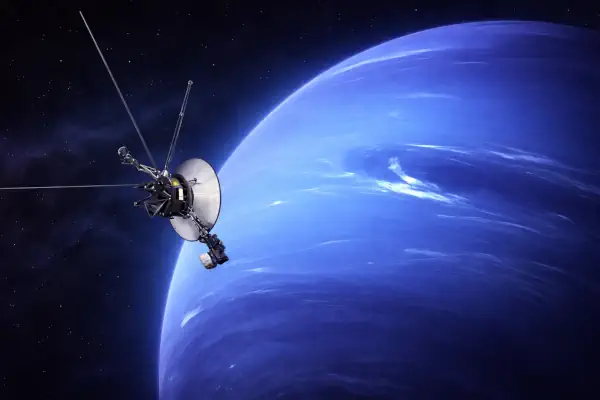
Voyager 2’s flyby of Neptune in 1989 still stands as the central moment in our direct knowledge of the planet. This encounter made it possible to obtain detailed images, study the atmosphere, observe certain major dynamical phenomena, and open a far more concrete view of the Neptunian system.
Yet this success also highlights a major limitation: Neptune has been approached only once, and only briefly. As with other distant worlds, a flyby mission does not replace a long-duration orbital mission. It brings revelation, but not exhaustive understanding.
This situation explains why Neptune remains both known and incompletely described. Voyager 2’s data were decisive, but they do not close the subject. On the contrary, they reinforced the idea that the planet deserves, in time, a far more ambitious exploration.
Triton further expands the complexity of the Neptunian system
Neptune cannot be fully understood without Triton. This large moon, which orbits in a retrograde direction, is generally interpreted as a captured object. This orbital singularity alone is enough to make it a major subject. It suggests a complex dynamical history in which Neptune did not simply form an orderly retinue of satellites, but also integrated a body that came from elsewhere.
Triton interests scientists for several reasons: its probable past, its internal structure, its surface properties, and the possibility of activity or an internal ocean beneath the ice. This single moon considerably broadens Neptune’s scientific reach.
In that sense, the Neptunian system should not be reduced to a single distant blue planet. It must be thought of as a whole in which the central planet and its most famous satellite extend one another’s mysteries.
An ice giant essential to understanding distant worlds
Neptune belongs to the category of ice giants, alongside Uranus. This planetary family is especially important because it builds a bridge between the worlds of our own solar neighborhood and many medium-sized exoplanets detected around other stars. Studying Neptune therefore also improves the understanding of objects far beyond our local system.
Why Neptune remains strategically important for planetary science
- it sheds light on the physical behavior of ice giants under extreme conditions
- it helps interpret comparable exoplanets observed elsewhere in the galaxy
- it links theoretical discovery, rare observation, and major questions of internal energy
- it imposes a systemic reflection including planet, atmosphere, magnetism, and satellites
Neptune is therefore not merely an end-of-route subject in a tour of the Solar System. It acts as an indispensable point of comparison for a planetary science that has become largely extrasolar.
Why Neptune remains an active enigma
Despite progress in remote observations, several questions remain open: what is the exact organization of its interior? How is its deep heat distributed? Why does its atmospheric dynamics remain so energetic? And to what extent does Triton alter our reading of the Neptunian system’s history?
Neptune’s strength lies precisely in that. It is not an object already stabilized in knowledge. It remains a world where theory, observation, and future exploration still need to converge more fully. This tension between beauty, remoteness, and residual ignorance explains the persistence of its fascination.
Neptune ultimately reminds us of a simple truth: the farther a world seems, the more central it can become for testing the solidity of our models. In the grand narrative of the Solar System, it is not a marginal note. It is one of the last great questions still open at the planetary scale.