The telescope: the instrument that fractures the ancient sky
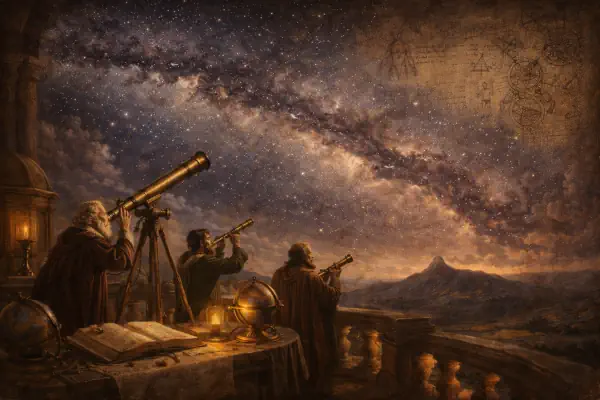
One of the most important gestures in the history of Western thought is not abstract at all: it consists of pointing a telescope toward the sky. With the Renaissance, the observation of the cosmos changes in nature. No longer is it enough to contemplate with the naked eye or simply inherit the authority of the ancients; the new ambition is to see farther, more precisely, and to test what once seemed immutable.
In 1609, Galileo improves the telescope and applies it to astronomical observation. That act has immense significance, because it introduces a new intermediary between human beings and the sky: glass. From that point onward, vision no longer rests solely on immediate perception. It becomes amplified, corrected, instrumented. The cosmos begins to reveal details that had previously remained inaccessible.
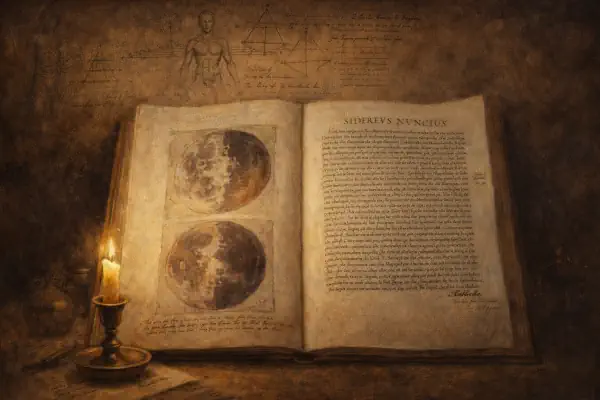
When Galileo states, in the Sidereus Nuncius, that the Milky Way is not a homogeneous celestial mist but a multitude of stars invisible to the naked eye, he does more than propose a new description. He destroys an ancient representation of the sky. The galaxy ceases to be a simple luminous band laden with symbolic meaning; it becomes a complex, material, layered reality.
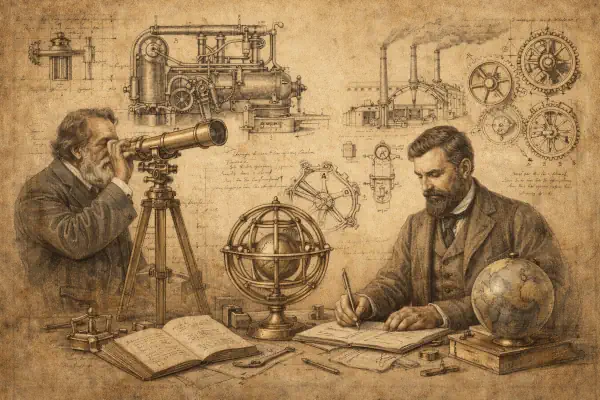
With the Renaissance, the sky is no longer contemplated only as a symbolic order. It becomes an object of inquiry, measurement, and possible contradiction.
From an immobile Earth to a world in motion
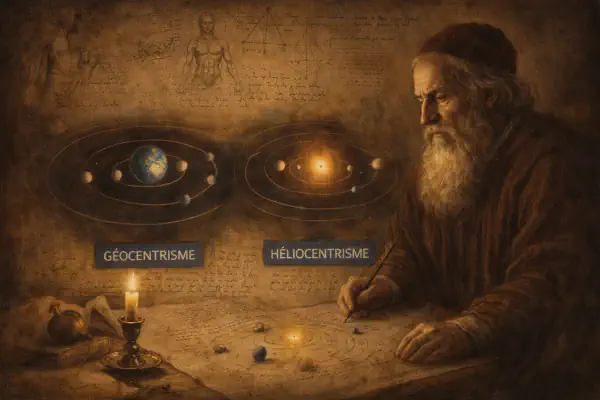
The Renaissance does not merely alter the appearance of the sky; it changes its logic. Since late Antiquity, the geocentric model, consolidated by Ptolemy, had placed an immobile Earth at the center of the world. This system was not merely astronomical: it carried a powerful philosophical and anthropological vision in which humanity occupied a central position within the cosmic order.
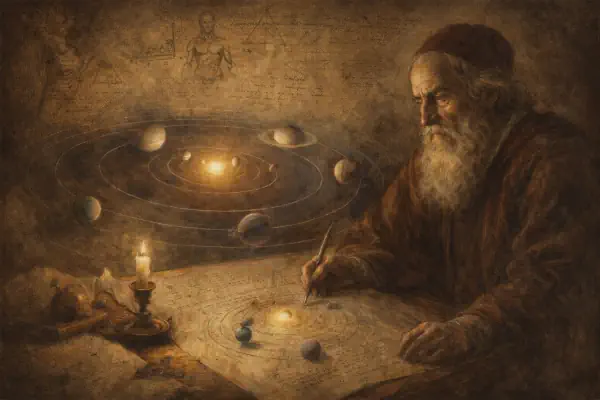
In 1543, Copernicus publishes a radical proposal: the Sun, not the Earth, occupies the center of the planetary system. This heliocentric hypothesis does more than shift orbits. It decenters humanity. It introduces the idea that our world may not be the absolute pivot of the cosmos, but a body in motion among others.
This intellectual displacement is vertiginous. It forces the sky to be reread, inherited traditions to be reconsidered, and the possibility to be accepted that a worldview can be corrected by a more coherent reading of reality. The galaxy is then inscribed within a much broader cosmic stage, where Earth becomes a position, not a metaphysical center.
Johannes Kepler: the end of perfect circles and the sky’s entry into law
Kepler’s work extends and deepens the Copernican revolution. Where the ancients still sought perfectly circular motions in keeping with the inherited geometrical ideal, Kepler demonstrates that planets follow elliptical orbits. The sky does not operate according to the imagined perfection of an ideal figure, but according to mathematical regularities that are subtler, more demanding, and truer.
This point is decisive. The Renaissance does not merely accumulate observations; it transforms the structure of explanation itself. The cosmos becomes calculable. Celestial trajectories can be described by laws, no longer only narrated through a symbolic or metaphysical order.
For the history of the galaxy, this transformation is immense. Even if the Milky Way is not yet understood as a spiral galaxy in the modern sense, a new age begins: one in which the sky can be interrogated through mathematical methods, instruments, and systematic comparison.
The end of a closed world: an imperfect, deep, and dynamic sky
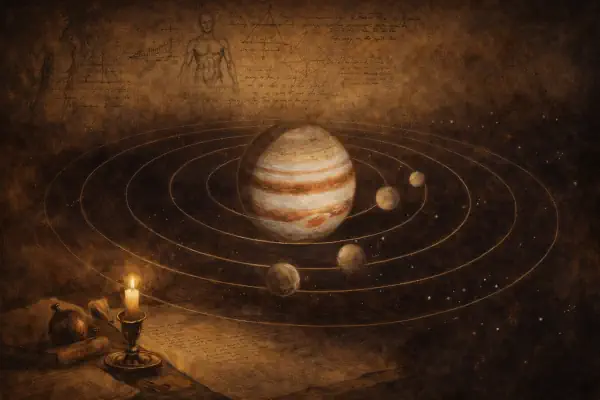
Instrumental observation also has another decisive consequence: it destroys the idea of a perfectly smooth, immutable sky separated from the earthly world. Galileo observes relief on the Moon, satellites around Jupiter, and the phases of Venus. The sky reveals itself as changing, structured, at times rough. It is no longer that pure and untouchable sphere opposed to the sublunar world.
This change in perspective directly affects the way the Milky Way is conceived. If it is composed of countless stars, then the sky gains depth. It is no longer a flat vault scattered with points, but a layered space crossed by distances, levels of visibility, and dense regions. The universe becomes broader than the naked eye or ancient schemes had ever allowed one to imagine.
It is here that the Renaissance accomplishes a major historical turning point: it replaces the closed, hierarchical, finite cosmos with a problematic, open, investigable cosmos. The galaxy no longer marks a symbolic boundary; it opens a question.
A new posture toward the cosmos: observe, measure, compare, doubt
What changes most profoundly during the Renaissance is not only the content of knowledge. It is the method itself. Modern science is born through a new requirement: to confront ancient inheritance with the test of reality, to multiply observations, compare results, correct errors, and accept that authority is no longer sufficient.
This posture transforms humanity’s relationship with the sky. The cosmos is no longer a mere reservoir of symbols, even if older imaginaries continue to exist. It becomes a field of inquiry. Vision becomes experimental. The telescope, calculations, tables, measurements, and the confrontation between hypotheses now constitute a new intellectual horizon.
What the Renaissance establishes permanently
- the use of instruments to overcome the limits of the naked eye
- the questioning of ancient models through observation
- the mathematical description of celestial motion
- a critical posture grounded in doubt, comparison, and evidence
The Milky Way is no longer simply contemplated. It becomes an analyzable object, inserted into a broader process of rationalizing the sky. The Renaissance does not yet know all the modern answers, but it definitively asks the right question: what is the sky really, once observed without the filter of inherited certainties?
From contemplation to scientific infinity
The Renaissance does not yet identify the Milky Way as a spiral galaxy among billions of others. It will take centuries more, new instruments, and additional theoretical revolutions to get there. But the point of no return has already been reached: the sky is no longer a closed décor governed by tradition—it becomes a territory of discovery.
By pointing a tube of glass toward the night, the thinkers and observers of the Renaissance alter humanity’s posture toward infinity itself. They accept that seeing more may compel us to think differently. The Milky Way, once read as a sign or a mystery, begins to be understood as a physical structure—immense, deep, and potentially measurable.
This is why the Renaissance represents a foundational moment in the history of the galaxy: it does not yet deliver the complete map of the cosmos, but it invents the modern way of searching for it.