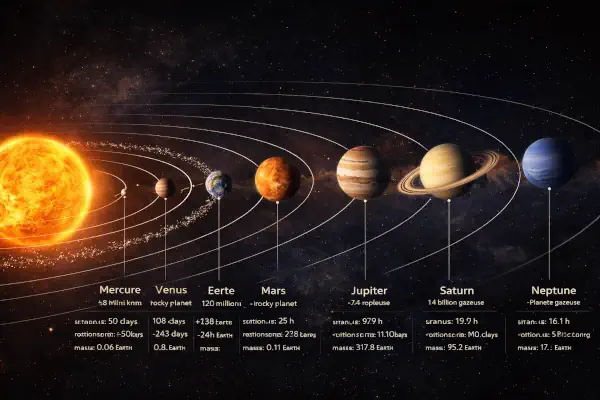
Why Mercury seems simple... and absolutely is not
Mercury is often the victim of a misunderstanding. Because it is small, rocky, and lacks the immediate exoticism of gas giants or ringed worlds, it is easily dismissed as a secondary planet. Yet its proximity to the Sun, its composition, and its physical behavior make it one of the most demanding objects in the inner solar system.
Studying it is difficult for very concrete reasons. Observing Mercury from Earth has never been simple: it remains close to the Sun in the sky, visible only during short windows, often drowned in the light of dawn or twilight. Even the space missions sent toward it must contend with a particularly constraining gravitational and thermal environment. Reaching Mercury does not simply mean “falling” toward the Sun; it also requires losing an enormous amount of speed in order to achieve a controlled orbital insertion.
This technical difficulty partly explains why the planet remained less well known than Mars or the Moon for such a long time. But it also explains the exceptional value of the data obtained when a mission such as MESSENGER succeeds in examining it closely. Mercury rewards scientific effort with a complexity that its austere appearance does not suggest.
Mercury fascinates because it combines the appearance of an austere world with such a density of physical enigmas that science is forced to revise its simplest models.
A planet of thermal extremes
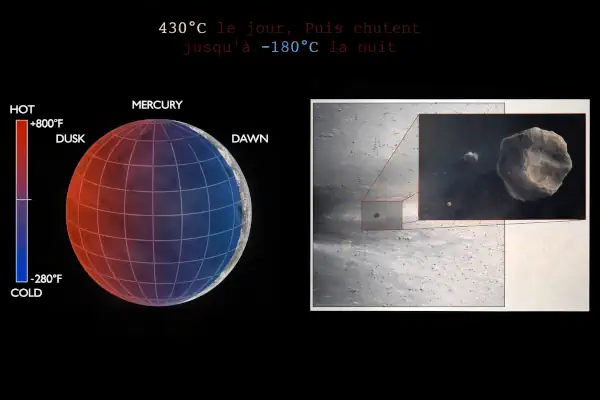
On Mercury, proximity to the Sun does not merely produce a very hot climate. It creates a radical situation. In the absence of a dense atmosphere capable of redistributing heat efficiently, the surface experiences violent contrasts between the illuminated face and the face plunged into night. The Mercurian day imposes temperatures capable of turning the planet into a mineral furnace. At night, heat escapes rapidly and the cold becomes extreme.
This thermal range should not be read as just another curiosity. It reveals a fundamental trait: Mercury absorbs almost nothing. It exposes its surface directly to the solar regime while allowing the night side to establish nearly opposite conditions. This behavior highlights the major difference between a bare rocky planet and a planet equipped with a protective, heat-redistributing atmosphere.
Mercury is therefore a textbook case. It shows that a world’s proximity to a star is not enough to describe its environment. Composition, rotation, surface geology, and the presence or absence of a gaseous envelope profoundly alter the thermal experience of a planet.
A surface that preserves the memory of its origins
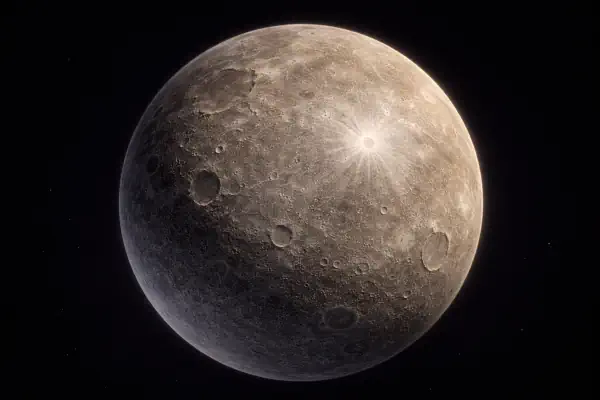
Mercury’s surface bears the marks of great antiquity. It is heavily cratered, to the point that in some places it evokes the Moon. But this visual resemblance should not hide Mercury’s specific character. Impacts, tectonic deformation, great basins, and traces of geological evolution make it a richer world than a simple motionless fossil block.
The Caloris Basin remains one of the most powerful symbols of this history. This gigantic structure bears witness to a colossal impact capable of disturbing the balance of the entire planet. Studying such landforms is not merely a matter of cataloging scars. It allows us to look back toward the intense bombardment of the early solar system and to question the way young planets were shaped by the violence of their environment.
What Mercury’s surface helps us understand
- the intensity of impacts at the beginning of the solar system’s history
- the persistence of ancient landforms on a world with almost no atmosphere
- the role of major basins, such as Caloris, in planetary reorganization
- the way a small rocky planet preserves the memory of deep time
Mercury must therefore be read as an archive. Its surface geology does not tell only its own story; it preserves part of the collective history of the inner rocky worlds.
The paradox of its magnetic field
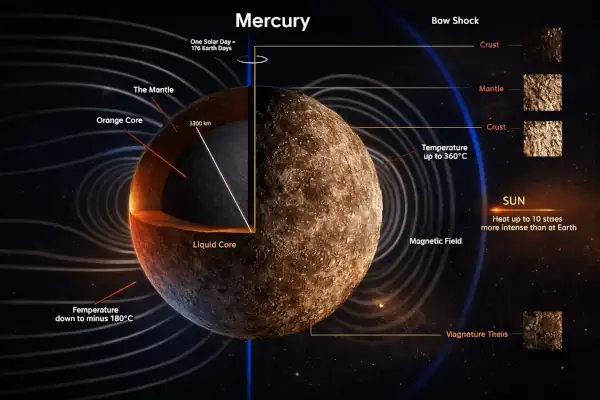
One of the great surprises associated with Mercury lies in its magnetic field. For a planet so small, the most intuitive theoretical expectations led researchers to imagine an interior that had largely cooled, incapable of maintaining enough activity to generate any notable global magnetism. And yet Mercury does indeed possess a magnetic field, weaker than Earth’s, but real enough to constitute a major scientific problem.
This paradox points directly toward its internal structure. Mercury seems to contain a proportionally enormous metallic core, occupying a very large fraction of the planet’s radius. That fact changes the way the planet is interpreted. It is not a standard small rocky body; it has a very particular internal architecture, one that conditions its density, its gravitational response, and its magnetic behavior.
Here again, Mercury shifts theory itself. It shows that a small planet can preserve more significant internal dynamics than expected, and that one must be wary of overly rapid classifications based on size alone.
MESSENGER transformed our understanding of Mercury
The MESSENGER mission marks a decisive turning point in Mercury’s scientific history. In orbit around the planet between 2011 and 2015, it delivered far more than improved cartography. It consolidated a new portrait of Mercury, denser, more technical, and far less intuitive than the one inherited from previous decades.
MESSENGER refined the planet’s topography, studied its surface composition, observed the singularities of its magnetic field, improved the evaluation of its internal structure, and revealed unexpected elements in the polar regions. Above all, the mission showed that Mercury can no longer be treated as a secondary case in the study of the inner solar system.
In editorial as well as scientific terms, MESSENGER changed the status of the planet itself. Mercury is no longer simply the first planet from the Sun. It becomes an object capable of testing our hypotheses about the formation of rocky planets, the evolution of metallic cores, and the interactions among surface, interior, and solar environment.
Ice on Mercury changed the story
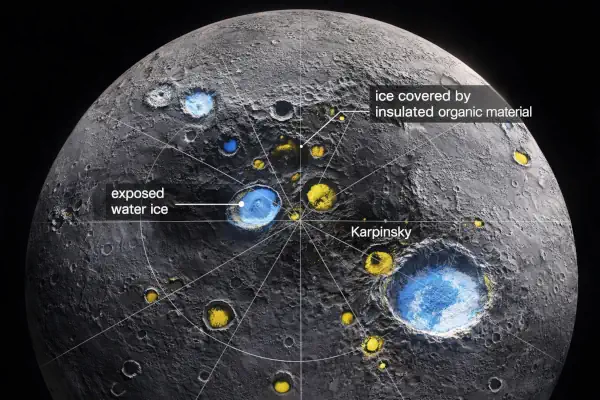
One of the most striking revelations of recent research concerns the presence of water ice in certain polar zones permanently plunged into shadow. This result appears almost counterintuitive for a planet associated with solar burning. And yet it underlines an essential rule of planetary science: the global conditions of a world do not always describe what happens locally.
Deeply shadowed polar craters function as thermal traps, capable of preserving volatiles over very long timescales. This discovery is not merely a spectacular contrast. It enriches our understanding of material cycles in the solar system and reminds us that even the most hostile environments can contain unexpected physical niches.
Mercury thus becomes an even subtler world. The planet closest to the Sun, far from being uniformly dried out and simple, combines extreme heat, radical cold, and local reservoirs of ice. Few planetary portraits offer such a dense concentration of contrasts.
Why Mercury matters for all of planetary science
Mercury matters not only because it is close. It matters because it forces us to rethink several fundamental questions. How does a small rocky planet acquire such a dominant core? How can a magnetic field persist in so compact a body? How does the surface record both the history of impacts and traces of internal evolution? And how can volatiles survive in an environment dominated by the Sun?
Why Mercury remains strategically important
- it sheds light on the formation and differentiation of rocky planets
- it tests models of metallic cores and planetary magnetism
- it preserves a very ancient geological memory of the inner solar system
- it shows that extreme environments can host unexpected local realities
In that sense, Mercury is not simply an early stop at the beginning of a tour of the solar system. It already condenses several of the most fundamental problems of planetary science.
What Mercury changes in the way we think about worlds close to the Sun
Mercury teaches us a methodological lesson. The worlds that seem closest and most familiar are not necessarily the easiest to understand. Proximity guarantees neither obviousness nor banality. On the contrary, it can conceal paradoxes that only long, instrumented, and patient exploration can reveal.
The first planet of the solar system is therefore not merely a stone desert exposed to light. It is an archive of origins, a test for planetary physics, and a demonstration of the humility required by science. Through Mercury, modern space exploration discovers that even the Sun’s immediate neighborhood still preserves a profound share of the unknown.
That is precisely what gives the subject its enduring strength. Mercury reminds us that the universe does not become less mysterious when it is nearby. It sometimes becomes more demanding.