The first visitor from another star system
ʻOumuamua is the first object identified with certainty as interstellar. Its hyperbolic trajectory immediately set it apart from ordinary comets and asteroids in the solar system. It was not orbiting the Sun. It was simply crossing our cosmic neighborhood before heading back into deep space.
That fact alone is enough to give it a historic place. Before 2017, interstellar objects belonged mostly to theoretical modeling. With ʻOumuamua, astronomy suddenly had a real case: fleeting, imperfectly observed, but solid enough to open a new field, that of directly detecting and studying visitors from elsewhere.
Its passage was brief, which explains much of the mystery. Astronomers had to work fast with an object already on its way out, faint, difficult to image, and impossible to approach. The ʻOumuamua case is therefore not obscure because no science was done. It is obscure because the object offered very little time and very little observable material.
Why ʻOumuamua immediately challenged existing classifications
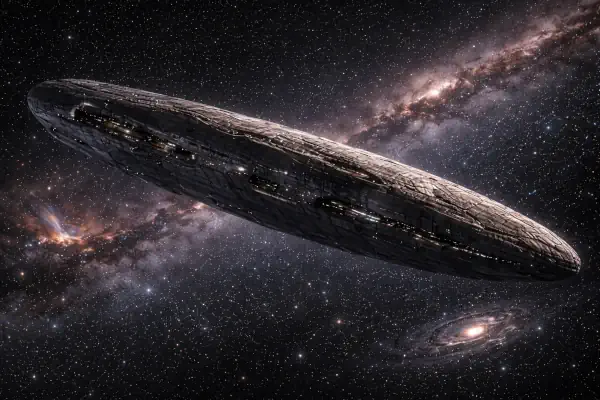
The object first surprised scientists because of its light curve, suggesting a very elongated or very flattened shape, far more extreme than those typically observed among small bodies in our solar system. Then there was no obvious cometary coma, even though a slight excess acceleration seemed to appear after its close passage by the Sun.
That precise point is what fueled the controversy. All objects accelerate and decelerate according to solar gravity. There is nothing strange about that. What caused debate was a small additional component, as if a weak but real force were slightly modifying its expected trajectory.
In a conventional scenario, such an effect can come from outgassing: a comet heats up, releases material, and experiences a push. But here, the absence of obvious cometary signs complicated the interpretation. Scientific caution therefore required two things at once: looking for plausible natural explanations, while not excluding the possibility that the object was more unusual than expected.
The features that made ʻOumuamua so unusual
- an unquestionably interstellar trajectory
- brightness variations compatible with an extreme shape
- no clear cometary coma during the observations
- a slight excess acceleration that is still debated
The real mystery of ʻOumuamua is not that it came from elsewhere. It is that it crossed our solar system leaving just enough data to raise powerful questions, without yet offering a definitive answer.
Natural explanations remain the strongest ones
Despite the appeal of an exotic scenario, the natural hypothesis remains the most robust position. Several models have been proposed: a fragment rich in unusual ices, a highly porous body, a flattened object pushed by radiation pressure, or the residue of a violent history in another planetary system.
That is precisely where ʻOumuamua’s scientific value lies: it forces us to broaden our sense of what a natural object can be. We still know very little about the true diversity of bodies produced in other stellar systems. It would therefore be premature to assume that a very strange object must be artificial simply because it does not resemble what we are used to observing near home.
That caution does not weaken the mystery. It makes it more rigorous. Serious science does not consist in choosing the most spectacular hypothesis, but the one that explains the most facts with the fewest extra assumptions.
Avi Loeb and the artifact hypothesis

Astrophysicist Avi Loeb gave the case global visibility by defending a hypothesis many considered too bold: ʻOumuamua might be a technological artifact, or at least an object whose artificial origin deserves to be examined.
In its most serious formulation, this did not mean a science-fiction spacecraft crossing space with obvious intent. The idea put forward was closer to a passive object, perhaps comparable to a lightsail, or to an ancient technological remnant drifting through interstellar space.
That proposal triggered a double discomfort. On one side, it fascinated the public because it immediately touched on the question of extraterrestrial civilizations. On the other, it irritated part of the scientific community, who saw it as too rapid an extrapolation from incomplete data.
Yet the issue deserves to be framed clearly: the problem is not that an artificial-origin hypothesis is forbidden. The problem is that it requires a level of evidence that ʻOumuamua, at this stage, still does not provide.
The real lesson: how science handles the unknown
ʻOumuamua reveals a productive tension between imagination and discipline. If we reject every unusual hypothesis in the name of intellectual comfort, we impoverish research. But if we turn an anomaly too quickly into proof of extraterrestrial intelligence, we leave scientific method behind and enter speculation.
The right balance is to hold together two demands: maximum curiosity and maximum rigor. In other words, examine everything, but assert nothing beyond what the data truly allow.
That attitude matters far beyond the case of ʻOumuamua. The coming decades will likely bring the detection of other interstellar objects. Some will be ordinary, others less so. The challenge will be not to be right too quickly, but to build, object by object, a more realistic map of cosmic diversity.
Why we do not have detailed images of the object
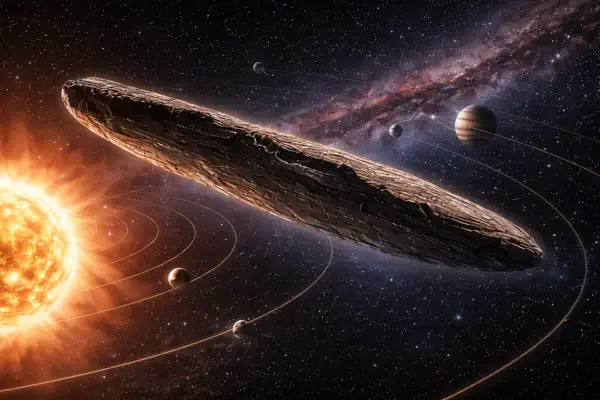
Many readers imagine that an object passing near the Sun should automatically be visible in detail. In practice, that is not how astronomical observation works. ʻOumuamua was small, dark, discovered late, and already heading away by the time its exceptional nature was fully understood.
Large telescopes therefore did not see a sharply resolved structure, but rather a point of light from which astronomers had to extract the maximum amount of photometric and dynamical information. That is a major difference: we observed its behavior, not its surface in a photographic sense.
This technical limit explains much of why so many scenarios remain open. An interception mission, or simply an earlier detection, might have been enough to settle the debate. Instead, we must work with indirect clues, which makes the discussion both more frustrating and more intellectually demanding.
ʻOumuamua is not a proof. It is a trigger for scientific clarity
As of today, no irrefutable evidence allows us to conclude that ʻOumuamua is an extraterrestrial artifact. But no honest reading of the case can deny that it is an exceptional object, unusual enough to justify sustained attention.
The value of this story therefore does not lie only in the final answer. It lies in what it reveals about us: our need to understand, our difficulty in dealing with uncertainty, and the way we draw the boundary between rigorous skepticism and automatic closure.
The next interstellar visitor will be observed with better tools, earlier, faster, and perhaps with a strategy designed from the outset for detailed study. ʻOumuamua will then have played its historical role: not as a conclusion, but as a scientific wake-up call. The cosmos sometimes sends us an enigmatic object. The real question is whether we will be ready when the next one appears.