Why Uranus remains a world apart in the Solar System
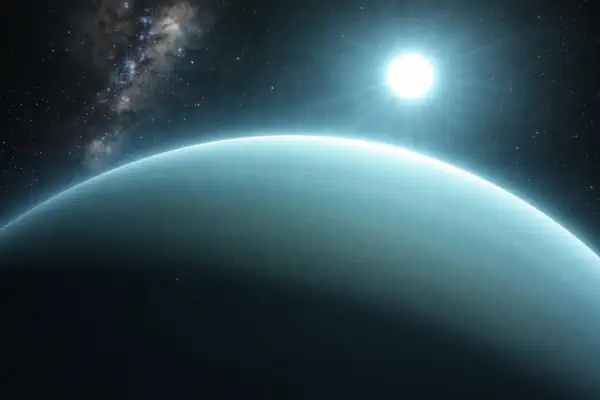
Uranus is not simply one more distant planet. It represents a limiting case for how we understand planetary worlds. Its blue-green hue, remoteness, and relative discretion have long pushed it into the background of the public imagination. Yet scientifically, its value is immense: Uranus combines physical, orbital, and magnetic properties that do not fit comfortably within the simplest models.
Where other giant planets project an impression of structural coherence, Uranus seems to accumulate singularities. It is often described as an ice giant, but that expression should not be misunderstood. This is not a world covered in solid ice in any Earthlike sense. The term primarily refers to a composition rich in volatile elements and to pressure and temperature conditions in which matter behaves in states profoundly unlike anything we experience at the surface of our own planet.
Uranus matters scientifically precisely because of this combination: a remote, rarely visited, visually restrained world that is theoretically explosive. The more closely it is examined, the more it forces planetary astronomy to rethink categories that had seemed almost too comfortable.
Uranus fascinates because it does not merely exist as an ice giant: it confronts science with a world that is tilted, off-center, apparently quiet, and still largely unexplored.
A planet almost lying sideways on its orbit
The most famous feature of Uranus remains its extreme tilt. With an axis inclined by about 98 degrees, the planet appears almost to roll around the Sun. This is not just a curiosity for comparison charts: it fundamentally alters how solar energy is received, redistributed, and experienced across the entire planet.
Such an orientation produces seasons that are wholly out of scale with anything familiar. Each pole can remain exposed to sunlight or plunged into darkness for extraordinarily long periods. On a human timescale, that means decades of radically asymmetric lighting conditions. This seasonal duration reshapes atmospheric dynamics, thermal contrasts, and the way researchers interpret observations.
One question remains at the heart of the scientific puzzle: how did Uranus acquire such an extreme tilt? The hypothesis of an ancient giant impact is often invoked, but it does not settle the debate. Other scenarios point to a more complex gravitational history, shaped by interactions and dynamic readjustments. In every case, the planet’s present state seems to preserve the memory of a violent past.

An ice giant whose internal workings remain blurred
Beneath its methane-tinted clouds, Uranus conceals an internal structure that remains difficult to reconstruct with precision. Current models point to a mixture of dense fluids, water, ammonia, and other components subjected to colossal pressures. Under such conditions, matter no longer behaves according to everyday intuition. The interior of Uranus is therefore less a simple stack of layers than an extreme laboratory for planetary physics.
It is in this context that striking hypotheses, such as carbon formations compared in popular science to diamond rain, have found a place in scientific storytelling. These scenarios must be handled with both seriousness and caution, but they underscore an essential reality: ice giants compel us to think about states of matter that lie far beyond terrestrial experience.
What makes Uranus especially difficult to model
- an internal composition still partly inferred rather than directly observed
- pressure and temperature conditions in which fluids behave in highly atypical ways
- limited knowledge of the planet’s deep energy circulation
- the absence of a modern dedicated orbiter able to gather long-duration, high-resolution data
This theoretical opacity is one of the reasons Uranus remains crucial to the future of planetary science. To understand this planet would also sharpen our interpretation of many comparable worlds now observed around other stars.
A magnetic field that refuses symmetry
Among Uranus’s most striking anomalies, its magnetic field occupies a central place. Contrary to the simple scheme one might expect, it is neither well aligned with the axis of rotation nor cleanly centered inside the planet. Instead, it appears tilted, displaced, and geometrically disorienting.
This behavior suggests that Uranus’s magnetic engine does not operate like the classical core too hastily described in simplified accounts. It may instead be linked to dynamic regions located higher within the planetary interior, in conductive layers whose behavior is far more complex. In other words, the planet does not merely defy the eye; it also defies the models used to interpret its internal activity.
For scientists, this magnetic field is not a technical footnote. It reveals clues about deep structure, internal motions of matter, and the way a planet builds its physical identity. Uranus thus stands apart as a world where magnetic geometry itself seems to tell a singular story.

The apparent silence of Uranus and the limits of interpretation
Uranus often projects the image of a calm world, almost asleep, especially when compared with Neptune and its fierce winds. Yet this visual sobriety can be misleading. In planetary science, what appears discreet is not necessarily simple. An atmosphere can hide as much as it reveals, and dynamics that seem unspectacular at first glance may conceal deep mechanisms that remain poorly understood.
This apparent reserve also contributes to the difficulty of the subject. Uranus does not immediately offer the theatricality of certain other planets. It demands more context, more patience, and more interpretive rigor. Perhaps that is also why it fascinates the public less than it should: it does not impose itself through visual obviousness, but it richly rewards scientific attention.
In that sense, Uranus reminds us of an important rule of research: what appears silent in the cosmos may be precisely what deserves to be studied again most urgently.
Voyager 2 and the great scientific frustration
Uranus has been approached only once by a spacecraft: Voyager 2, in 1986. That flyby was a historic moment, but also the beginning of a lasting frustration. A passing mission, however important, cannot replace prolonged, repeated observation conducted with instruments designed to current standards.
Since that singular encounter, the data have continued to nourish research, yet they remain limited compared with the scale of the unanswered questions. Scientists now want a dedicated mission capable of entering orbit, following the seasons, studying the magnetosphere, observing the atmosphere over time, and refining our understanding of the planet’s interior.
Uranus is therefore both known and unknown. It has been visited, but too briefly. It has been described, but not yet sufficiently explained. That tension between available data and persistent ignorance is precisely what gives Uranus its strategic importance in the future priorities of space exploration.
Why Uranus matters for the future of astronomy
Studying Uranus is not simply about completing an encyclopedia of the Solar System. It is also about preparing a better understanding of intermediate-size exoplanets, which are now abundant in modern catalogs. Ice giants form a crucial bridge between local astronomy and extrasolar astronomy.
Uranus, in particular, allows several decisive questions to be asked: how does a planet acquire an extreme tilt? How can a magnetic field become so strongly off-center? How does the internal structure of an ice giant organize its energy dynamics? And to what extent do our models remain valid when direct observations are rare?
At heart, Uranus is not merely a strange planet. It is a test of our ability to think about complex worlds without reducing them too quickly. The more we try to understand it, the more it reminds us that the Solar System still contains very real zones of ignorance. That is precisely where its intellectual power lies.