The sky was not always an object of science
For centuries, the sky was observed, commented on and interpreted, but rarely understood as a physical system governed by universal laws. The true rupture begins when Galileo turns his telescope toward Jupiter in 1610 and discovers that several bodies orbit a planet other than Earth. That gesture seems simple today; in reality, it was decisive. It demonstrated that our world was not the absolute center of all celestial motions.
This discovery did more than enrich astronomy. It changed the very structure of scientific thought. The sky ceased to be a theater of appearances and became a domain that could be measured, verified and challenged. From that moment on, observing the cosmos meant investigating the deep order of reality.
The solar system thus emerged as the first great laboratory of scientific modernity. Before looking toward distant galaxies, humanity first had to learn how to read its own cosmic neighborhood correctly.
Exploring the solar system means telling the story of how humanity learned to replace passive wonder with a methodical understanding of the cosmos.
Equations to explain the motion of worlds
In 1687, Newton formalized universal gravitation and gave science a tool of unprecedented power: the same law could now explain both the fall of a body on Earth and the path of a planet around the Sun. The sky and the terrestrial world no longer obeyed two separate logics. They belonged to one single physics.
This unification changed everything. The solar system became predictable. Orbits, velocities and gravitational perturbations could be calculated. Astronomy definitively left the sole realm of description and entered that of demonstration.
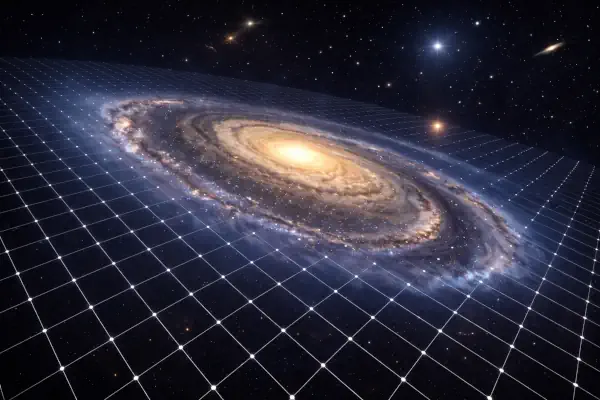
Then came Einstein, who profoundly reformulated our understanding of gravity. With general relativity, space-time was no longer a mere backdrop. It became a dynamic structure, curved by mass and energy. This new vision did not erase Newton in the ordinary uses of the solar system, but it revealed the deeper framework behind it.
What this scientific turning point made possible
- predict planetary trajectories with precision
- understand gravitational perturbations
- simulate complex systems on computers
- connect celestial mechanics to fundamental physics
The solar system is only one district of the Milky Way
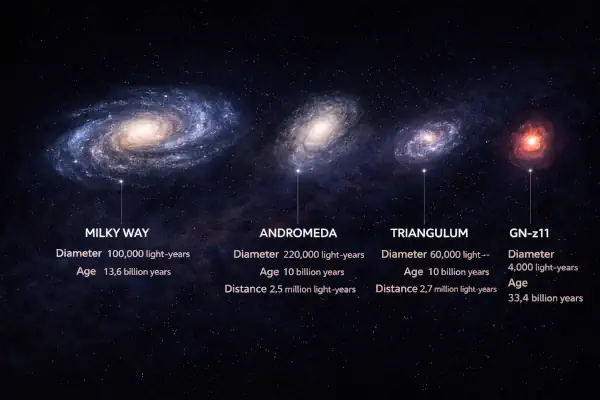
Understanding our solar system also requires placing it back on its true scale. It is not isolated in emptiness. It belongs to the Milky Way, a barred spiral galaxy containing hundreds of billions of stars. The Sun holds no central privileged position within it. It lies in a peripheral region of the galactic disk, far from the center where Sagittarius A*, the supermassive black hole of our galaxy, resides.
This perspective is essential. It reminds us that the solar system is not the whole cosmos, but a local structure within a vastly larger ensemble. Yet it is within this relatively modest space that humanity carried out its first major experiments in exploring reality.
The passage from planetary scale to galactic scale was also made possible by increasingly powerful instruments: ground-based telescopes, spectroscopy, radio telescopes, space imaging and large-scale computation. Hubble, in particular, profoundly changed our visual relationship with the universe. It did not merely show spectacular images. It gave historical and physical depth to what we were observing.
The Sun: gravitational center and energetic engine
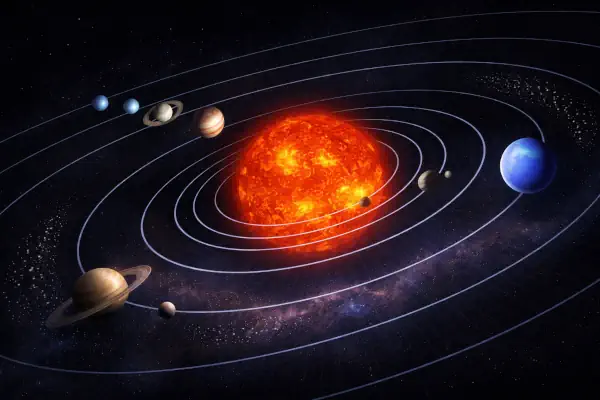
The solar system bears that name for a simple reason: the Sun is its dominant axis. It contains about 99.8% of the system’s total mass. This dominance is not symbolic; it structures the whole set of planetary motions. Orbits, resonances, velocities and cycles all depend first on this central presence.
But the Sun is not only a gravitational center. It is also the main source of energy in the system. Its radiation shapes surface temperatures, planetary atmospheric dynamics and the fundamental contrasts between rocky worlds, gas giants, icy moons and outer regions.
Studying the solar system without understanding the Sun would amount to describing an architecture without its engine. All planetary diversity derives, in one way or another, from the specific relationship each world maintains with this star.
Why the solar system remains a major archive of planetary formation
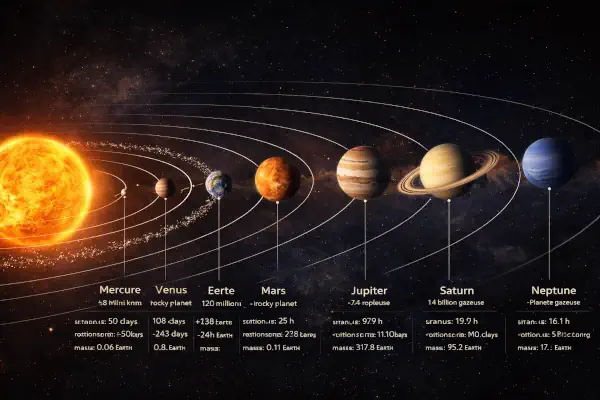
The solar system matters not only because it contains Earth. It is one of the best fields of study for understanding how planetary worlds are born. The rocky inner planets, the gas giants, the ice giants, differentiated moons, asteroids and trans-Neptunian objects form an extraordinarily varied ensemble born from a common history.
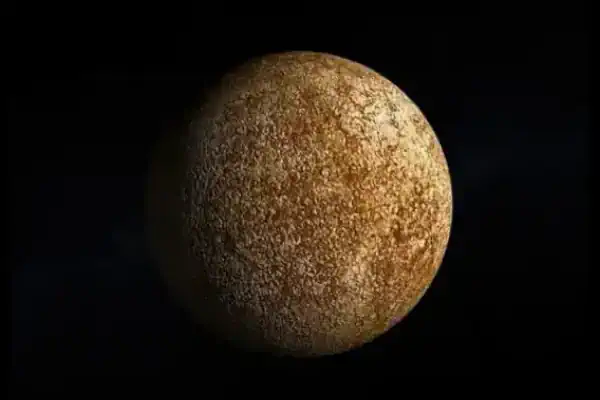
This diversity turns the solar system into a comparative archive. Mercury reveals thermal extremes and metallic density. Venus raises questions about runaway climates. Earth documents long-term habitability. Mars preserves traces of a wetter past. Jupiter and Saturn reveal the physics of giant planets, while Uranus and Neptune extend the investigation toward other planetary regimes.
By studying these worlds side by side, science does more than accumulate planetary portraits. It reconstructs the mechanisms of formation, migration, differentiation and evolution that shaped the entire solar neighborhood.
Voyager: when exploration ceases to be theoretical and becomes physical
The Voyager probes gave the solar system a new depth. They did not merely observe from afar; they crossed the outer planetary regions, photographed the giants, studied their magnetic fields, their moons and their environments, then continued toward the boundaries of the domain ruled by the Sun.
Their importance lies as much in their longevity as in their symbolism. They embody a stage where humanity no longer merely calculates worlds or looks at them from Earth: it sends instruments to them, makes them work across immense distances, and still receives data after decades of travel.
Voyager also reminds us that space exploration is not just a succession of iconic images. It is a technical infrastructure made of antennas, gravitational trajectories, limited energy, patient telecommunications and long-term scientific decisions.
Modern astronomy: seeing, measuring, simulating, connecting
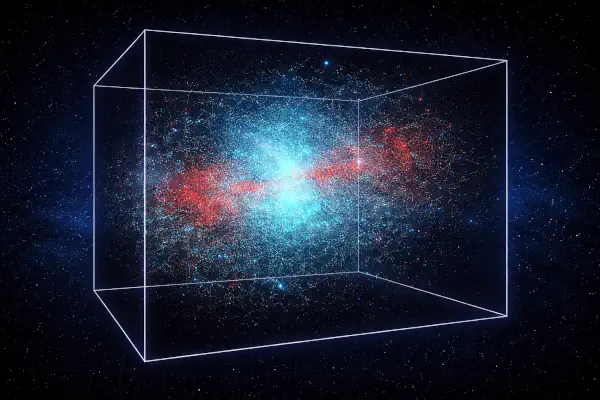
Our current understanding of the solar system rests on the convergence of several methods. Spectroscopy identifies compositions. Radio telescopes extend observation beyond the visible. Interferometry pushes resolution to extreme levels. Supercomputers make it possible to simulate complex dynamics. Probes, finally, bring local measurements impossible to obtain from Earth.
This accumulation of tools has not only improved the precision of the data. It has changed the very nature of astronomical knowledge. We no longer contemplate the solar system as a set of lights in the sky. We study it as a physical, dynamic, hierarchical and historical architecture.
The strength of contemporary astronomy
- observe worlds across multiple wavelengths
- measure their composition and environment
- simulate their evolution over time
- combine observation, theory and direct exploration
Why this journey retains a fundamental value
To visit the solar system intellectually is not to indulge in nostalgia for classical astronomy. It is to return to the place where the great scientific questions intersect most clearly: how worlds are born, why some become habitable, how gravity structures celestial architectures, and how far a civilization’s technical exploration can go.
It is also an excellent point of entry for thinking about the cosmos as a whole. Before searching for life elsewhere, we must understand Earth’s conditions. Before comparing exoplanets, we must know the planets of our own system. Before speaking of the universe, we must know how to read our neighborhood.
The solar system is therefore both a beginning and a synthesis. It concentrates enough diversity to open all the major branches of space science, while remaining close enough to be explored rigorously.
Knowledge as a lasting adventure
Exploring the solar system is not a simple inventory of planets. It is a story of method, intellectual courage and the gradual expansion of reality. Galileo shifted our gaze. Newton gave laws to celestial motion. Einstein reformulated gravity. Hubble broadened the visual horizon. Voyager carried the investigation to the farthest regions of the solar domain.
What we now call cosmic knowledge did not simply fall from the sky. It was built against illusions, through instruments, calculations, repeated observations and scientific patience. To read the solar system is to read the history of that intellectual conquest.
And that is precisely why the journey deserves to continue. Every planet, every moon, every probe and every measurement adds depth to a question that seems simple at first glance, yet immense in its implications: how did one fragment of the universe come to understand itself?