Why the galaxy has always fascinated humanity
Long before observatories, probes, and space telescopes, the night sky already stood as one of humanity’s first great open books. The stars guided journeys, structured narratives, and nourished religious, philosophical, and mythological visions of the world. The galaxy was not yet understood as a physical system; it appeared instead as a luminous, vast, mysterious, and almost sacred presence.
That fascination has never disappeared. It has merely changed form. What the ancients read as a sign or a symbolic figure, modern science began to read as an organized ensemble of stars, dust, gas, and dynamic phenomena. Wonder remained, but it was enriched by instruments, measurements, and models capable of transforming intuition into knowledge.
To understand the galaxy today is therefore not to deny the emotion of the first gaze lifted toward the sky. On the contrary, it is to extend that emotion through a more rigorous inquiry: where does this immense luminous band come from? Where is our Solar System located within it? And how did humanity learn, century after century, to read the universe with greater precision?
To understand the Milky Way is to move from a sky contemplated as an enigma to a universe studied as a real, immense, and still largely unexplored structure.
The Milky Way: a river of light turned into a scientific object
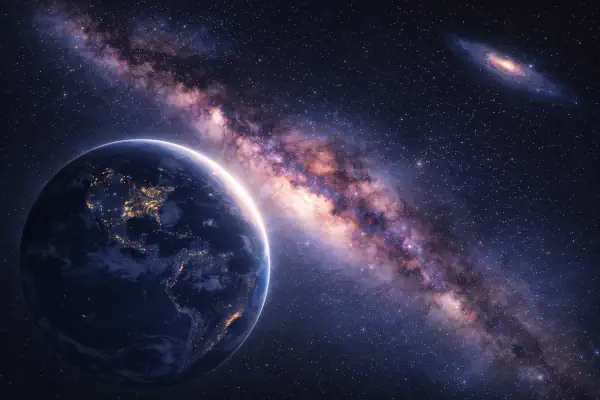
For a long time, the Milky Way was perceived as a luminous trail crossing the night. Its diffuse appearance inspired powerful narratives in many civilizations. And yet this pale ribbon is not a simple celestial backdrop: it is the partial view of our own galaxy, observed from within the very disk that contains us.
This idea changes everything. It means that we do not observe the Milky Way as an external object that can be easily identified, but as a structure in which we ourselves are immersed. Our gaze is therefore situated, limited, and partial. This starting point explains why understanding the galaxy required so much time: humanity first had to learn how to interpret a whole of which it is itself a part.
The Milky Way is not merely a poetic name. It is an immense cosmic organization of stars, gas, dust, and gravitational motion, within which our Solar System occupies only a modest position. That awareness deeply shifted our perception of the world: Earth is not the center of the sky, and our immediate environment is only a fragment of an infinitely larger whole.
From the Solar System to the edges of the cosmos: changing scale to understand
The Solar System represents our first level of cosmic proximity. It is the space within which scientific understanding could begin to take concrete form through regular observation of the planets, the apparent motions of the sky, and the laws of celestial mechanics. Yet it remains only a local neighborhood inside a far greater structure.
One of astronomy’s great difficulties lies precisely in this question of scale. What we casually call “space” in fact covers radically different orders of magnitude. Between the orbit of a planet, the size of a stellar system, the extension of a galaxy, and intergalactic distances, the human mind must constantly readjust its frames of reference.
A few essential reference points
- the Solar System is our immediate cosmic environment
- the Milky Way is the galaxy within which that system is embedded
- the stars visible to the naked eye represent only a tiny fraction of the observable cosmos
- understanding the universe requires thinking in structures, distances, and very long spans of time
This change of scale is what transforms astronomy into a major discipline. It does not merely name celestial objects: it teaches us to connect levels of reality, from the nearby to the immensely distant, from the visible to the invisible, and from ancient storytelling to scientific measurement.
The history of astronomy: a gradual revolution of the human gaze
Modern understanding of the cosmos did not appear all at once. It is the result of a long succession of intellectual revisions. Every age brought its own way of describing the sky, but also its own limits. The earliest narratives often placed humanity at the center of a stable cosmic order. The great scientific advances gradually displaced that centrality.
The Renaissance marks a major turning point. With the improvement of observational instruments and the emergence of more rigorous methods, the sky ceases to be only a symbolic décor. It becomes a field of study. Planetary trajectories, phases, motions, and the structure of the celestial world then begin to be described with unprecedented precision.
This shift did not merely transform astronomy. It altered intellectual culture itself. Observing the cosmos now meant accepting that reality could contradict inherited certainties, and that a universe far larger, more complex, and less centered on us might in fact exist.
From founding myths to instruments of measurement
Constellations long served as mental maps of the sky. They made it possible to organize observation, transmit stories, and connect the motion of the stars to familiar cultural frameworks. This phase is not anecdotal: it shows that knowledge of the sky often begins with a symbolic ordering of the visible.
But modern astronomy took shape when observation ceased to depend solely on the naked eye and interpretation. Instruments played a decisive role. They made it possible to see more, but above all to verify, compare, correct, and accumulate evidence. It is at that moment that the study of the cosmos became a science in the full sense of the term.
The history of the sky is therefore also the history of a change in method. Between contemplating the firmament and analyzing it scientifically lies a steady rise in rigor: measuring rather than assuming, confronting rather than merely affirming, and accepting that cosmic reality is far larger than first intuition had suggested.
Why the cosmos remains a territory of exploration
Despite the considerable progress of astronomy, the cosmos remains a domain of incompleteness. We have learned to situate Earth, to better understand the Solar System, to recognize our place within the Milky Way, and to identify many celestial structures. Yet that rise in understanding does not close the mystery: it displaces it and deepens it.
Every advance opens new questions. How do galactic structures form? How do stars and nebulae evolve across immense spans of time? What exactly is the place of our local environment within the great cosmic ensembles? Space exploration and astronomical observation do not merely confirm what we know; they constantly extend the inquiry.
This is precisely what gives the subject its enduring power. The cosmos fascinates because it combines visual beauty, historical depth, scientific rigor, and the awareness of our own smallness. In this perspective, the galaxy is never reduced to a spectacular image: it becomes a framework for reflecting on knowledge itself.
What this journey changes in the way we think about the universe
The true value of a journey through the galaxy does not lie only in accumulating information about stars or nebulae. It lies in the intellectual shift it produces. The more we understand the cosmos, the more we perceive how narrow our initial point of view was. Science does not strip the sky of its poetry; it gives it a new depth.
The Milky Way, the Solar System, the history of astronomy, and space exploration thus form a single trajectory: that of a humanity learning to step beyond itself in order to think on a larger scale. That movement is not finished. It continues each time an observation refines our representation of reality, each time an instrument reveals an ignored detail, each time a new question forces us to revise the old map of the world.
That is perhaps the true lesson of the cosmos: the farther we advance, the more we understand that the sky is not merely above us. It also redraws, at a deep level, the way we inhabit knowledge itself.