The modern era changes the very nature of the astronomical gaze
With the arrival of contemporary astronomy, the galaxy ceases to be an object merely observed and becomes a system quantitatively reconstructed. This shift is profound. For centuries, knowledge of the sky advanced mainly through improvements in optical instruments and the refinement of models. In the modern era, it also becomes a science of large surveys, massive databases, statistical inference, and multi-wavelength imaging.
This evolution changes the very nature of the knowledge being produced. It is no longer merely a matter of seeing better, but of linking billions of measurements, tracking stellar motions, comparing spectral signatures, modeling invisible structures, and reconstructing the dynamic history of the Milky Way across immense spans of time. The galaxy becomes at once a physical, mathematical, and computational object.
In that sense, galactic modernity is not merely a technical stage. It marks an intellectual change of scale. The nearby universe is no longer contemplated simply as a backdrop of stars; it is read as an evolving, complex, and partly hidden architecture.
The modern vision of the Milky Way begins when astronomy no longer seeks only to see more, but to transform the immense dispersion of celestial signals into a coherent map of reality.
Hubble: when observation truly leaves the ground
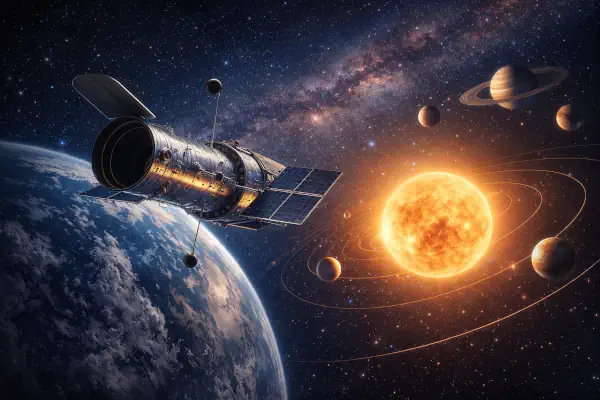
The Hubble Space Telescope played a decisive role in transforming our gaze. Placed above the atmosphere, it frees observation from part of the disturbances that had long limited visual sharpness from the ground. This gain in clarity is not merely a matter of image comfort: it changes the very quality of the information that can be extracted from clusters, star-forming regions, nebulae, and distant structures.
In the galactic context, Hubble helped make visible details that strengthened the structural understanding of the Milky Way and its environment. It also reinforced an essential idea: our galaxy is neither unique nor central. The modern era reads the Milky Way with precision, but always within a broader comparative framework, where other galaxies help position our own within a wider cosmic plurality.
Hubble’s symbolic reach is immense. The astronomical eye no longer merely perfects its lenses; it physically emancipates itself from the terrestrial medium in order to construct a cleaner, steadier, and more ambitious vision of the cosmos.
Gaia: the Milky Way becomes a three-dimensional measured object
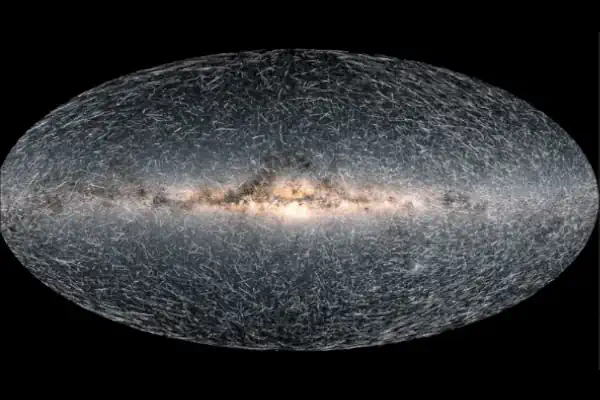
The Gaia mission represents one of the most important turning points in modern galactic knowledge. Its ambition is immense: to record the position, motion, and, for part of the objects, certain physical properties of more than a billion stars. Where classical astronomy patiently built partial maps, Gaia imposes the logic of a massive, homogeneous survey of exceptional precision.
This change produces a quiet but decisive revolution. The Milky Way is no longer described only through a general shape; it is analyzed through a network of positions, velocities, and trajectories. One can identify stellar streams, detect the traces of ancient galactic mergers, study the distribution of stellar populations, and approach the dynamic history of our galaxy with unprecedented finesse.
What Gaia’s modern mapping changes in concrete terms
- it gives three-dimensional depth to the study of the galaxy
- it links the position of stars to their actual motion through time
- it reveals gravitational scars left by ancient interactions
- it transforms the Milky Way into a large-scale dynamic system open to analysis
Gaia’s great lesson is clear: a galaxy is not merely a form in space, but a kinematic history made of displacements, absorptions, imbalances, and continuous reorganizations.
The galactic center is no longer merely assumed
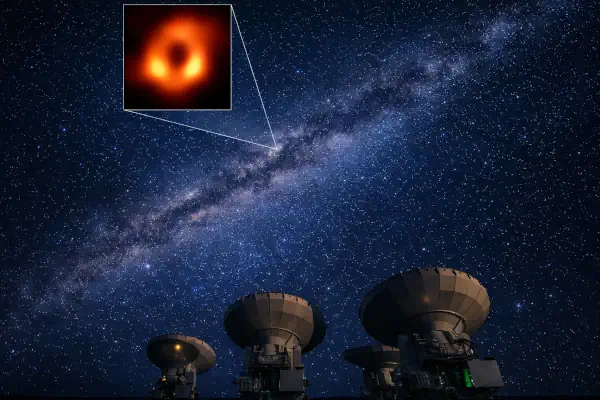
One of the major achievements of the modern era concerns the center of the Milky Way. Long thought of as a dense and difficult region to access because of dust and instrumental limitations, it is now studied with growing precision thanks to infrared and radio observation as well as very high-resolution imaging.
The confirmation of Sagittarius A* as the supermassive black hole at the heart of our galaxy marks a major turning point. With the Event Horizon Telescope, humanity crossed a considerable symbolic threshold: it obtained an image of the shadow of an object whose gravity structures the central galactic region. What was once theoretically suspected becomes an instrumental and visual reality.
The galactic center is no longer a simple abstract point in a calculation. It becomes an active, central, gravitationally dominant region around which an essential part of the modern reading of the Milky Way is organized.
Simulating the galaxy becomes a form of knowledge
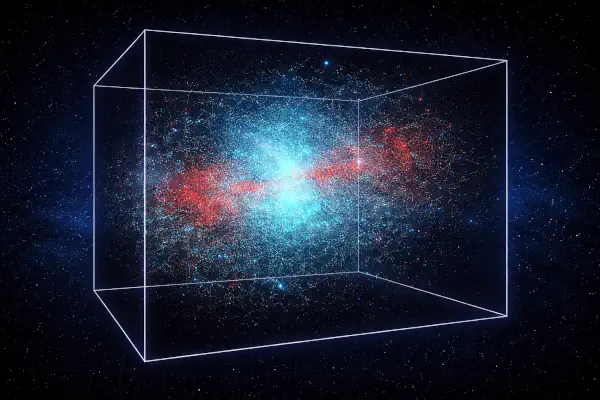
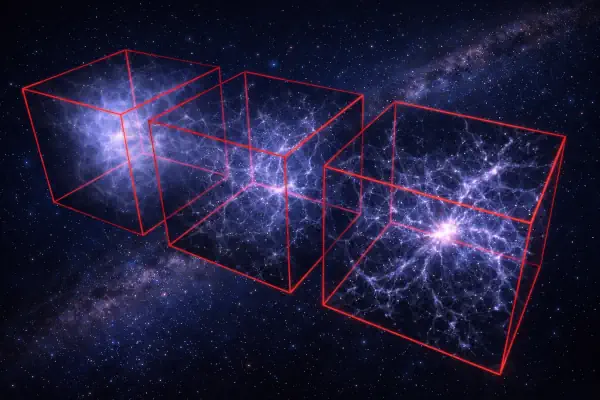
Modern astronomy no longer rests solely on direct observation. It also relies on numerical simulation as an instrument of understanding. Thanks to contemporary computing power, astrophysicists model the evolution of galaxies, large-scale gravitational interactions, the birth of spiral structures, the effects of dark matter, and the consequences of ancient collisions.
This simulation is not a mere pedagogical illustration. It makes it possible to confront hypotheses with observations, test evolutionary scenarios, connect current data to past and future phases of the galaxy, and reconstruct the Milky Way inside spaces of calculation.
The epistemological significance is major: to understand the modern galaxy is to accept that the visible is no longer enough. A great part of what structures it must be approached indirectly, through inference, modeling, and the confrontation between observed data and simulated worlds.
Dark matter and invisible structures impose a new reading
The modern era also teaches a more troubling lesson: what we see of the Milky Way does not exhaust what it is. Stars, nebulae, and luminous regions represent only part of the problem. In order to account for observed motions, orbital velocities, and large-scale stability, astrophysicists must integrate an invisible component: dark matter.
This notion is not a mere conceptual addition. It changes the very way the galaxy is mapped. The modern map is not only that of luminous objects; it also seeks to grasp the gravitational infrastructure that surrounds them. The galactic halo, mass distributions, and dynamical effects become as important as spectacular images.
Galactic modernity thus introduces a new demand: to read the invisible through its consequences. That is probably one of the greatest intellectual shifts in contemporary astronomy.
A complex, living, and historically marked galaxy
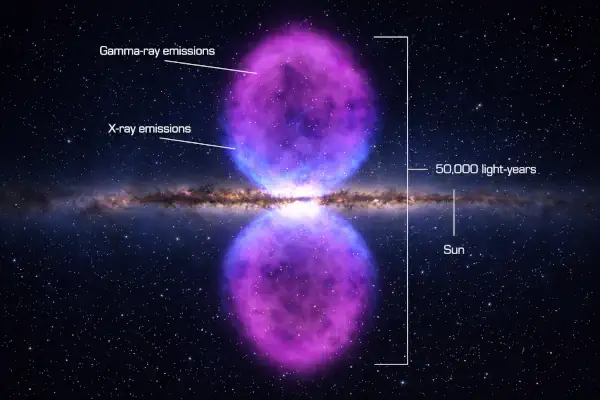
The modern Milky Way can no longer be reduced to a simplified spiral disk. It has a central bar, structured but unevenly defined arms, stellar populations of different ages, a halo, residual streams from ancient mergers, and large-scale energetic phenomena. Certain giant structures, such as the Fermi bubbles, remind us that the galaxy is not only vast: it is also active, stratified, and still partly enigmatic.
This more precise portrait does not produce a closure of knowledge. On the contrary, it reveals a new depth. The finer the maps become, the more irregularities, asymmetries, and traces of past events appear. The galaxy then resembles less a perfect system than an ongoing gravitational history accumulated across billions of years.
Modernity decentralizes even the Milky Way
One of the most powerful effects of this era is philosophical as much as scientific. After moving Earth from the center, then removing the Sun from all absolute cosmic centrality, modern research also places the Milky Way within a broader whole. Our galaxy belongs to the Local Group, interacts gravitationally with other systems, and is part of a cosmic web in which it is only one element among hundreds of billions of other galaxies.
Modernity does not merely humble the human ego; it expands the frame of reference. The galaxy we map with sophistication remains itself an average structure in an immense, expanding universe crossed by still vaster dynamics.
This realization does not diminish the Milky Way. On the contrary, it gives it its proper place: that of an extraordinarily rich system, but one that does not exhaust either the cosmos or the question of our position within it.
What the modern vision really changes in the way we think about the galaxy
The great transformation of the modern era lies in this synthesis: the galaxy is no longer only a luminous figure, nor even a global system inferred from afar. It becomes an object whose positions, motions, densities, anomalies, historical scars, and certain invisible structures can be measured. This rise in precision produces a new form of scientific humility.
The more powerful our instruments become, the more the complexity of reality unfolds. The modern mapping of the Milky Way does not abolish mystery; it makes it more demanding. It shows that contemporary knowledge does not consist in eliminating the unknown, but in giving it a more precise, verifiable, and intelligible form.
That may be the true signature of the modern era: a humanity capable of drawing maps of its own galaxy while understanding, in the same movement, how much the invisible continues to structure the visible.