
The Past Has Not Disappeared: It Still Organizes Part of Our Present
When we look at the first great civilizations, it quickly becomes clear that they did not merely invent ancient forms of power or knowledge. They developed durable frameworks: writing the rule, preserving the archive, planning production, observing the sky, healing, building, and symbolizing authority. These frameworks crossed centuries because they answered structural needs shared by every complex society.
Egypt and Mesopotamia are foundational in that respect. They show how a society can stabilize its functioning through visible signs, normative texts, tools of calculation, and iconographic traditions. Their legacy must therefore not be reduced to a few famous monuments: it also lies in the methods, administrative logics, and imaginaries they transmitted.
To understand this legacy is to recognize that the modern world was not born from a total rupture with antiquity, but from a long continuity made of reuses, adaptations, and transmissions.
To me, these first civilizations launched the evolution of human technology in the broadest sense. They did not only invent objects or monuments; they invented systems of administration, calendars, engineering, and transmission. That is why their heritage still feels profoundly modern.
The great ancient civilizations did not merely leave admirable ruins behind them: they transmitted ways of ordering the world, measuring reality, and making power intelligible.
Law Before the Modern State: When Writing the Rule Becomes a Force of Stability
In Mesopotamia, the Code of Hammurabi represents one of the clearest expressions of this desire to make law visible. Engraved in stone, normativity becomes public, identifiable, and durable. Beyond its famous formulas, this corpus reveals above all a decisive idea: social order does not rest only on custom or force, but on an explicit framework that can be consulted, interpreted, and applied.
In Egypt, the logic is different yet equally structuring. The principle of Ma’at associates justice, truth, and cosmic balance. Governing does not consist only in punishing or collecting taxes; it also means ensuring a just, stable, and intelligible order. In this perspective, administration, contracts, land management, and judicial decisions all participate in the same demand: maintaining the harmony of the social body.
What this legal heritage still transmits
- the idea that a complex society needs written, durable, and legible rules
- the recognition of civil responsibility and regulated exchange
- the deep relationship between justice, administration, and collective trust
Our contemporary legal codes obviously do not reproduce these ancient systems, yet they extend an essential intuition born very early: law gains legitimacy when it can be formulated, preserved, and made enforceable.
Mathematics, Astronomy, Medicine: Ancient Knowledge at the Heart of a Durable Rationality
Mesopotamia very early developed a culture of calculation and recording. Counting grain, measuring surfaces, distributing resources, or fixing commercial equivalences already required abstract procedures. Tablets, numerical systems, and scribal practices express an administrative intelligence of the world: one must quantify in order to organize.
In Egypt, observation of the sky and the rhythm of the Nile favored another form of rationality, closely linked to agriculture, the calendar, and prediction. Time is not merely lived; it is observed, ordered, and placed in the service of collective survival. This articulation between natural phenomena, practical knowledge, and public decisions announces a durable way of turning knowledge into an instrument of organization.
Ancient medicine extends this movement. Medical papyri testify to a methodical attention to symptoms, remedies, fractures, bodily care, and hygiene. Not everything there belongs to science in the modern sense, yet the effort to describe, classify, and transmit already reveals a technical culture of observation.
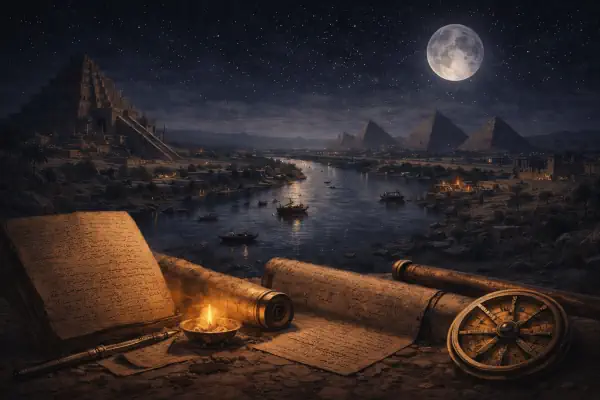
What I find powerful is that writing and calculation changed human destiny because they made the world more intelligible and more efficient at the same time. Administration, calendars, engineering, and transmission all emerge from that same movement: the human desire to organize reality so that it can endure.
Pyramids, Ziggurats, Irrigation: The Intelligence of Building and Administering Space
Great ancient constructions are not merely spectacular feats. They reveal coordinated forms of knowledge: geometry, extraction of materials, transport, organization of labor, hydraulic management, and political planning. A pyramid or a ziggurat is at once an architectural object, a sign of power, and the result of a complex technical chain.
Mesopotamian irrigation networks reveal the same organizational depth. To master water, distribute land, maintain canals, and secure harvests already required administrative, technical, and collective competencies of a high level. Ancient engineering is therefore not limited to isolated feats: it is linked to the governance of territory.
In the modern world, we continue to think about planning, infrastructure, and major projects through a comparable logic: measuring, coordinating, distributing, forecasting. Materials have changed and methods have improved, yet the mental structure of the monumental project remains strikingly close.
Art, Myths, and Symbols: A Visual Memory That Still Inhabits Our Imagination
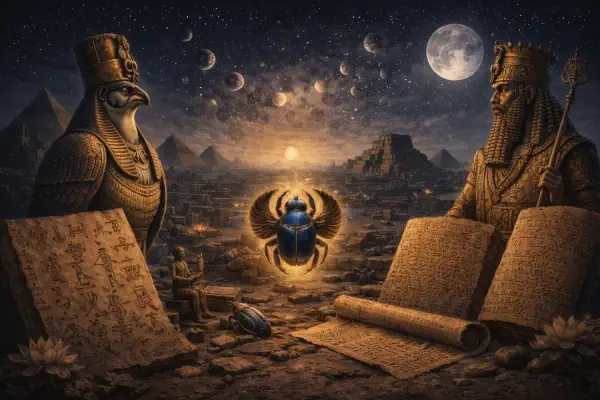
The civilizations of Egypt and Mesopotamia also bequeathed powerful forms of representation. The scarab, the pyramid, the ziggurat, the solar god, the hieratic king, hieroglyphs, and cuneiform signs are not mere ancient curiosities. They are visual and symbolic matrices that have continued to nourish architecture, the arts, publishing, narratives, logos, and the collective imagination.
This persistence can be explained by the force of their visual grammar. Each form binds an idea to a durable image: protection, eternity, the verticality of power, cosmic order, sacred memory. A civilization that produces such symbols creates more than a style; it shapes a way of imagining the world.
Why this cultural legacy remains alive
- it gives durable forms to notions such as authority, the sacred, and permanence
- it still nourishes art, literature, architecture, and contemporary visual culture
- it maintains a sensitive link between historical memory and collective imagination
What the First Civilizations Still Teach Us About the Transmission of Knowledge
One of the most decisive legacies of Egypt and Mesopotamia lies in their capacity to transmit. Writing, archiving, teaching, reproducing technical gestures, preserving narratives, formalizing practices: all of this made it possible for knowledge to outlive the life of an individual or the duration of a reign. A society becomes durable when it knows how to circulate what it has learned.
This continuity lies at the foundation of modernity itself. Our institutions, sciences, techniques, and even our cultural memory all rest on the possibility of collecting experience, reformulating it, and transmitting it to other generations. In this sense, the ancient civilizations are not only admirable for their achievements; they are foundational because they understood very early that knowledge not transmitted is knowledge lost.
The contemporary world therefore remains, in a certain way, the prolongation of that essential discovery: humanity advances when it knows how to transform experience into organized memory.
I see a direct continuity here with our own age. The internet, media, and social networks can be understood as a new liberation of writing: a vast extension of that ancient impulse to preserve, transmit, and share human experience beyond the limits of presence and time. The tools have changed, but the civilizational gesture remains the same.
Why the Legacy of Egypt and Mesopotamia Remains Foundational for Our Time
Written law, the administration of resources, observation of the sky, recorded medicine, monumental engineering, and the visual symbols of power are not marginal inventions of antiquity. They are long structures of civilization. They explain why ancient Egypt and Mesopotamia occupy such a singular place in human history: they reveal the moment when societies learn to make their knowledge, rules, and representations durable.
Their legacy remains alive because it touches questions we have never stopped asking: how to govern, how to count, how to predict, how to transmit, how to heal, how to build, how to give meaning to authority and time. The answers have changed, but the depth of the questions remains.
That is why these civilizations are not merely ancient. They remain contemporary through their effects. They belong to the past, yet they are still at work within the present.
My own reading is analytical, admiring, philosophical, and turned toward the future. The first civilizations founded our modern way of organizing the world because they understood that no society can endure without memory, administration, calendars, engineering, and transmission. To me, this is why Egypt and Mesopotamia remain so decisive: they did not simply produce an impressive past, they established mental and technical frameworks that still shape our institutions, our infrastructures, and even our digital culture. The modern world often believes itself radically new, yet a part of its deep architecture was already being drafted on clay tablets, papyrus, stone, and in the observation of the sky thousands of years ago.
