When seeing is no longer enough: we must instrument vision
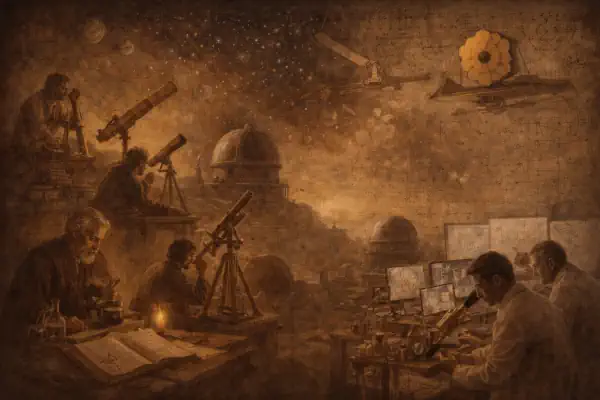
The optical revolution begins with a simple but decisive idea: the human eye is not enough. As long as observation depends on the senses alone, part of reality escapes knowledge. The appearance of polished lenses, and then their combination into instruments, opens a new age of proof. Seeing farther, seeing smaller and seeing more precisely becomes a technical operation.
This transformation is major because it changes the very status of observation. The instrument is no longer an accessory; it becomes a condition of access to reality. The sky, living beings and measured objects are no longer described from general impressions: they become observable under controlled, repeatable and comparable conditions.
This is where modern scientific vision is born. The world does not suddenly change its nature, but the way of grasping it changes radically. The lens, then the telescope and the microscope, introduce a technical mediation that gives science an unprecedented power: correcting the natural limits of perception.
Scientific modernity begins when the instrument becomes more than a tool: a legitimate way of seeing what the eye alone can neither distinguish, nor measure, nor prove.
The spyglass: bringing the horizon closer
The first major stage in this story begins with the spyglass. At the start of the 17th century, an instrument made of two aligned lenses inside a tube spread through the Dutch Republic. Its principle remained rudimentary, but its effect was spectacular: distant objects could be magnified and identified sooner than with the naked eye.
At first, the spyglass had mainly practical value. In navigation and military contexts, it made it possible to anticipate movement, identify distant sails and monitor positions. But its historical importance lies less in those uses than in what it made thinkable: human vision could be artificially enhanced.
With this invention, the horizon ceased to be a fixed limit. It became a technically adjustable space. What is visible was no longer defined by the natural capabilities of the eye, but by the quality of the lenses, their polishing, their alignment and the stability of the device.
Galileo: when the telescope enters astronomy
In 1609, Galileo Galilei took up the principle of the spyglass, improved the quality of the lenses and achieved far greater magnification than the earliest models. The decisive move was to divert the instrument away from military and maritime uses and turn it toward the sky.
What he observed overturned inherited certainties. The Moon showed relief, shadows and irregularities. Jupiter had satellites. Venus displayed phases compatible with motion around the Sun. The instrument did not merely provide new images: it produced facts that contradicted traditional cosmology.
From that point onward, astronomy became deeply instrumental. Observation of the sky was no longer only geometric or speculative; it relied on a technique of vision. The telescope changed the nature of scientific proof: what could be seen, recorded, compared and reproduced gradually prevailed over ancient authorities.
Kepler and dioptrics: understanding how the image forms
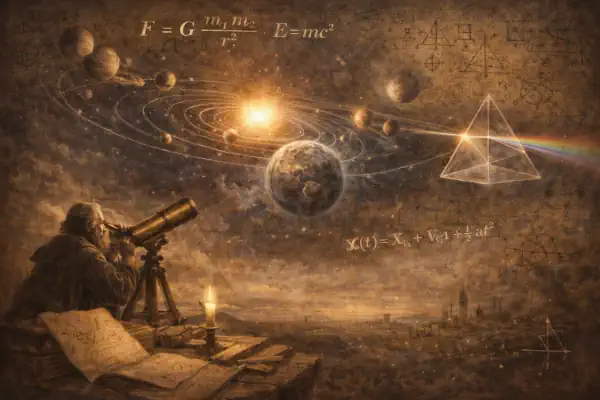
The optical revolution did not rely only on the ingenious tinkering of artisans. It also progressed thanks to theoretical formalization. With Johannes Kepler, optics gained a more rigorous mathematical framework. In the Dioptrice, published in 1611, he analyzed the way lenses form images and proposed a new telescope configuration.
This work was decisive because it moved the instrument from the realm of artisanal empiricism into that of optical calculation. The performance of a telescope no longer depended only on successive trials; it could be understood through the properties of refraction, the convergence of light rays and the relative position of the lenses.
Modern science gained a fundamental principle here: a good instrument is not only well made, it is also theoretically intelligible. Optics became a discipline where the quality of vision could be related to physical and geometric laws.
The microscope: revealing the infinitely small
While the telescope opened access to the infinitely distant, the microscope revealed another continent of reality: the infinitely small. At the end of the 16th century and the beginning of the 17th, the first combinations of lenses made it possible to magnify tiny objects and observe details invisible to the naked eye.
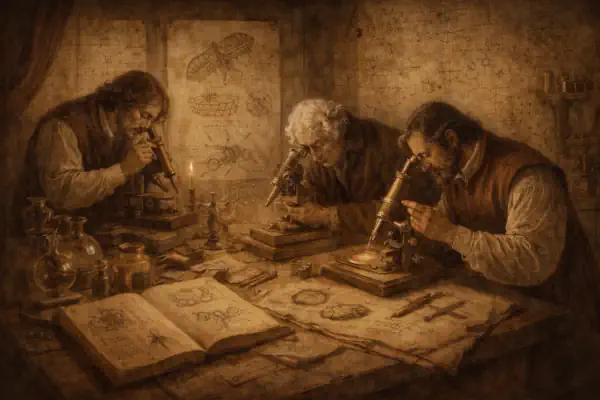
With Robert Hooke, this exploration took on spectacular scope. The publication of Micrographia in 1665 showed learned and cultivated audiences an unexpected world: the structure of cork, the surface of a needle, the anatomy of insects. The microscope did not merely embellish detail; it changed the very structure of the visible.
A few years later, Antonie van Leeuwenhoek pushed this exploratory power even further. Thanks to simple lenses of exceptional quality, he observed microorganisms, red blood cells and spermatozoa. Living matter then revealed an unsuspected depth. What had seemed homogeneous appeared populated, structured and dynamic.
What the microscope changes in knowledge
- it reveals a level of reality inaccessible to the naked eye
- it transforms the study of life into the observation of invisible structures
- it imposes the idea that reality has multiple scales of organization
Measurement and precision: fixing reality through number
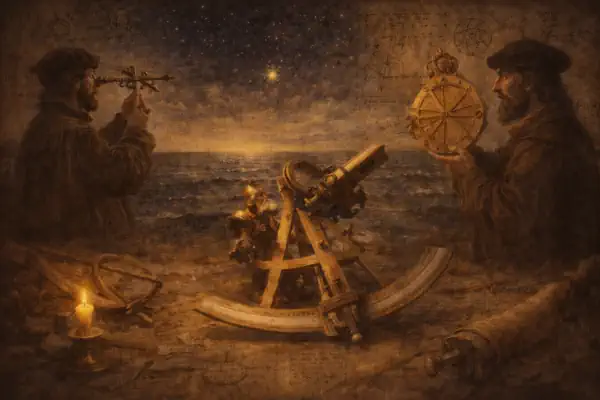
The instrumental revolution was not only about magnification. It also stemmed from the growing demand for precision. Seeing a phenomenon is one thing; measuring it reliably is another. With astronomers such as Tycho Brahe, and later with the improvement of graduations, verniers and micrometers, observation became quantifiable.
This development profoundly transformed scientific practice. A well-measured phenomenon can be compared, verified and corrected. It no longer depends only on a visual impression or an isolated testimony. It can enter a coherent series of observations, serving as the basis for mathematical laws or explanatory models.
The measuring instrument therefore does much more than add precision. It institutes a new discipline of vision. From then on, science required values, deviations, repetitions and protocols. Reality became more than observable: it became quantifiable.
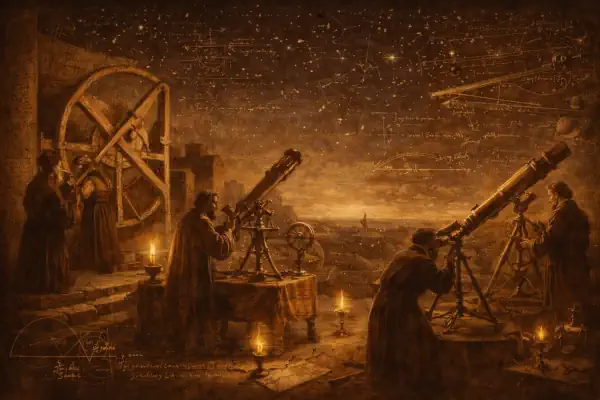
When the instrument becomes more credible than the text
One of the deepest consequences of this story is epistemological. For a long time, learned knowledge was largely built on the authority of ancient texts. Yet the telescope and microscope introduced an irreversible difficulty: what should be done when the instrument shows something different from tradition?
The answer did not impose itself immediately. Contemporaries wondered: is the instrument reliable? Does it produce illusions? This very distrust is what led to multiplied verifications, improved glass, stabilized assemblies and repeated observations. Gradually, trust no longer rested on the prestige of an author, but on the reproducibility of results.
This shift was fundamental. Truth was no longer based primarily on inherited authority, but on the agreement between observation, instrument and method. Modern science was thus born from a new hierarchy of proof: seeing through an instrument, measuring, repeating and comparing.
From glassmakers’ workshops to modern observatories: a lasting legacy
What took place in glassmakers’ workshops, lens makers’ shops and scholars’ cabinets was not a mere technical parenthesis. It was one of the foundations of modern science. Large telescopes, modern microscopes, laboratory instruments and the most advanced measuring devices all extend, in their own way, that first optical conquest.
The Renaissance did not yet invent giant observatories or electron microscopy, but it imposed the logic that would make them possible: to know, one often has to mediate vision. Reality is broader and deeper than what raw senses can grasp.
This is why the history of optics is also a history of scientific humility. It reminds us that the human eye, left to itself, is insufficient. But it also shows that this limit can be overcome through technical intelligence. Polishing a lens is already transforming the field of knowledge.