
A gradual exit from prehistory, not a sudden rupture
The end of prehistory cannot be reduced to a single magical date. It designates a process during which certain societies acquired new capacities: producing surpluses, stabilizing settlements, structuring power, recording information and transmitting memory over time. Depending on the region of the world, this transition unfolded at very different rhythms.
What changed profoundly was not technique alone, but the scale of organization. Human communities no longer lived only according to the immediate rhythm of available resources. They began to plan, accumulate, exchange, organize hierarchies and think of themselves as more stable political entities. The end of prehistory therefore corresponds to the emergence of a new form of social complexity.
In that sense, the end of prehistory does not mean the disappearance of the Neolithic world, but its extension toward societies capable of producing administration, institutions and, ultimately, written history.
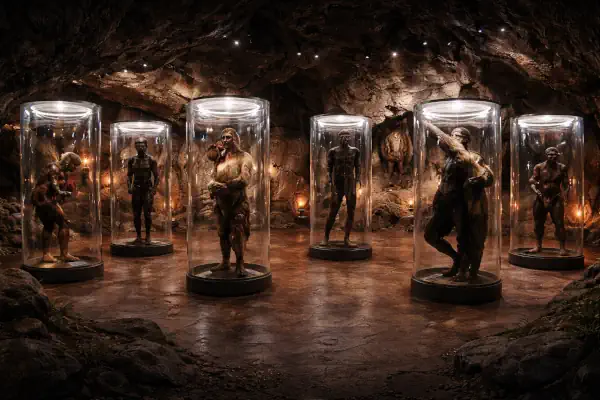
The end of prehistory begins when human societies no longer transmit their world only orally, but learn to administer it, inscribe it and make it endure.
Sedentarization, surplus and specialization: the foundations of the first civilizations
One of the essential drivers of this transition was sedentarization. Once agriculture and animal husbandry ensured a more regular production of food, human groups were able to settle more permanently. Villages grew stronger, constructions became more lasting, reserves expanded and the collective management of resources became central.
Food surpluses profoundly altered the social balance. They enabled some individuals to devote themselves to tasks other than subsistence alone. Specialized roles appeared: craftsmanship, trade, religious management, political organization. The group ceased to be a simple community of survival and became a society structured by distinct functions and by more clearly defined relations of power.
This evolution also encouraged a growing intensification of exchange. Raw materials, techniques and objects circulated more widely. Settlements became economic, symbolic or political poles, foreshadowing the formation of the first proto-urban entities.
The major transformations of this period
- lasting settlement of populations around exploited territories
- accumulation of surpluses and diversification of social functions
- emergence of powers capable of organizing and controlling resources
Before writing: proto-writing as functional memory
Before writing became capable of transcribing a complete language, certain societies developed intermediate systems designed to preserve simple forms of information. Proto-writing did not yet narrate the world; it recorded it in practical ways. Tokens, marks, accounting signs and systems of classification were used to track goods, reserves and exchanges.
These systems show that economic and administrative complexity often preceded writing in the full sense. When a group had to count livestock, measure harvests or validate transactions, it needed a memory more reliable than human recollection alone. Proto-writing responded to that necessity by transforming information into material traces.
It therefore constitutes a decisive stage, because it prepares the passage from simple symbolization to a more abstract and standardized inscription. In other words, it already announces a society beginning to govern itself through signs.
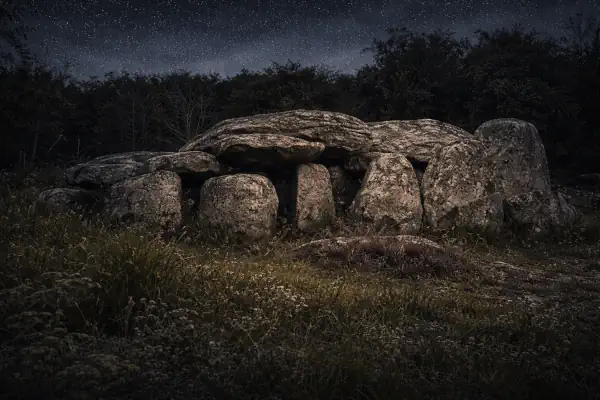
The emergence of writing around 3300 BCE: a decisive threshold
The appearance of writing around 3300 BCE, especially in Mesopotamia, is one of the most widely used markers of the entry into History. With the first cuneiform systems, information was no longer merely counted or symbolized: it could be fixed, organized and gradually developed into administrative, legal, religious and cultural records.
This shift was immense. Writing made it possible to preserve decisions, record levies, formalize obligations and transmit knowledge without relying exclusively on oral memory. It enabled a broader, more stable and more impersonal administration. Societies could now govern over longer durations and on greater scales.
Writing was therefore not simply a graphic innovation. It became a political and cultural infrastructure. It made archives, law, inventories, narratives and then history itself possible. From the moment information could be inscribed, societies acquired a new documentary depth.
From city-states to the first states: why Sumerian civilizations matter so much
Sumerian city-states illustrate this turning point in exemplary fashion. In these societies, writing accompanied the concentration of power, the organization of the economy, the management of temples and the structuring of durable political authority. Archives were not merely a by-product of civilization: they directly participated in its construction.
The first states emerged precisely when centralization became strong enough to organize works, collect resources, distribute functions and impose common rules. Writing reinforced this movement, because it made continuous administration possible through accounts, lists, decisions and models of legitimacy.
A virtuous circle was then set in motion: the more complex society became, the more it needed writing; the more it wrote, the more it could grow in complexity. It is this dynamic that opened the way to the great civilizations of the Ancient World and to historical Antiquity.
Why this transition leads directly into Antiquity
The end of prehistory prepared Antiquity because it established the structures that make historical civilizations possible: lasting sedentarization, political hierarchies, organized economies, complex symbolic systems and inscribed memory. Once these elements were brought together, societies could move beyond the sole management of the present in order to plan, legislate, transmit and narrate themselves.
This transition did not concern technique alone. It changed the way humanity thought about itself. With writing, founding narratives, laws, inventories and political decisions could be preserved. Communities became historical entities conscious of their continuity, their power and their past.
To enter Antiquity is therefore to enter a world in which memory is no longer only lived, but organized. The end of prehistory marks precisely this moment when human societies begin to leave traces durable enough to become readable across the long span of time.
