
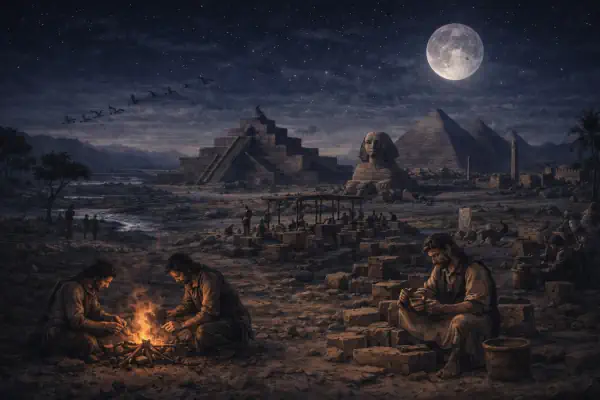
From the Neolithic to the first complex societies
Around 10,000 BCE, at the end of the last Ice Age, certain regions of the world became more favorable to agriculture. Human groups began to settle, cultivate, store, and raise livestock. This Neolithic transition did not yet create civilizations, but it prepared the essential conditions for them: surplus production, sedentary life, task specialization, and demographic growth.
A few millennia later, around 3500 BCE, another threshold was crossed. In certain river valleys, human organization became dense enough to produce urban centers, administrative hierarchies, storage systems, irrigation techniques, and forms of centralized power. This is where the history of the first civilizations truly begins.
Egypt and Mesopotamia occupy a decisive place in this process. They are two major centers where humanity learned not only to live together on a large scale, but also to make that organization durable.
With Egypt and Mesopotamia, humanity did not only invent monuments or kingdoms: it invented systems capable of organizing time, water, memory, and power.
The Nile, the Tigris, and the Euphrates: rivers that produce a world
The valley of the Nile in Egypt and the region between the Tigris and the Euphrates in Mesopotamia share a fundamental trait: civilization developed there around water. Intensive agriculture, collective survival, and urban growth depended directly on the ability to manage floods, canals, dikes, and reserves.
This mastery of water was not a minor technical detail. It required social coordination, the ability to anticipate, to distribute labor, and to stabilize harvests. In other words, rivers did not only feed the fields: they were already shaping institutions.
The difference between the two worlds was also decisive. The Nile offered more regular and predictable floods, favoring a certain territorial continuity. Mesopotamian rivers were more unstable, which pushed local societies to develop more fragmented, but also highly innovative, forms of adaptation and management.
Cities, power, and administration: the birth of the first states
Around 3300 BCE, Uruk emerged as one of the first great urban centers in human history. There we find concentrated populations, monumental temples, specialized districts, and administrative structures capable of coordinating resources and labor. The city was no longer only a place to live: it became a machine for collective organization.
In Egypt, the unification of the kingdom around 3100 BCE, traditionally associated with Narmer, marked another major step. The territory was no longer merely occupied: it was governed. Central power, resource management, monumentality, and royal ideology came together to form a durable state.
What these first civilizations put in place
- collective management of water, harvests, and territory
- cities capable of organizing labor, production, and authority
- forms of administration that made it possible to preserve the memory of exchanges, laws, and decisions
With them, humanity invented a new scale of cooperation. The village became a city, the community became an administration, and the territory became a political space.
When writing turns memory into an institution
One of the most decisive thresholds was crossed between 3400 BCE and 3200 BCE. In Mesopotamia, to record harvests, stocks, exchanges, and taxes, signs were inscribed on clay tablets: this was the birth of cuneiform writing. Writing first appeared as a management tool, not simply as a literary expression.
In Egypt, hieroglyphs emerged at roughly the same period. Here too, writing served to fix power, rituals, names, accounts, and transmission. The change was immense: memory ceased to be purely oral. It became material, transmissible, and archivable.
Once a society writes, it can record its laws, beliefs, techniques, decisions, and narratives. Writing does not merely add a tool: it transforms the relationship a civilization has with time itself.
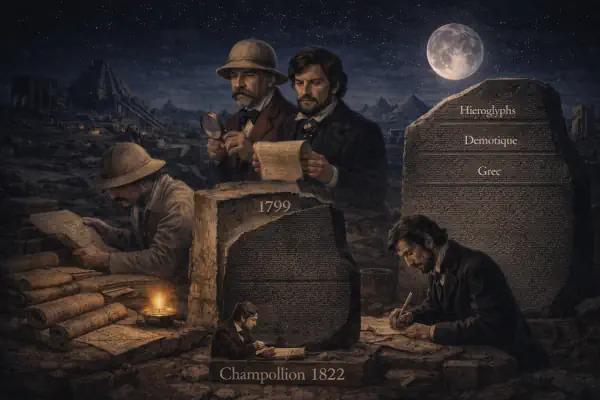
Building, counting, measuring: the first great techniques
Between 3000 BCE and 2000 BCE, Egypt and Mesopotamia developed technical knowledge of remarkable coherence. Mesopotamians used a sexagesimal system whose legacy remains in the measurement of time and angles. Egyptians mobilized geometry to organize lands, restore boundaries after floods, and plan major works.
Astronomy, observed without modern instruments but recorded with rigor, served to create calendars, anticipate seasons, and stabilize agricultural and religious life. Medicine, attested in various papyri and administered practices, also shows that these societies did not merely believe: they observed, classified, and transmitted.
This point is essential to understanding their legacy. These civilizations were not only monumental; they were also procedural. They counted, noted, distributed, standardized, and memorized. They invented a culture of managing reality.
Why Egypt and Mesopotamia mark humanity’s entry into History
The importance of Egypt and Mesopotamia lies not only in their antiquity. It lies in the fact that, with them, humanity became legible to itself. From the moment writing appeared, events, reigns, laws, exchanges, and beliefs were no longer reconstructed solely through archaeology: they were also transmitted by those who recorded them.
Prehistory did not disappear all at once, but a methodological boundary emerged. The past ceased to be inferred only from objects; it also became narrated, recorded, dated, and compared. It is in this deep sense that one can say History begins.
By making possible the city, administration, writing, the memory of power, and the first major collective techniques, Egypt and Mesopotamia laid the invisible foundations of almost all later civilizations. They are not only at the origin of an ancient world; they are at the beginning of our very way of organizing the human world.
