When Water Becomes the Condition of the City
Before it became a monumental capital, Rome faced a basic constraint: supplying water to an increasingly dense population. Wells, cisterns, and the Tiber were enough for a modest city at first, but they quickly proved insufficient to sustain urban growth, everyday hygiene, and the security of an expanding built environment.
It is from this necessity that aqueducts take on their full meaning. They were not born from a simple taste for technical prowess: they answered a structural problem. A great city cannot endure without a continuous, reliable, and controlled supply. In Roman thought, water therefore ceased to be merely a domestic concern and became a political, sanitary, and territorial issue.
The inauguration of the Aqua Appia in 312 BCE, under the authority of Appius Claudius Caecus, marks a major turning point. For the first time, Rome decided to seek farther from its walls a purer, steadier, and better controlled water source. The conveyance of water thus became an act of urban organization as much as an act of engineering.
To me, Rome offers an example that remains strikingly clear: to master water is to make the city possible. That is one of the deepest lessons of Roman civilization. A city may display monuments, power, and culture, but none of that truly endures if the essential resource is not secured first. Rome understood very early that governing water meant governing the conditions of urban life itself.
Roman aqueducts do not transport water alone: they transport the material conditions that make a durable city possible.
The Gradient: The Detail That Holds the Entire System Together
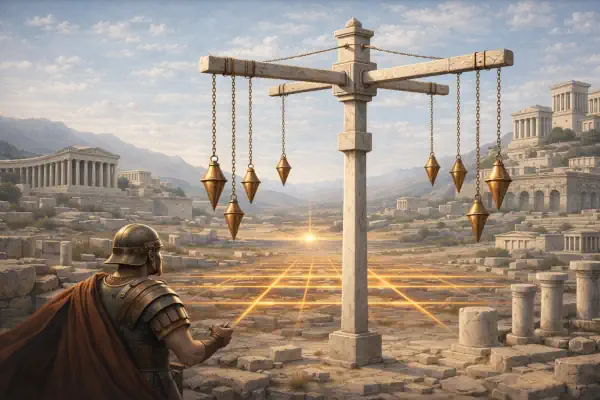
Contrary to a spectacular but inaccurate image, the power of Roman aqueducts did not rest on mechanical force or on complex machines. It rested first on a very fine understanding of gravity, gradient, and flow rate. Water had to move without stopping, without rushing uncontrollably, and without damaging the conduits.
The whole challenge lay in maintaining an inclination regular enough to ensure flow over long distances. If the gradient was too slight, the water slowed and deposits accumulated. If it was too steep, structures were weakened and distribution became unstable. This intelligence of balance is one of the most remarkable aspects of Roman hydraulics.
What Roman engineers had to master
- capturing water that was stable, clean, and sustainably usable
- maintaining a regular gradient over miles, despite changes in relief
- preserving a flow compatible with urban and collective needs
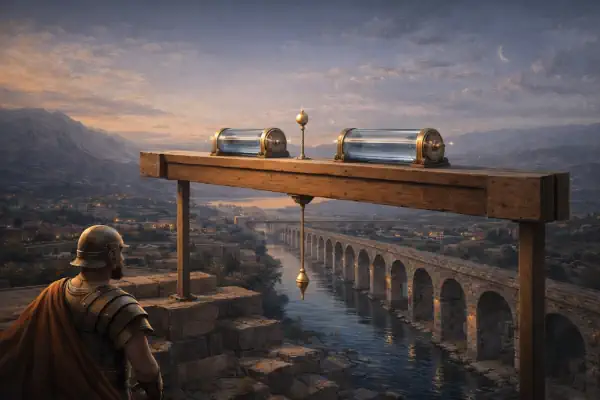
To achieve this, the Romans used instruments such as the chorobates, described by Vitruvius, which made it possible to control horizontality and variations in level with great reliability. It was not a spectacular technology: it was a precise, repeatable, and sufficient technology capable of turning water into a technical datum.
What I find especially inspiring here is the sobriety of the solution. Rome reminds us that decisive infrastructure does not always depend on visible technological excess. It often depends on precision, balance, and maintenance. In our own era of resource management, ecological transition, and sanitary safety, that lesson matters enormously. The quality of a system is often decided by the intelligence of its invisible details.
Building Without Violating Either Water or Terrain
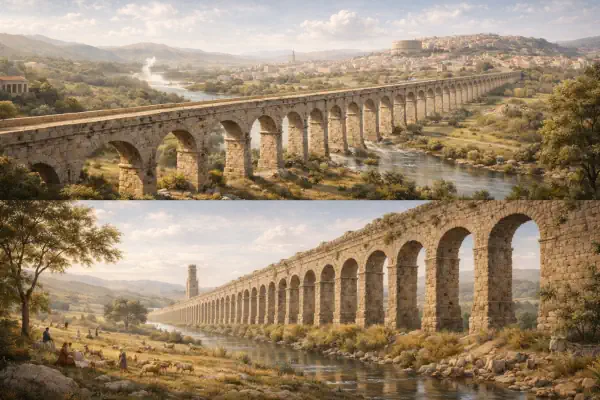
Popular imagery retains above all the great monumental arches. Yet the majority of a Roman aqueduct was often underground. This solution protected water from heat, limited exposure to pollution, reduced sabotage, and stabilized the route. The great visible arcades represented only one part of the system, deployed when the relief required a valley or obstacle to be crossed.
The conduits, known as specus, were lined with a hydraulic mortar, opus signinum, intended to ensure watertightness. Roman engineers also knew how to dig tunnels, multiply access shafts, distribute loads, and adapt materials to the terrain. In more complex zones, they resorted to inverted siphons or to arcade structures in order to preserve continuity of flow.
The Pont du Gard, built around the middle of the first century CE, remains one of the most famous examples of this mastery. But it should be understood as a fragment of a broader logic: the entire Roman work aimed at the continuity of the network, the stability of flow, and the durability of infrastructure across time.
This is also why Roman aqueducts still speak so directly to the present. They show that infrastructure is not just an object; it is a chain of foresight. Today we speak of maintenance planning, resilience, network safety, and sustainable design. Rome already teaches the same principle in another language: to build well is not only to construct, but to anticipate wear, protect the resource, and respect the terrain through which the system must endure.
When Water Distributes Hygiene, Comfort, and Urban Life
In Rome, water never served only one use. It supplied drinking needs, fountains, baths, the maintenance of certain public spaces, and more broadly everything that made a great city habitable. The aqueduct was therefore not a mere large-scale pipe: it was an infrastructure of civilization, at the heart of collective life.
The baths illustrate this logic particularly well. Their functioning required considerable volumes of water, a stable distribution, and a precise management of circuits. Water there contributed to hygiene, but also to sociability, leisure, health, and the representation of an organized city. Public fountains, meanwhile, made another essential Roman idea visible: access to water belonged to the common good.
This logic extended across the Empire. Cities such as Nîmes, Lugdunum, Carthage, or Antioch developed networks of capture, settling, distribution, and storage. The Roman city was not built only in stone: it was conceived as an organism crossed by flows, priorities of distribution, and hierarchized uses.
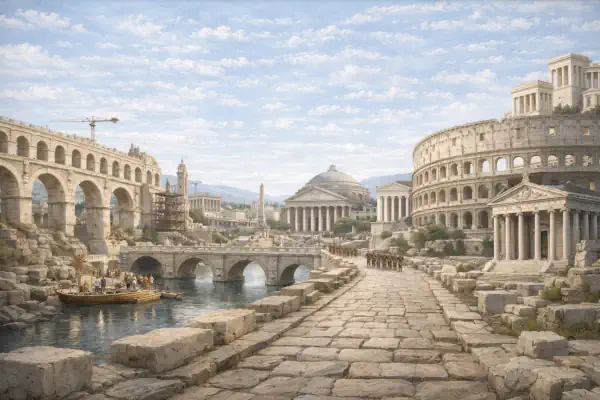
To my mind, this is where Roman hydraulic thinking becomes truly exemplary for our time. Resource management, ecology, sanitary safety, and the maintenance of infrastructures should never be treated as secondary matters. They are among the deepest foundations of civilized life. A city becomes credible not when it multiplies surfaces of prestige, but when it secures water, health, continuity, and dignity for those who live within it.
A Lesson in Engineering That Reaches Beyond Antiquity
After the fall of the Western Empire, many aqueducts decayed or ceased to be maintained. And yet their technical logic did not disappear. Some structures were reused, others inspired medieval repairs, and Renaissance engineers rediscovered in these works a concrete knowledge of the movement of water, gravity, and long-term maintenance.
The legacy of Roman aqueducts lies precisely in this effective sobriety. They remind us that durable infrastructure depends not only on spectacular innovation, but on precision of calculation, adaptation to terrain, quality of materials, and a long-term vision. There lies their profound modernity.
Roman aqueducts finally show that a civilization is also judged by its ability to secure what is essential. To transport water without rupture, over dozens of miles, with regularity and resilience, is to organize health, hygiene, urban density, and collective continuity. In that sense, water does not follow the city: it makes the city possible.
My own reading is both analytical and resolutely forward-looking. Rome shows, with remarkable clarity, that mastering water means making the city possible. It sets an example that still deserves to be taken seriously. At a time when resource management, ecology, sanitary security, and infrastructure maintenance are becoming ever more decisive, the Roman lesson feels almost urgent. The future will belong less to the cities that merely expand than to those that know how to secure the essential with intelligence, discipline, and long-term care. In that sense, Roman aqueducts are not just relics of the past: they remain a premium lesson in how civilization is sustained from below.