From Greek inheritance to Roman power
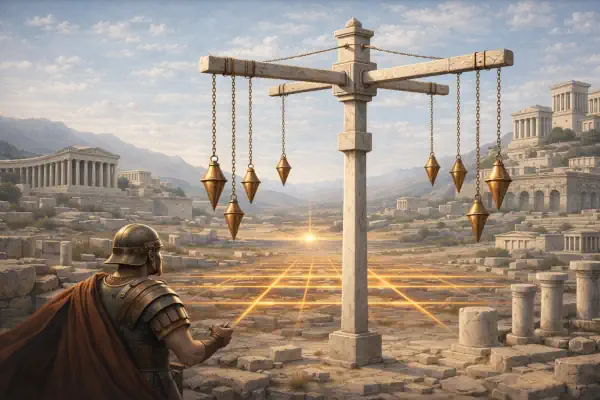
When Rome emerged on the Mediterranean stage, it did not rise in an intellectual vacuum. It inherited a world already shaped by Euclid’s geometry, Archimedes’ mechanics, and Aristotle’s natural philosophy. Such knowledge had long circulated through the ports and cities of southern Italy, from Tarentum to Syracuse. Rome observed, absorbed, and reformulated.
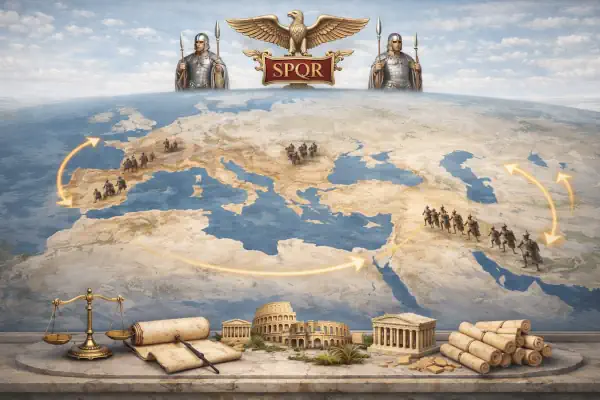
Roman originality therefore does not lie in a theoretical rupture comparable to that of Greece, but in a decisive redirection of knowledge. Where Greek tradition sought harmony, form, and truth, Roman civilization privileged solidity, use, efficient repetition, and the ability to extend across territory. Knowledge was no longer only what illuminated the mind: it became what made the Empire workable.
Vitruvius already summarized this in the first century BCE in De Architectura: to build is not merely to raise structures, but to articulate stability, utility, and beauty. Among the Romans, this idea acquired political depth. Technique served order, duration, and overall coherence.
To me, this is where Rome becomes truly fascinating. Its strength lies in the combination of engineering, law, and organization, but also in its ability to put Greek theory into practice. Rome shows that a civilization can inherit ideas without merely admiring them; it can turn them into systems that reshape the world.
Rome does not first seek to explain the world in the abstract: it wants to know how to make it durable, governable, and functional on the scale of an empire.
Engineering as the language of the Empire
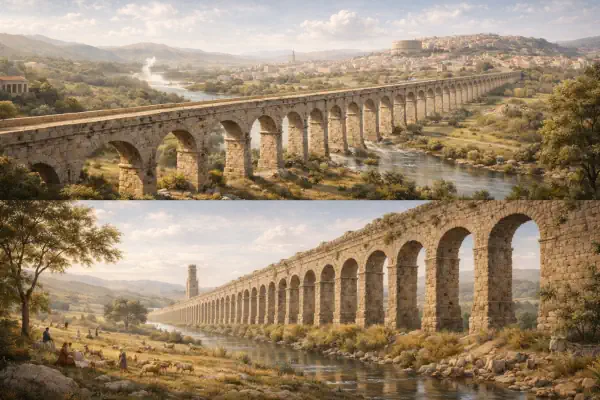
Roads, aqueducts, bridges, sewers, forums, walls, and ports: in Rome, every piece of infrastructure answered a specific need, but every need was also conceived within a larger whole. The Via Appia and the Aqua Appia, both launched in 312 BCE, were not merely technical works. They inaugurated a logic in which engineering became one of the principal tools of government.
Carrying water over dozens of kilometers, moving troops, goods, and information, maintaining the cohesion of an immense territory: all these challenges required a technical mindset oriented toward continuity and reliability. Ancient Rome did not build at random; it mapped, supplied, connected, and ranked.
What Roman infrastructure made possible
- the rapid circulation of armies, trade, and administration
- the lasting supply of cities with water and collective services
- the transformation of territory into governable, measurable, and reproducible space
This is one of Rome’s great strengths: turning technique into a system, and that system into a lever of political stability. Infrastructure was not peripheral; it formed the very framework of Roman order.
I also see a clear parallel with the modern world here. Today, digital infrastructure and networks play a role that is not so different in spirit: they connect, stabilize, coordinate, and make large-scale organization possible. Rome reminds us that power is never only an idea; it also depends on the quality of the systems that carry it.
Roman genius: building to last and to serve
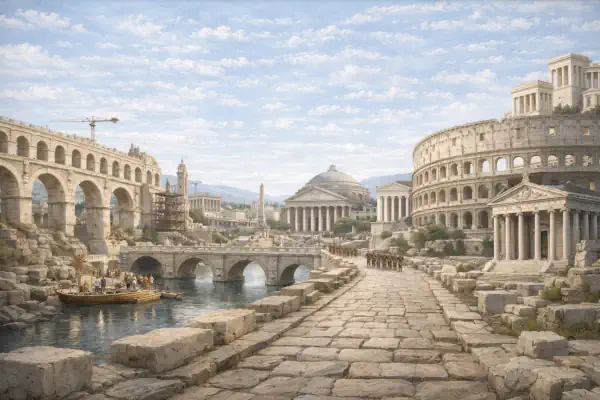
Roman genius reveals itself not primarily in spectacular invention, but in a remarkable ability to optimize, standardize, and transmit know-how. Roman concrete, opus caementicium, was not merely an efficient material: it made possible another scale of construction, faster, stronger, and more adaptable.
Arches, vaults, and domes express that constructive intelligence oriented toward solving concrete problems. The Pantheon under Hadrian remains one of the most impressive examples of this mastery of mass, thrust, and balance. Rome did not leave behind a fully exhaustive mathematical theory of such structures, but it produced an extraordinarily effective technical tradition.
This pragmatism is essential: the Romans built to make the city habitable, the Empire navigable, and power visible. Monumentality was not merely aesthetic. It served duration, legibility, and the presence of Roman order in space.
One point I believe remains underestimated in the history of Rome is precisely this material intelligence. Roman stone and concrete are too often reduced to simple durability, when in reality some structures seem almost to regenerate and strengthen over time. That alone should force us to reconsider Rome not only as an empire of domination, but also as a civilization of advanced practical mastery.
Organizing the world: urbanism, law, and administration
Rome’s greatness does not rest only on its monuments, but on its ability to conceive the city and the territory as coordinated wholes. The forum, baths, water networks, roads, seats of power, and commercial spaces were not merely juxtaposed: they composed an integrated urban logic.
This material structuring was mirrored by legal structuring. Roman law, administrative procedures, censuses, and frameworks of management and decision-making extended infrastructure into the institutional order. From stone to rule, Rome organized the conditions of its own continuity.
There lies perhaps its deepest singularity: making technique, space, and authority hold together. The Roman city became a system of flows, norms, and functions. It was not merely inhabited; it was governed by design.
Rome, or efficiency as a form of civilization
This civilization was profoundly action-oriented. It did not idealize abstraction for its own sake. It transformed inherited knowledge into tools of duration. Every road stabilized a territory. Every aqueduct sustained the city. Every administrative norm reduced uncertainty. Every monument reminded the viewer that imperial order was inscribed in reality.
Rome built to last, not out of a romantic love of eternity, but because a vast empire could not endure without reliable repetition, territorial maintenance, and reproducible frameworks. Its pragmatism was a political vision of technique.
That is why the history of Rome remains fundamental: it shows how a civilization can transform engineering, urbanism, law, and organization into a coherent form of power. Where others dream the world, Rome made it workable.
I would describe Rome above all as a civilization more pragmatic than theoretical. That is not a weakness. On the contrary, it is what allowed it to reconstruct the world and its organization. Rome teaches us that theory reaches its full meaning only when it becomes structure, network, law, and durable form.
A personal perspective on Rome’s enduring lesson
What strikes me most about Rome is not a single monument, a single battle, or even a single legal text. It is the way this civilization knew how to combine engineering, law, and administration into one coherent force. Rome did not simply inherit Greek intelligence; it proved that theory becomes truly historic when it is translated into systems capable of organizing reality.
That is also why I see Rome as surprisingly close to our own age. Today, digital infrastructures and networks shape the circulation of information, power, coordination, and decision-making much as roads, aqueducts, and administrative grids once shaped the Roman world. The form has changed, but the logic remains familiar: a civilization lasts when it knows how to make its organization concrete.
In my view, Roman mastery is still underestimated in one essential respect: its material intelligence. The fact that some Roman constructions seem to strengthen over time reveals something deeper than technical competence. It reveals a civilization that understood durability not as an accident, but as a principle of design.
Rome teaches us to rebuild the world and its organization. That may be its most modern lesson. A civilization becomes durable not only by producing ideas, but by giving them roads, rules, structures, and systems capable of carrying them across time.