
Feeding oneself in an uncertain world: the logic of survival
In prehistoric societies, food depended on a fragile balance between the availability of resources, knowledge of the environment, and the ability to anticipate. Each day could be affected by animal migrations, seasonal cycles, climatic hazards, or competition with other predators. Finding enough to eat therefore required far more than physical effort: it demanded observation, memory, transmission, and collective decision-making.
This pressure produced a highly elaborate form of practical intelligence. Human groups learned to exploit several food sources at once so as not to depend on a single resource. Hunting provided protein and useful materials such as hides and bones; gathering supplied plant diversity that was often more regular; fishing strengthened food security in water-rich environments; and storage, finally, smoothed out periods of scarcity.
Prehistoric food systems must therefore be understood as a complete adaptive framework. They involved the body, technique, group memory, territorial use, and the ability to turn a natural opportunity into a durable resource.
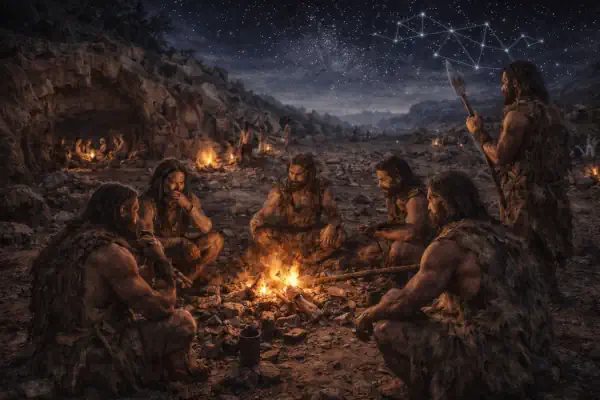
In prehistory, feeding oneself does not merely mean consuming resources: it means knowing how to locate them, share them, preserve them, and turn them into collective security.
Hunting: a collective technology before the term
Hunting is one of the most visible expressions of prehistoric survival, but it should never be reduced to brute force alone. It mobilized tracking skills, trajectory analysis, coordination, and toolmaking. Spears, worked points, throwing spears, and traps all testify to an already advanced technical thought based on the gradual improvement of performance.
Hunting large animals also demanded group organization. Roles had to be distributed, the prey’s reactions anticipated, and the terrain used to advantage — sometimes to drive, encircle, or exhaust the animal. Hunting thus reveals a profound articulation between technology, communication, and cooperation. It is not only a food-gathering act: it structures time, space, and social relations.
The traces left on bones — fractures, cut marks, tool marks — show that prehistoric humans did not merely take a resource; they knew how to exploit it fully. Meat fed the group, but tendons, bones, and hides also supported its technical needs.

Gathering and fishing: diversity as the key to resilience
If hunting occupies a strong place in the imagination, prehistoric survival rested just as much on dietary diversity. Gathering supplied fruits, roots, seeds, nuts, and edible plants. It required a fine knowledge of seasonal cycles, harvesting zones, and dangerous species. This competence was strategic: it limited dependence on uncertain hunting and ensured a more continuous food supply.
Fishing, for its part, represented an essential resource for groups living near rivers, lakes, or coastlines. Harpoons, rudimentary lines, fish traps, and capture devices testify to a precise adaptation to aquatic environments. Once again, effectiveness depended not only on tools, but on understanding animal behavior, favorable locations, and the right moments.
Why these resources were decisive
- they diversified the diet and reduced the risk of shortage
- they required a deep knowledge of natural environments
- they strengthened the ability to adapt to changing surroundings
This diversity of resources shows that prehistoric food systems were less a single model than a set of flexible strategies adapted to territories, seasons, and local constraints.
Storing, preserving, anticipating: survival becomes planning
Once resources had been obtained, another question became central: how could they be prevented from being lost? Storage marks a decisive stage in the history of survival techniques. Preserving roots, drying plants, smoking certain meats, or protecting provisions in rudimentary containers already meant acting upon time. Human beings no longer merely responded to urgency; they began organizing what came next.
This capacity for anticipation profoundly transformed societies. It reduced vulnerability in times of scarcity, created safety margins, and freed up time for other activities: tool maintenance, improvement of shelter, transmission of know-how, and more structured group organization.
Storage is therefore far more than a simple domestic practice. It constitutes both a technical and mental threshold in which immediate survival gives way to a form of resource management. In that sense, it already prepares the Neolithic world.
From extraction to production: the rupture of Neolithic agriculture
With the Neolithic, the history of food enters a new phase. Humans no longer depend exclusively on resources that are spontaneously available: they begin to domesticate plants and animals, plan harvests, shape cultivated spaces, and strengthen their storage capacities. This mutation changes food itself, but also habitat, seasonal rhythms, population density, and social organization.
Neolithic agriculture is not a marginal improvement of the previous model: it introduces another way of living. Sedentarization favors the appearance of more durable villages, the division of labor becomes clearer, tools become more specialized, stores acquire collective value, and the relationship to territory changes in depth.
This transition does not mean that older skills disappear at once. It rather shows how survival techniques accumulated over the long term — knowing plants, observing the seasons, preserving resources, organizing the group — make possible a new historical stage: the controlled production of food.
Food as a revealer of human evolution
Studying prehistoric food systems means understanding how humanity learned to secure its existence through observation, cooperation, and technique. Each stage — hunting, gathering, fishing, preservation, agriculture — reveals a deepening of the relationship between human beings and their environment.
Food is therefore never a simple biological need. It organizes mobility, hierarchies, exchanges, knowledge, tools, and forms of settlement. It lies at the heart of social evolution as much as technical evolution. In this perspective, prehistoric food history does not merely tell us what our ancestors ate; it shows how they gradually built the material conditions of a world that was more stable, more transmissible, and more complex.
