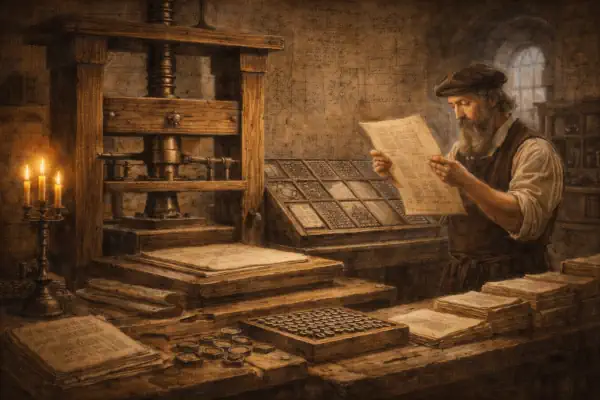
Mainz, around 1450: an invention whose power lies in its system
Gutenberg’s innovation does not reside in a single object, but in the successful assembly of several techniques. It is this combination that transformed printing into a true industrial revolution of text. Movable metal type, the screw press adapted for printing, and oil-based inks designed to adhere to metal together form a coherent, reliable, and reproducible system.
The great strength of movable type lies in its modularity. Each letter becomes a reusable unit, capable of entering thousands of compositions without needing to be copied by hand. Language itself thus acquires a mechanical form. Where manuscript culture depends on the singular gesture of the copyist, printed text can be reconstructed, recomposed, and multiplied from the same elements.
The press turns this typographic composition into regular production. Inspired by techniques already known in other uses, it ensures more uniform pressure, and therefore better legibility and an unprecedented rhythm of output. As for the inks, they allow the text to adhere clearly to paper, making the whole system durable and usable on a large scale.
The Gutenberg Bible crystallizes this turning point. It proves that print can produce ambitious works of high visual quality in quantities entirely beyond the possibilities of manuscript culture. From that point on, the book is no longer only a rare object: it becomes a technical medium of diffusion.
Printing changes the nature of ideas less than it changes their power to reproduce, to circulate without distortion, and to settle durably into collective memory.
When Europe changes its intellectual speed
The significance of printing is measured not only by Gutenberg’s invention, but by the speed of its diffusion. Within a few decades, workshops appear in Strasbourg, Venice, Paris, Basel, Nuremberg, and many other cities. This rapid spread reveals that printing was not a marginal craft process, but a technology immediately perceived as strategic.
Its deepest effect is the greater stability of texts. For the first time, the same work can circulate in many nearly identical copies. That changes everything: a work is no longer condemned to be altered with each copy. It can be read, compared, annotated, and discussed on a common basis.
This gain in stability transforms intellectual history. Ideas travel better because they lose less fidelity. A text printed in Mainz or Venice can reach distant readers while preserving its structure, formulas, and demonstrations. Diffusion is not only faster: it becomes more reliable.
On a European scale, printing thus moves knowledge from a regime of dispersion into a regime of structured circulation. Texts cease to be singular objects and become the vehicles of a shared intellectual space.
This is where the resemblance to the Internet becomes most striking to me. The true power of printing does not lie only in the production of books, but in making ideas shareable on a large scale. That is precisely what changes a civilization: not merely creating content, but giving it a medium capable of reaching far beyond its point of origin.
The book becomes an economic object
One of the major consequences of printing is the gradual birth of a book market. Before it, owning a manuscript represented a considerable expense. Copying required time, materials, and highly specialized labor. With mechanical reproduction, the cost structure of diffusion changed, and access to text began to widen.
This transformation favored the emergence of new actors: printers, booksellers, publishers, specialized workshops, and networks of sale and transport. The book gradually ceased to be exclusively monastic or aristocratic. It became urban, commercial, circulating. Students, jurists, humanists, physicians, and merchants could now build libraries far broader than before.
In Venice, Aldus Manutius perfectly embodies this new phase. His work did not consist merely in reproducing texts; it participated in shaping an editorial culture. The selection of works, their quality, their portability, and their circulation gave birth to a new relationship between reader and book.
With this emerging market, knowledge changes its social support. It partially detaches itself from traditional places of authority and enters an urban and economic network. This is a decisive shift: knowledge enters a logic of regular circulation.
Standardizing texts, preparing modern science
Printing does not transform only the quantity of available books. It modifies the way knowledge can be stabilized and shared. Before the 15th century, manuscript copying frequently introduced variations between versions of the same text. In learned fields, these variations could affect diagrams, data, calculations, or demonstrations.
With print, scholars increasingly work from common references. Foundational works circulate with an unprecedented coherence. When Copernicus publishes De revolutionibus or when Vesalius publishes De humani corporis fabrica, their works can be read, cited, and discussed in versions far more stable than those of the manuscript world.
This stability has an immense methodological consequence: it favors intellectual reproducibility. Readers no longer comment on fluctuating versions, but on reference texts. Learned discussion gains in precision because it now concerns a common object. Printing alone does not yet produce the modern scientific method, but it prepares one of its essential conditions: the possibility of shared knowledge that is not constantly altered.
In this sense, the history of modern science is inseparable from the material history of the book. What observatories, laboratories, and dissections discover, printing makes cumulative.
My admiration for Gutenberg comes from there. Some inventions improve tools; others change the structure of civilization itself. Printing belongs to that second category. It does not merely accelerate writing — it gives knowledge a new destiny.
Literacy, school, readers: the widening of the public
Printing did not instantly create a literate Europe, but it powerfully accelerated the spread of reading. As books became more available, learning to read acquired greater usefulness in urban, religious, commercial, and administrative life.
This process acted slowly yet deeply. Reading was no longer reserved for extremely restricted circles. Cities, schools, universities, and religious institutions increasingly relied on the printed book. Texts circulated more widely, uses diversified, and the reader became a more visible social figure.
The school itself was transformed. When works can be reproduced in series, educational supports gain in regularity. The printed manual gradually becomes a central tool of transmission. This does not mean that education was immediately democratized, but that it now possessed a technical support capable of amplifying its reach.

A Republic of Letters made possible by the book
One of the most enduring consequences of printing is the formation of a transnational intellectual space. Scholars separated by geography can read the same works, comment on the same authors, correct the same errors, and take part in common controversies.
This phenomenon prepares what will later be called the Republic of Letters. Ideas no longer remain confined to their place of origin. They cross borders, circulate through books and correspondence, and then return enriched by criticism, additions, and revisions. Printing gives learned Europe an infrastructure of memory and exchange.
It is this infrastructure that allows knowledge to become more collective. A text is no longer valuable only because of its author, but because of the chain of readers, commentators, and contradictors it sets in motion. Knowledge thus gains a cumulative dimension far more powerful than in the manuscript world.
What printing changes in the long run
- it makes text reproducible on a large scale
- it stabilizes different copies of the same work
- it structures a book market and broadens readership
- it encourages the pedagogical use of printed books
- it provides modern science with a common basis for discussion and transmission
A technical revolution with civilizational effects
Looking back, printing appears as one of the most decisive technical transformations in European history. It changes not only the production of books, but the conditions under which ideas circulate, the authority of texts, learning, research, administration, and collective memory.
Its power lies precisely in its apparent simplicity: allowing the same text to exist simultaneously in many copies. This technical gesture produces immense effects. It gives ideas a duration, a reach, and a capacity for replication without precedent. Works no longer belong only to those who wrote or copied them; they enter a public space of reading, debate, and transmission.
The Renaissance does not become modern through printing alone, but without it, much of Europe’s intellectual acceleration would have remained impossible. Printing moves knowledge from the rare manuscript to the shareable text. In that sense, it marks one of the great thresholds in world history.
If I had to formulate my own signature vision here, it would be this: the true power of printing is not only to print books, but to make ideas shareable on a large scale. That is why it reminds me so strongly of the Internet. In both cases, technique does more than improve communication — it reshapes civilization by altering the scale at which knowledge can exist, circulate, and transform human communities.