Rome Did Not Invent Everything: It Redirected Greek Knowledge Toward Use
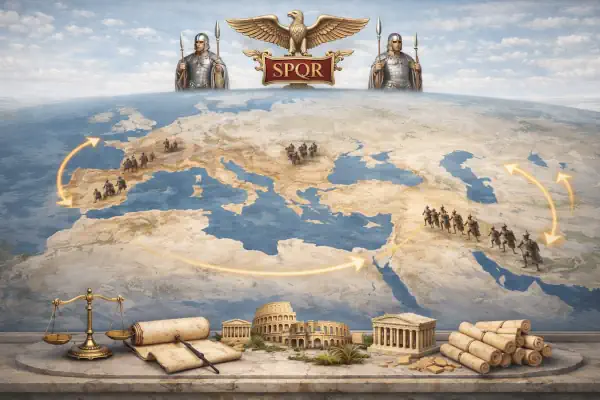
As Rome gradually came to dominate the eastern Mediterranean world, it entered into contact with intellectual traditions that were already powerful. Greek schools, libraries, and works in astronomy, medicine, geometry, and natural philosophy formed a considerable inheritance. The Romans themselves acknowledged this reality: they arrived after a world that was already deeply elaborated in intellectual terms.
Yet this is precisely where Roman originality begins. Rome did not adopt these bodies of knowledge passively. It sorted them and adapted them. Where Greek science often sought to understand first causes or demonstrate general truths, Rome asked a more immediate question of knowledge: could it help build, measure, administer, date, heal, or maintain order?
This shift is fundamental. It does not mean a rejection of abstract intelligence, but its reinsertion into a logic of effectiveness. In Rome, science mattered less as the contemplation of truth than as an instrument of stability, organization, and duration.
From my perspective, this is where Rome reveals both its strength and its limit. It did not simply expand knowledge; it transformed knowledge into an instrument of power, organization, and efficiency. That legacy is impressive, but it also raises a lasting question: when a civilization values knowledge mainly for what it can immediately produce, structure, or control, does it risk weakening the freer and more theoretical search that often makes the greatest breakthroughs possible?
Roman thought does not ask only whether knowledge is true: it asks above all what that knowledge can build, organize, and make last.
When Science Becomes an Instrument of Civilization
Once absorbed, inherited knowledge changed function. Astronomy fed the civil calendar and the temporal markers of public life. Geometry served surveying, urban planning, and the layout of infrastructure. Medicine became an organized practice serving armies, cities, and individuals. Knowledge ceased to be merely a domain of reflection: it began to nourish concrete systems.
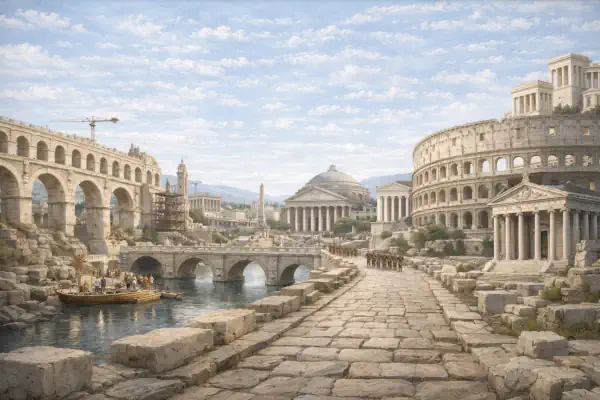
This pragmatism helps explain the power of Roman engineering. Aqueducts, roads, bridges, street networks, urban systems, and public buildings all required an accumulation of technical knowledge, measurements, and observations that were never detached from action. Roman thought thus turned science into operational capacity.
What Rome Expected from Knowledge
- to make phenomena usable within collective organization
- to produce tools for measuring, dating, building, and administering
- to stabilize the city, the territory, and institutions over the long term
This orientation was not secondary. It shaped an entire intellectual culture. Roman knowledge was not anti-theoretical in principle: it was hierarchized by use. What mattered was its capacity to become networks, procedures, materials, or norms.
This Roman logic still speaks to the modern world. States, corporations, administrations, and now AI systems are often praised not for the depth of what they understand, but for the speed with which they can classify, optimize, predict, and organize. I find that inspiring in one sense, because it shows how ideas can reshape reality. But I also think we should remain vigilant: a culture that honors knowledge only when it is immediately useful may become extraordinarily efficient while also becoming intellectually narrower.
Roman Encyclopedias: Classifying the World in Order to Better Master It
Imperial expansion created a new need: to gather, order, and transmit an ever-growing mass of knowledge. It is in this context that the work of Pliny the Elder takes on its full importance. In his Natural History, he does not offer experimental science in the modern sense, but rather a vast enterprise of organized compilation.
The stake is decisive. To classify plants, animals, minerals, techniques, medical uses, or geographical knowledge is to make the world more legible. The Roman encyclopedia does not serve erudition alone. It supports an administrative and technical culture of totality. A world that has been intellectually ordered becomes more accessible to action.
This logic helps explain why Roman encyclopedias occupy such an important place in the history of transmission. They did not always create the knowledge they presented, but they gave that knowledge a form that could circulate, serve, and endure. Knowledge became inventory, and inventory became a resource of government.
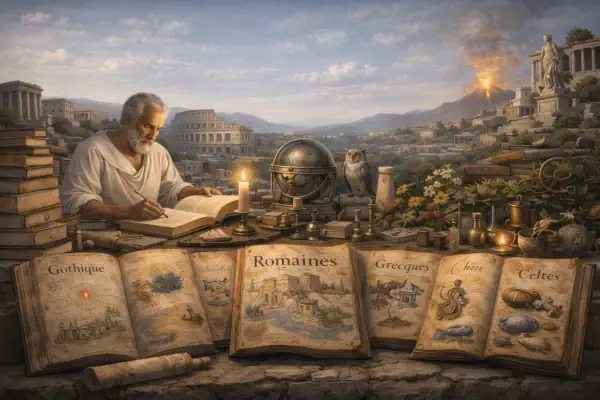
What strikes me here is how modern this Roman reflex feels. To classify is never neutral. To inventory the world is already to prepare it for administration, exploitation, optimization, and sometimes domination. That is true of imperial archives, but it is also true of databases, platforms, and artificial intelligence today. We still live in civilizations that believe that once the world is made legible, it becomes manageable. Rome understood that very early.
Science in the Service of the State, the City, and Duration
Roman science almost never existed outside a political framework. It accompanied the city, the army, law, the calendar, hydraulic networks, and logistics. Knowledge was mobilized inside systems that exceeded the individual. One did not measure for the sake of measuring: one measured in order to distribute water, fix boundaries, date obligations, organize harvests, or regulate flows.
The Julian calendar perfectly illustrates this articulation. Grounded in astronomical knowledge, the reform advanced by Julius Caesar and Sosigenes stabilized civic and administrative time. It was not only a matter of correcting a calculation: it was a matter of unifying collective life through a more reliable temporal structure.
Likewise, Roman infrastructures show how scientific and technical knowledge was converted into political stability. Aqueducts, roads, and sanitation systems were not merely practical applications of prior knowledge. They materialized a Roman vision of the world: a world that had to be connected, maintained, standardized, and made durable.
Personally, I do not think Rome should be celebrated simply because it was effective. What interests me is the lesson hidden behind that effectiveness: every society chooses what kind of knowledge it rewards. Rome rewarded knowledge that could administer, organize, and last. Our own era often does the same. The question, then, is not whether utility matters, because of course it does. The deeper question is whether a civilization can still leave room for research that is uncertain, slow, theoretical, and not immediately profitable.
A Legacy in Which Thought Becomes the Structure of the World
Rome's contribution to the history of science does not therefore lie only in isolated discoveries. It lies in a deeper transformation: knowledge became infrastructure, administration, inventory, standardization, and organizational power. Where other traditions first pursue theoretical elegance, Rome emphasized the robustness of uses.
This legacy is immense. It has shaped our modern way of valuing knowledge by its capacity to be transmitted, reproduced, applied, and integrated into collective systems. A part of scientific and technical modernity must therefore be understood as a double inheritance: Greek in its methods of reasoning, Roman in its power to convert ideas into institutions, networks, and durable material forms.
That is why Roman thought remains essential. It reminds us that a civilization is defined not only by what it knows, but by what it is able to do with that knowledge. In Rome, knowledge became matter, order, and power: not in order to shine for a moment, but to structure the world across time.
My own reading is ultimately both analytical and hopeful. Rome shows how knowledge can leave the realm of abstraction and become architecture, administration, and civil continuity. That is a powerful lesson. But I also believe that the future belongs to civilizations capable of holding two ambitions together: the Roman ambition to build durable systems, and the freer ambition to preserve spaces where thought does not yet know what it will serve. Without that balance, power may grow—but vision becomes poorer.