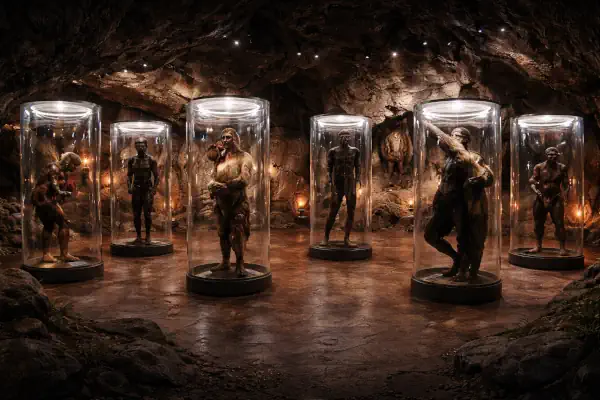
Prehistory, the matrix of the first innovations
Prehistory refers to the immense span of time that precedes the invention of writing. Its temporal reach is staggering: it covers several million years, from the first hominins to the societies that began to produce written traces and more durable political organizations. To treat it as a mere prelude would be a mistake. It is during this immense duration that the technical, cognitive and social capacities that make human history intelligible first took shape.
Shaping a stone, selecting a material, transmitting a gesture, protecting a group, exploiting a seasonal resource or structuring a habitat are already acts of technology. Prehistory therefore shows that innovation did not suddenly appear with the ancient civilizations: it reaches much further back, into long chains of experience, trial, error and learning accumulated across deep time.
Far from the caricature of a static and rudimentary world, this period now appears as a laboratory of the human condition. It witnessed the emergence of bipedalism, the transformation of tools, the growing mastery of the environment, the first forms of art, migratory dynamics and collective organization. In other words, Prehistory is not the absence of civilization: it is the deep phase of its preparation.
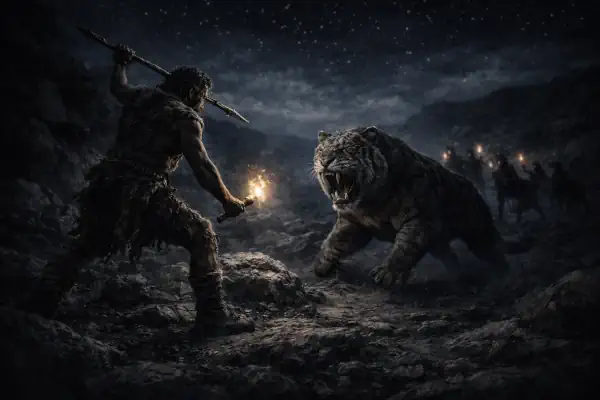
Prehistory is not an empty space before History: it is the long age during which humanity learns to make, transmit, cooperate and transform the world.
Dating methods, material traces and the scientific reading of the past
Studying Prehistory involves a radical constraint: there are no administrative archives, no contemporary narratives and no explanatory texts. All knowledge therefore rests on the rigorous interpretation of traces. That is precisely what gives prehistoric archaeology its scientific power: it cross-references material, biological and environmental evidence in order to reconstruct vanished worlds.
Researchers first distinguish relative dating, based on stratigraphy and the superposition of layers, from absolute dating, which aims to assign a more precise age to remains. Carbon-14 illuminates recent organic matter on the prehistoric timescale, while other methods such as thermoluminescence, potassium-argon or uranium-thorium are used for older contexts or different materials.
The disciplines that make Prehistory readable
- paleoanthropology, which analyzes human remains in order to understand biological evolution
- paleoclimatology, which reconstructs ancient environments and climatic changes
- experimental archaeology, which reproduces ancient technical gestures to test their plausibility
- genetics, which sheds light on migrations, kinships and interbreeding between human groups
Thanks to these intersecting approaches, Prehistory is no longer a zone of darkness. It becomes a demanding field of inquiry in which tools, hearths, bones, pollens and combustion residues all tell a coherent story of human adaptation.
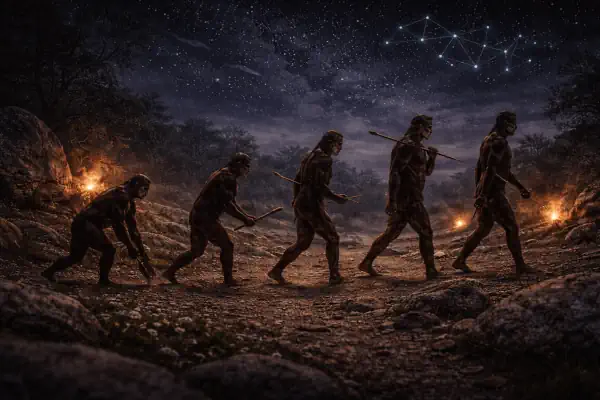
Tools, fire, language: the technical turning points of Prehistory
Prehistory is not a flat continuum. It is punctuated by major transformations that change the very way humans inhabit the world. The first tools constitute one of the foundational turning points: they extend the hand, increase the power to act and already testify to operational thought. Choosing a stone, shaping it according to an intention and preserving a transmissible gesture presupposes an elaborate practical intelligence.
The mastery of fire represents another revolution. It changes diet, protection, the occupation of space, sociability and the relationship to time. The hearth becomes a center of gathering, cooking, warmth and probably oral transmission. In that sense, fire is not merely an energy resource: it reorganizes collective life.
Articulated language, even if it remains difficult to date precisely, marks a decisive advance. It makes it possible to coordinate action, transmit techniques without immediate demonstration, preserve group memory and elaborate more abstract representations. Where the tool acts upon matter, language acts upon human organization itself.
These innovations are not isolated. They reinforce one another: to speak better is to transmit better; to transmit better is to make better; to make better is to survive better. Prehistory is therefore already a system of interdependent innovations.
From the Paleolithic to the Neolithic: toward more structured societies
Any introduction to Prehistory naturally opens onto its major sequences. The Paleolithic corresponds to the long age of hunter-gatherers, lithic industries, mobility adapted to available resources and the first symbolic expressions. The Mesolithic accompanies reorganizations linked to climatic change and subsistence strategies. The Neolithic, finally, introduces a decisive shift with agriculture, herding, sedentism and a more sustained transformation of landscapes.
This transition is not merely economic. It modifies social rhythms, hierarchies, exchanges, stock management, habitat and collective memory. When human communities begin to produce, store and organize their resources more extensively, they change historical scale.
To understand Prehistory is therefore to follow a continuous narrative: that of a humanity moving from immediate adaptation toward a growing capacity for planning, anticipation and transformation. From the rudimentary tool to Neolithic societies, it is not only technique that advances; it is the entire relationship between humanity, time and environment that is reconfigured.
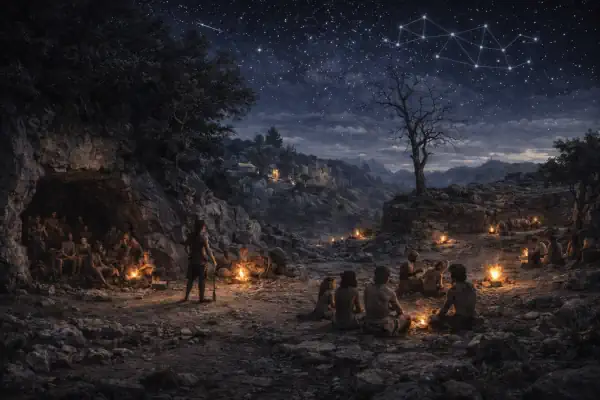
Why Prehistory remains a strategic field of knowledge
Prehistory illuminates far more than origins. It helps us understand the deep mechanisms of human innovation: how a practice is born, how a technique spreads, how a group adapts to a constraining environment and how knowledge survives without writing. In that sense, it speaks directly to the history of science, anthropology, biology, ecology and even contemporary reflections on resilience.
It also reminds us of an essential reality: the great human advances do not rest only on spectacular inventions, but on slow accumulation, durable cooperation and effective transmission. Civilization does not emerge all at once. It is built through the intelligent repetition of gestures, through the ability to share techniques and through the capacity to transform experience into collective knowledge.
Understood in this way, Prehistory is not the distant past of a primitive humanity; it is the opening chapter of a technical and cultural history that leads, through successive continuities, to the complex worlds we still inhabit today.