
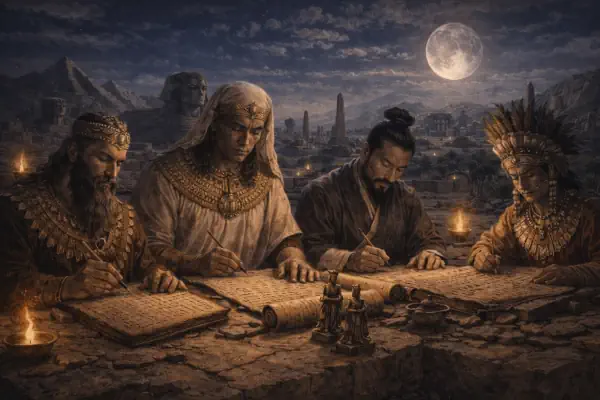
When Speech Becomes Trace: The Decisive Passage Toward Durable Memory
The invention of writing is not merely a technical advance. It changes the relationship of societies to time. As long as rules, accounts, genealogies, and narratives depend solely on oral memory, they remain tied to the presence of those who carry them. The moment signs are inscribed onto a material support, a society can preserve what it knows beyond individuals, generations, and circumstances.
This transformation accompanies the rise of the first urban civilizations. Wherever cities expand, agricultural surpluses must be managed, taxes and exchanges become more complex, and hierarchies must be stabilized, human memory alone is no longer enough. It becomes necessary to record, verify, and archive. Writing thus emerges as a response to a major political, administrative, and cultural problem.
In that sense, writing was not born simply to tell stories. It was also born to count, control, govern, and transmit. It is precisely this density of functions that makes it a foundational invention.
To me, this is first and foremost a revolution of human memory. Writing allows humanity to remember, to free itself, and to tell its own story. If literacy had once been widespread, we might have inherited far more accounts reflecting the full reality of those eras, almost like the newspapers, media, and everyday chronicles of our own time.
With writing, humanity does not merely learn to note signs: it discovers how to make speech, law, and memory survive beyond human time.
Writing Does Not Appear Everywhere in the Same Way, Yet Everywhere to Answer the Same Need
The history of writing cannot be reduced to a single isolated invention. Mesopotamia and Egypt are among the oldest and most decisive centers, but other regions of the world also developed their own graphic systems. This plurality reminds us of an essential truth: when societies become larger, more hierarchical, and more administratively complex, they all feel the need to fix information.
This point matters deeply. Writing is not, at first, an intellectual luxury; it is a technology of social organization. It makes it possible to preserve data, transmit orders, legitimize power, and inscribe beliefs across time. Its emergence in multiple regions of the world is therefore not surprising at all: it responds to a structural challenge of civilization.
Yet it is in Mesopotamia and Egypt that this invention takes two especially influential forms. One is born from accounting and clay; the other from kingship, the sacred, and the image. These two trajectories will profoundly shape human history.
Uruk and Clay Tablets: The Birth of Cuneiform in the World of Administration
In Mesopotamia, writing emerges within a world of management. The earliest tablets discovered at Uruk contain markings linked to goods, herds, rations, or flows of merchandise. At this stage, the goal is not literary: it is to preserve a reliable trace of resources and obligations in an increasingly complex urban society.
This is where the historical power of cuneiform lies. It transforms information into document. A quantity, a debt, a grain distribution, or a labor assignment can now be fixed into matter. A decision no longer disappears with the person who pronounced it; it can be reread, verified, and preserved.
Very quickly, this system expands. The signs become more structured, their uses broaden, and writing leaves the storehouses to enter palaces, temples, royal archives, and schools of scribes. Cuneiform thus becomes far more than an accounting tool: it becomes an instrument of statehood.
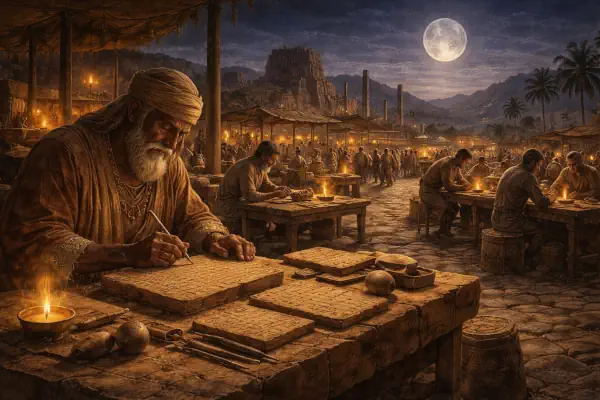
What strikes me here is how writing immediately makes things more effective. It turns memory into procedure, intention into record, and authority into something that can be checked, transmitted, and applied beyond the fragile limits of spoken words alone.
From Accounting to Law, Then to Narrative: When Writing Learns to Govern and Transmit
Once established within administrative structures, Mesopotamian writing crosses a decisive threshold: it becomes a support for law, authority, and cultural memory. The text is no longer only a record of stock; it can now formalize obligations, fix decisions, and establish political continuity beyond immediate speech.
The Code of Hammurabi perfectly embodies this moment. Law engraved in stone is not just a series of articles: it is also a staging of justice as stable, visible, and legitimate authority. To write the law is to give it a durable form. It is also to make it understood that political order rests on something other than arbitrariness.
Yet writing does not stop at the normative register. With religious texts, hymns, learned lists, and above all the Epic of Gilgamesh, it also becomes a vehicle for reflection on the human condition. An invention born within the circuits of administration ultimately comes to carry the great questions of meaning, mortality, and memory.
What cuneiform changes in depth
- it enables administration to preserve and control complex information
- it makes written, durable, and visible law possible
- it opens the way to literary and religious memory transmissible across centuries
In Egypt, to Write Is Also to Sanctify: Hieroglyphs, Hieratic, and the Power of the Name
Egyptian writing is born in a different context. From its earliest attestations, it appears linked to royal power, the tomb, ritual, and sacred representation. Where Mesopotamia first emphasizes management, Egypt very early associates writing with image, kingship, and symbolic survival.
Hieroglyphs are not merely functional signs. They possess a distinctive visual and religious density. To inscribe a name, a titulary, an offering, or a narrative on stone is to grant that speech a durable and prestigious existence. Writing is not merely a tool: it participates in the order of the world as conceived by the pharaonic state.
This dimension does not prevent administrative efficiency. Very early on, Egypt also develops hieratic, faster and more flexible, adapted to papyrus and daily uses. Later, demotic extends this simplification into more ordinary spheres of social life. Egyptian writing thus shows that one and the same system can articulate sacred monumentality and administrative pragmatism.
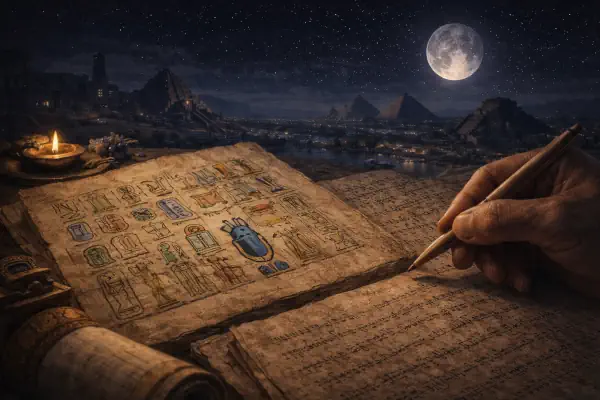
A State Memory Engraved in Stone: Writing to Govern, Legitimize, and Make Authority Endure
In Egypt, writing occupies a central place in the making of power. Monumental inscriptions, royal reliefs, decrees, and funerary texts form an official memory. They do not merely describe the kingdom; they contribute to making it intelligible, hierarchical, and stable.
To inscribe a victory, a royal name, or an offering on the walls of a temple is to produce a durable presence. The text extends the authority of the pharaoh and connects his action to cosmic order. Writing thus becomes a political support as much as an instrument of religious continuity.
This logic also explains why the disappearance of the ability to read hieroglyphs constituted such a profound rupture. The signs remained visible, but their voice was lost. Egypt remained present in stone while becoming opaque. The return of meaning through decipherment was therefore much more than a scholarly success: it restored a civilization’s historical speech.
What fascinates me is that writing does not only preserve memory; it also gives a civilization the power to narrate itself. And if more people had been able to read and write in those distant periods, we might possess a much broader range of voices, a truer mosaic of daily realities, almost like the newspapers, media, and small factual records of our own age.
How Historians Give Voice Back to Forgotten Signs: The Patient Work of Decipherment
Reading an ancient script never consists in “guessing” a text. Decipherment depends on linguistic comparisons, observed repetitions, identifiable proper names, dated archaeological supports, and above all an immense cumulative effort. An isolated inscription often remains mute; a corpus, a context, and a method gradually allow meaning to emerge.
The Rosetta Stone played that role for ancient Egyptian. Because the same text appeared there in Greek, demotic, and hieroglyphs, it offered a comparative key. With Champollion, hieroglyphs ceased to be regarded as a purely symbolic language: they also revealed a phonetic value. Ancient Egypt could then be read again.
Cuneiform followed a comparable trajectory thanks to multilingual inscriptions, to the work of scholars such as Grotefend and Rawlinson, and to archaeological discoveries in Persia and Mesopotamia. There too, meaning gradually returned through cross-checking. The process reminds us of a simple truth: civilizations do not reappear only through the objects they leave behind, but through our ability to hear their texts again.
Why the Invention of Writing Remains One of Humanity’s Greatest Thresholds
Writing allows a society to move beyond the immediate. It makes archives possible, gives law durability, enables large-scale management, secures the transmission of knowledge, preserves religious memory, and opens the way to literature. In this sense, it is not merely a tool of notation: it is a change in civilizational regime.
Mesopotamia and Egypt show two complementary ways of entering this new age. On one side, writing as an instrument of management, accounting, law, and statehood. On the other, writing as a language of the sacred, of kingship, of monumentality, and of symbolic memory. Together, they reveal that fixing signs also means fixing a vision of the world.
That is why the invention of writing remains a foundational event. It marks the moment when humanity begins to speak not only to its contemporaries, but also to those who will come after it.
My own view is clear and deeply forward-looking: writing is one of humanity’s great acts of liberation because it allows us to remember, to tell, and to transmit beyond the limits of a single lifetime. Today, the internet, media, and social networks can be seen as a new liberation of writing, an immense extension of that ancient gesture by which human beings refuse disappearance and insist on leaving trace, testimony, and meaning behind them. That is why the birth of writing remains so decisive to me: it did not merely create records, it changed the destiny of memory itself.
