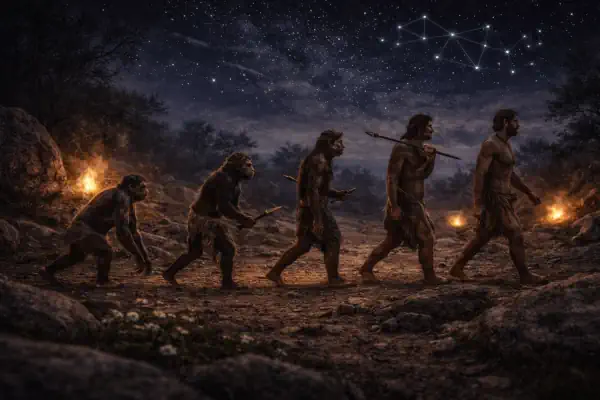
What are hominins? The roots of the human lineage
Hominins refer to all species belonging to the human lineage after the split from the other great apes. The term therefore includes not only Homo sapiens, but also earlier forms such as the Australopithecines and the various species of the genus Homo. To speak of the first hominins is to go back to the biological and behavioral origins of what would eventually become modern humanity.
Their scientific importance is immense, because they help us understand how essential characteristics such as bipedalism, tool use, the gradual increase of brain volume and adaptation to diverse environments came into being. Human evolution is not a simple, steady progression: it is more like a complex tree, with multiple branches, cousin species, extinctions and periods of coexistence.
Studying the first hominins therefore means observing the deep foundations of our species. Through them, we understand that human history is made up of successive evolutionary experiments, not of a single inevitable path leading mechanically to Homo sapiens.
Human history is not the story of a solitary species moving in a straight line, but of a plurality of humanities that coexisted, innovated and sometimes even shared their genes.
Australopithecines: bipedalism before the great human brain
Australopithecines occupy a central place in the history of the first hominins. Present in Africa more than 4 million years ago, they embody one of the earliest major turning points in our lineage: established bipedalism. Their bodies still retained several traits close to arboreal primates, yet their mode of movement already announced a new relationship to the ground, to distance and to the environment.
This bipedalism was not a simple anatomical detail. It freed the hands, changed bodily balance, transformed locomotion and opened the way to future developments, including object manipulation, resource transport and a broader exploitation of space. Australopithecines did not yet belong to the genus Homo, but they laid a fundamental foundation upon which later human evolution could build.
Their importance lies less in a direct resemblance to us than in the transition they represent. With them, human history gradually left behind the world of strictly arboreal great apes and entered that of bipedal hominins capable of inventing new strategies of survival.
The birth of the genus Homo: tools, brain growth and technical adaptation
With Homo habilis, followed by other early representatives of the genus Homo, human evolution crossed a new threshold. The brain gradually expanded, the hands were used for more specialized actions, and the first stone tools began to appear in more systematic contexts. This was not yet modern humanity, but it already marked a decisive technical shift.
The relationship between the genus Homo and material culture is essential. Tools are not merely objects found in nature: they reveal the ability to choose a material, alter it intentionally and assign it a function. This new relationship to technique marks a major difference from the older forms of the lineage.
Homo habilis perfectly illustrates this turning point. Its name, “handy man,” reflects the idea that hand and brain had begun to cooperate differently. Technical innovation became an adaptive advantage, and human evolution increasingly relied on material culture to extend biological capacities.
What the emergence of the genus Homo changes
- a more regular use of stone tools
- greater flexibility in adapting to varied environments
- a growing link between cognition, technique and survival
Homo erectus: expansion beyond Africa and increasing mastery of the environment
Homo erectus is one of the most important species in all of prehistory. Its exceptional longevity, its expansion beyond Africa and its technical abilities make it a major figure in human evolution. With this species, the human lineage ceased to be exclusively African and began to occupy a significant part of Eurasia.
Its body was better adapted to walking and endurance, which encouraged long-distance movements. Its tools became more elaborate, and its relationship to fire, in several archaeological contexts, suggests a growing control over the environment. Homo erectus was not merely an effective survivor: it embodied a humanity capable of conquering new spaces and stabilizing forms of knowledge over a very long time span.
This species clearly shows that human evolution cannot be reduced to brain enlargement alone. Endurance, mobility, cooperation and environmental adaptation also play a fundamental role in the success of a human species over time.
Neanderthals, Denisovans and other humanities: the diversity of the later genus Homo species
For a long time, human history was told as a simple succession of species leading to us. Recent discoveries have profoundly changed that picture. Neanderthals, Denisovans, Homo floresiensis and Homo naledi remind us that, in a relatively recent past, several kinds of humanity coexisted on Earth.
Neanderthals are now recognized as a fully human species in their adaptive capacities. Their material culture, funerary behaviors, hunting techniques and physical robustness reveal a level of organization and intelligence far beyond what older clichés once suggested. Denisovans, although known from only a few fossils, are equally essential thanks to genetics, which has revealed their role in the biological history of several present-day human populations.
More unexpected species, such as the small-bodied Homo floresiensis or the anatomically mosaic Homo naledi, remind us that human evolution was never a uniform movement. Several branches of the genus Homo followed their own trajectories, shaped by different environments and local histories.
Coexistence among human species, not merely an isolated succession
One of the major contributions of modern paleoanthropology has been to demonstrate that different human species could live at the same time. For tens of thousands of years, Homo sapiens was not alone. It shared the world with Neanderthals, Denisovans and perhaps other forms that remain poorly known.
This coexistence profoundly changes the way we think about evolution. It is no longer a race in which one species immediately replaces another, but a landscape inhabited by multiple humanities. Some crossed paths geographically, and others even exchanged genes. DNA analyses clearly show that our own genetic heritage still preserves part of that shared past.
To understand this coexistence is to recognize that our species belongs to a broader collective history. Homo sapiens is not the sole heir of a purely isolated lineage; it is also the product of a multiple human world, sometimes competitive, sometimes intertwined.
Why did Homo sapiens survive? Not a simple superiority
Homo sapiens is now the only surviving human species, but this should not be interpreted as proof of a simple or automatic superiority. Several factors likely acted together: cognitive flexibility, innovation, wider social networks, stronger demographic resilience, effective migrations and favorable environmental circumstances.
The particular strength of sapiens appears to lie in its capacity to cooperate on a large scale, to transmit cultural innovations rapidly and to build powerful symbolic systems. Art, structured language, complex exchange and rapid adaptation to highly varied environments may all have constituted decisive advantages.
Yet this final success should not erase the other humanities. If sapiens survived, it is also because it inherited a world already shaped by other human species. Its victory is not that of a solitary trajectory, but that of an heir emerging from an older and much richer collective history.
What the first hominins reveal about ourselves
The first hominins show that humanity did not emerge from a single spectacular leap, but from a slow accumulation of biological, technical and social transformations. Bipedalism, tool use, mobility, cooperation, climate adaptation and material culture appeared step by step, combined differently across species and eventually produced the human complexity we know today.
Their study also reminds us of an essential truth: human history is a history of diversity. Several species carried, each in their own way, fragments of what we call the human condition. Some disappeared, others left genetic or cultural traces, but all contribute to illuminating our origins.
In this sense, the first hominins are not merely distant ancestors. They are a profound mirror of our own condition: that of a species born from a long past of experiments, multiple branches, adaptations and innovations. To understand their history is to understand that humanity was built through plurality, duration and transformation.