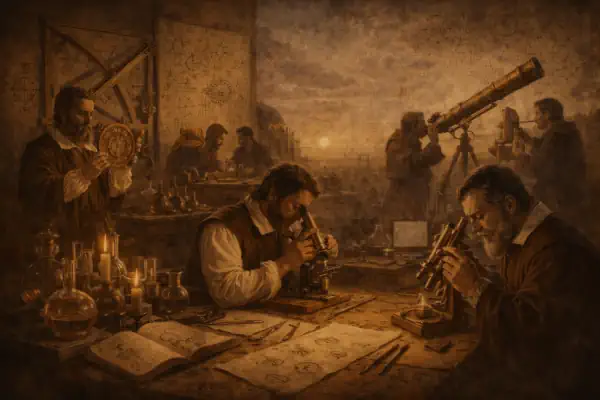
When experience begins to challenge authority
For many centuries, to know meant first and foremost to inherit. The great names of Antiquity, Aristotle for natural philosophy, Ptolemy for astronomy, Galen for medicine, formed such a powerful intellectual foundation that challenging them often seemed unthinkable. Knowledge circulated primarily through commentary, interpretation and transmission.
The Renaissance did not abruptly abolish this legacy, but it altered its hierarchy. Gradually, some scholars came to believe that nature itself had to be questioned directly. The world was no longer merely a text to be read; it became a phenomenon to be examined, compared and tested. This shift was fundamental: it introduced the idea that a claim mattered less because of its prestige than because of its resistance to observation.
Leonardo da Vinci powerfully embodies this transition. In his notebooks, the study of the human body, the motion of water, machines, structures and technical gestures reveals the same demand: to understand through concrete examination. His famous claim that experience never deceives, and that it is only our judgments that deceive us, sums up a decisive intuition. Reality becomes the arbiter of reasoning.
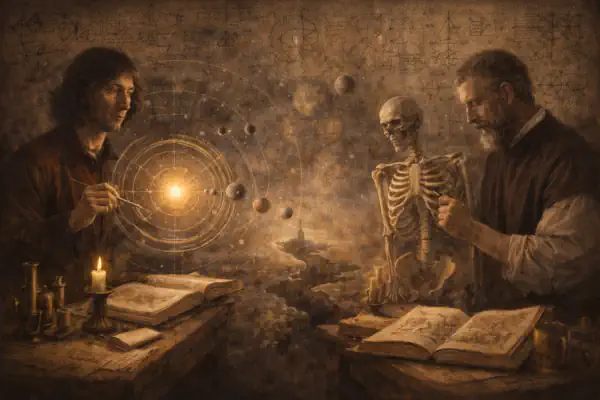
The modern scientific method is born when truth ceases to be guaranteed by the prestige of a name and begins to depend on what can be observed, measured, repeated and demonstrated.
Bacon: organizing experience to make nature speak
With Francis Bacon, this transformation acquires an explicitly methodological scope. It is no longer enough simply to have the intuition that experience matters; experience itself must become an organized procedure. Nature must be questioned under constructed conditions, through rigorous, compared and repeated observations.
This point is crucial. Observing a phenomenon is still not enough to produce solid knowledge. One must create situations that make it possible to separate causes, limit illusions and verify results. In other words, scientific truth does not emerge spontaneously from reality: it requires a method capable of distinguishing appearance, accident and law.
This logic introduces a lasting shift. The scholar no longer merely receives nature; he constructs the conditions under which it can be understood. Controlled experiment thus becomes a major intellectual tool. It prepares the future demand for protocol, description of instruments and reproducibility that will structure modern science.
Observation is no longer enough: one must measure
Renaissance science did not merely invent a new trust in experience; it also imposed another requirement, that of quantification. A phenomenon may be well described and still remain ambiguous as long as it is not captured through precise measurements. The moment one counts, compares and calculates, knowledge changes in nature: it becomes verifiable, cumulative and potentially predictive.
Astronomy offers an exemplary field here. Tycho Brahe amassed observations of unprecedented precision even before the telescope came into general use. His data were valuable not only because of their volume, but because they imposed a new discipline. Theories could no longer be content with being elegant or inherited. They had to answer to numerical facts.
Drawing on these measurements, Johannes Kepler succeeded in formulating laws of planetary motion that broke with purely speculative models. The sky ceased to be only contemplated: it became a calculable system. Measurement thus transformed observation into argument.
The same movement appears in the work of Galileo Galilei. In studying motion, time and the fall of bodies, it was no longer enough simply to say that objects fall or move, but to determine how, at what speed, and according to what regularities. Reality became quantifiable, and quantification opened the way to prediction.
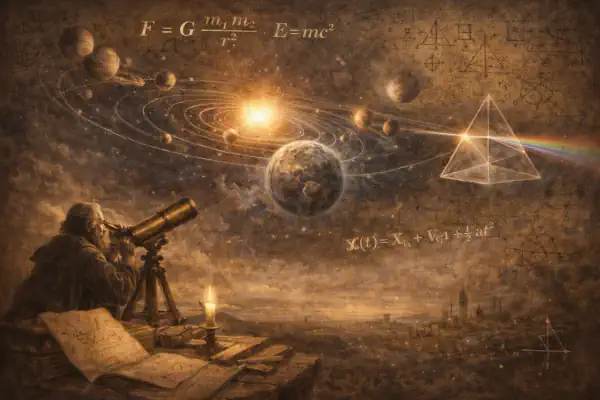
Mathematizing reality: when nature becomes calculable
Another rupture, deeper still, gradually imposed itself: the world was not only observable and measurable, it could also be translated into mathematical relations. This idea gave modern science its distinctive power. It made it possible to move beyond simple description and toward law.
Galileo formulated this intuition with a clarity that became famous: the book of nature is written in mathematical language. Behind this phrase lies a major intellectual revolution. Physical phenomena were no longer perceived as scattered singularities, but as realities structured by relationships, proportions and regularities that could be expressed.
This movement was rooted in earlier and converging work. The Copernican model had already proposed a mathematical reorganization of the planetary system. Kepler connected orbits to quantitative laws. Optics progressed through the calculation of angles, focal lengths and light trajectories. In anatomy, Andreas Vesalius imposed a descriptive precision that subjected the body itself to a more rigorous, more systematic and more objectifiable reading.
The consequence was decisive: to understand no longer meant simply to name or classify, but to establish exact relations between phenomena. Reality entered the order of calculation. This mathematization did not reduce the world; it made it intelligible in a new form, more abstract, but also more powerful.
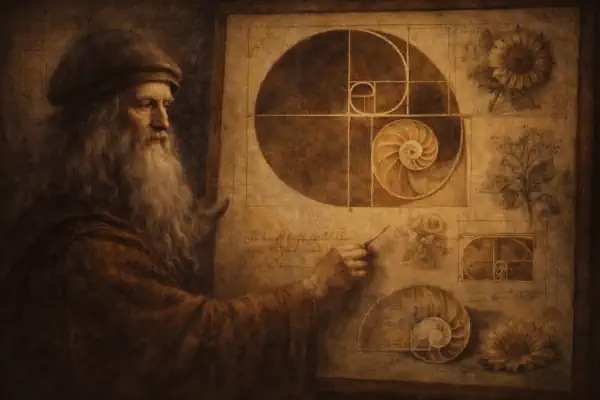
From the Renaissance to modern science: toward a universal method
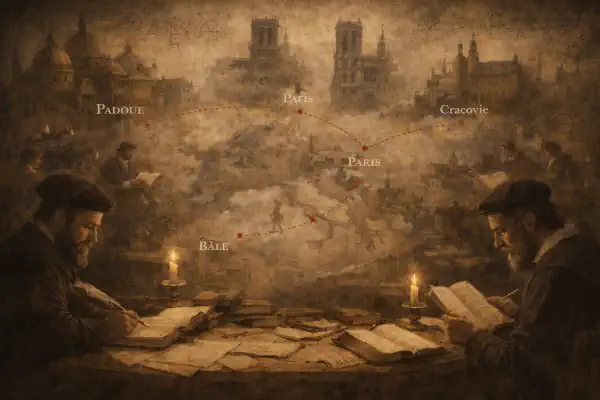
The advances of the 16th century did not remain isolated. They gradually converged toward a broader upheaval: the constitution of a general method for producing knowledge. What had once been scattered across workshops, observatories, notebooks, dissections and experiments slowly became a shared set of rules.
The founding of the Royal Society in the 17th century symbolizes this stage of structuring. Research ceased to be only the business of exceptional individuals; it also became a collective, organized, discussed and published practice. Modern science no longer rests solely on discovery, but on the conditions that make discovery shareable.
The pillars that then imposed themselves durably
- controlled experimentation to provoke phenomena under defined conditions
- systematic observation supported by instruments and precise records
- quantitative measurement in order to compare, calculate and discuss results
- publication of procedures and conclusions to allow verification
- reproducibility as a criterion of the solidity of knowledge
This change transformed scientific truth itself. A proposition was no longer strong because it was ancient, brilliant or seductive, but because it could be tested, confirmed, criticized and reproduced. Science became a structured collective process, rather than a simple accumulation of individual intuitions.
When knowledge becomes technical power
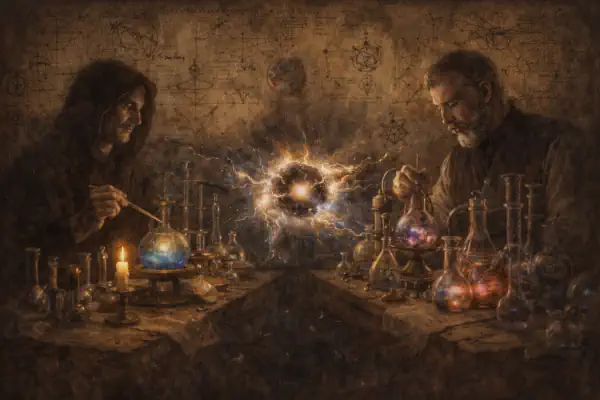
The modern scientific method did not transform theory alone. It also changed the relationship between knowledge and fabrication. As soon as a phenomenon could be understood through experience, quantified and modeled, it also became actionable. One could reproduce an effect, improve a process, correct an instrument or design a machine.
This is where the Renaissance appears as the intellectual infrastructure of the technological world. Measuring motion prepared mechanics. Understanding pressure, heat or the transformation of matter opened the way to future engineering. Describing the body with precision prepared a more operative medicine. Science did not remain contemplative: it gradually became productive.
Printing played a decisive role in this movement. By accelerating the circulation of texts, diagrams, results and methods, it encouraged a dynamic of cumulative innovation. Knowledge escaped the local framework, compared itself more quickly, corrected itself more widely and transmitted itself more effectively. Europe entered a regime in which technical improvement could rely on an increasingly accessible written memory.
The discreet foundations of the industrial revolution
When the industrial revolution asserted itself later, it did not emerge from a vacuum. It inherited a world already transformed by several centuries of scientific discipline. The idea that a process could be described precisely, repeated, compared, improved and transmitted constituted a decisive prerequisite for industrialization.
What the Renaissance durably bequeathed to the industrial future
- a taste for technical experimentation before large-scale production
- the central place of calculation in the design and correction of devices
- the demand for precise measurement to stabilize processes
- reproducibility as the condition for reliable and transmissible technique
This legacy was immense. Without this culture of proof, quantification and formalization, later developments in mechanics, industrial chemistry or heat engines would have been much slower, less reliable and less cumulative. In this sense, the Renaissance acted like a historical seed: it did not yet produce the industrial world, but it made it possible.
The moment when nature became intelligible and transformable
The Renaissance thus constitutes far more than a simple artistic or humanist renewal. It marks a deep transformation in humanity’s relationship to reality. Nature was no longer perceived only as an external, mysterious or sacred power; it began to be thought of as a system that could be understood methodically.
This change was decisive because it concerned not only science. It also touched technology, medicine, instruments, the circulation of knowledge and, in the long term, the very organization of modern societies. A world capable of measuring, experimenting and calculating is also a world capable of transforming its environment more profoundly.
That is why the birth of the modern scientific method remains a major historical threshold. It founded not only a new way of establishing truth, but also a new power to act. And this power already raises, in embryo, a question that remains with us today: when knowledge becomes technical capacity, according to what ends do we decide to use it?