
A modernity of transformation rather than rupture
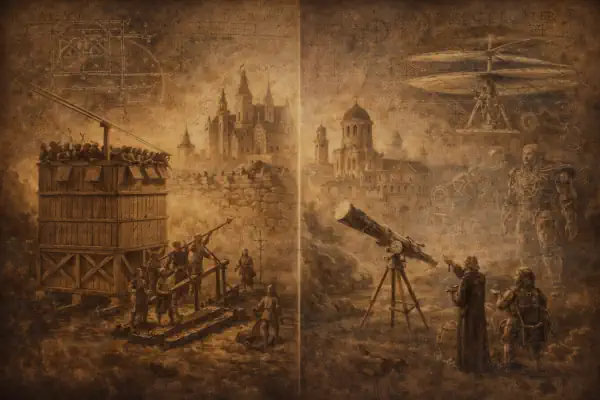
One of the most common misconceptions about the Renaissance is to present it as a pure beginning, almost without a past. In reality, when one looks at concrete objects, mills, forges, clocks or fortifications, one first sees continuity. The late Middle Ages had already accumulated considerable technical know-how: the use of hydraulic energy, the refinement of gears, the development of Gothic structures, the spread of metallurgical processes and the organization of specialized workshops.
What the Renaissance changed was not the existence of these techniques, but their degree of formalization. Mechanisms were more often drawn, compared, described and improved. Treatises circulated more quickly thanks to printing. Geometry and perspective helped people think more clearly about structures. Workshops gradually became places not only of fabrication, but also of reflection on causes, yields and forms.
European technical modernity was therefore born less from a clean break than from a progressive metamorphosis. Medieval inheritances were taken up again, refined and made more precise and more transmissible. It is within this transformed continuity that a new relationship to matter, energy and calculation took shape.
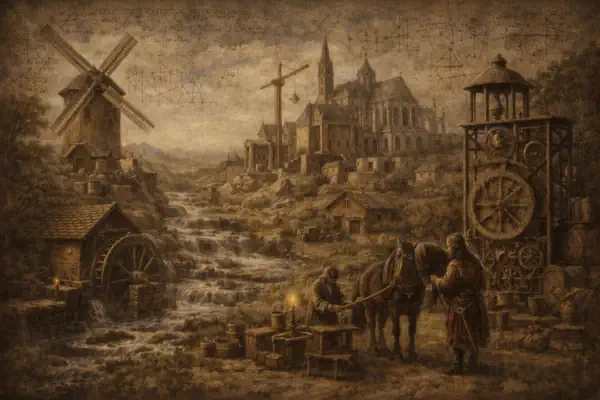
The Renaissance does not invent everything: it transforms inherited know-how into technical systems that are more precise, more calculated and more reproducible.
Hydraulic power: from an old use to an organized force
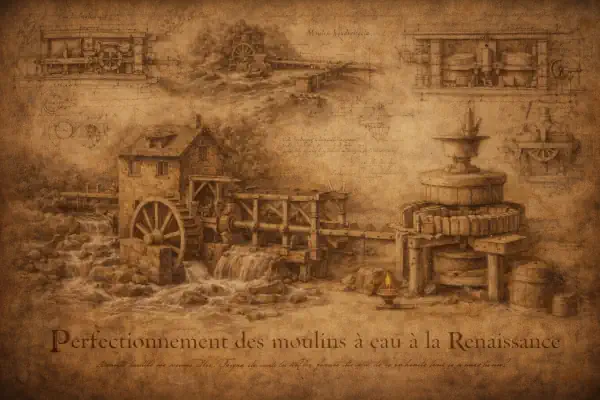
Watermills had existed in Europe for a long time, but the Renaissance deepened their mechanical logic. The issue was no longer simply to turn a millstone: it was to optimize the capture of movement, transform rotation according to need and distribute that energy to a variety of uses. Wheels were improved, gear systems refined, and clearer distinctions were made between devices according to the way water struck their blades.
These improvements in yield changed the scale of applications. Hydraulic energy could now power not only grain mills, but also sawmills, forge hammers, fulling mills and pumps for mining extraction. Every workshop connected to a river became a small energy infrastructure. This was not yet the age of the heat engine, but it was already a society that understood that a natural force could be captured, converted and redistributed in a rational way.
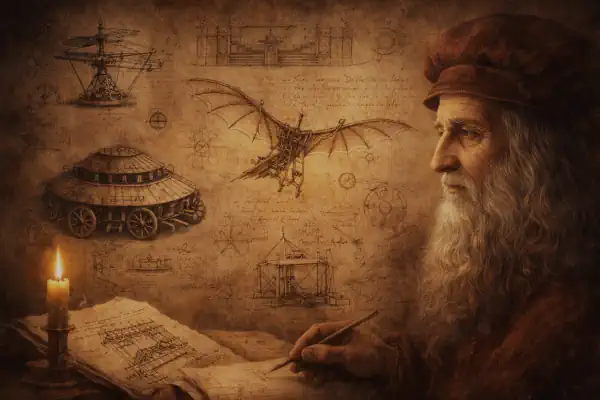
Leonardo da Vinci’s sketches illustrate this evolution well: he was interested less in the mill as an isolated object than in the complete path of energy, from falling water to the final tool. The Renaissance thus brought energy into a new culture of efficiency and mechanical organization.
Metallurgy: the rise of precision
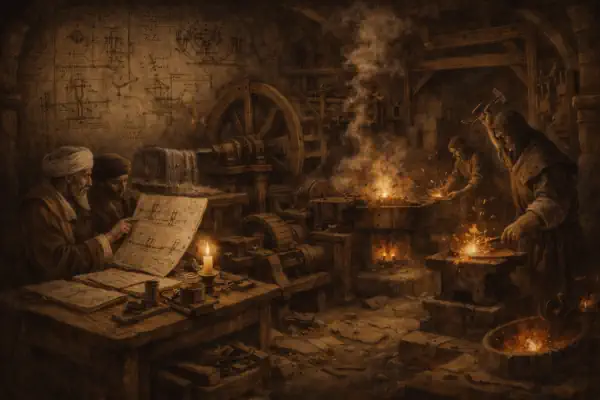
Metallurgy formed another pillar of this transformation. Extracting ore, draining galleries, ventilating mines, feeding furnaces and controlling temperatures: each of these stages required a more rigorous technical organization. The use of hydraulic mechanisms to drive pumps, bellows or winches shows how different technical fields increasingly began to support one another.
With treatises such as De re metallica by Georgius Agricola, processes were no longer transmitted only by imitation or workshop secrecy. They were described, ordered and illustrated. This structuring of knowledge had major effects: it made it possible to compare methods, better control alloys and increase the regularity of production.
Metal thus ceased to be merely a material shaped by manual strength; it became a calibrated substance essential to agricultural tools, weapons, clockwork mechanisms, presses and scientific instruments. Technical modernity rested in large part on this conquest of fire and material precision.
Clockmaking: when time becomes mechanical
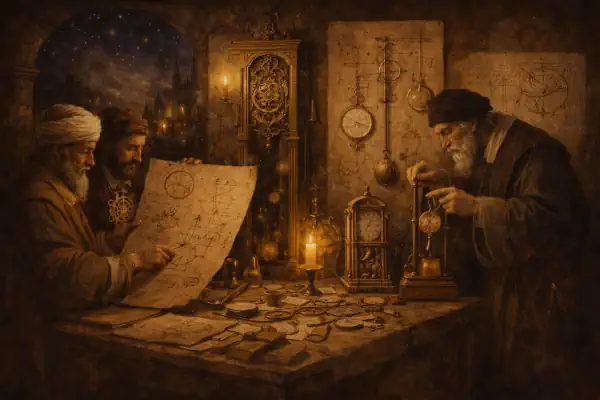
The measurement of time also changed status. Mechanical clocks already existed at the end of the Middle Ages, but the Renaissance refined their gear trains, regulating devices and, later, their portable forms. Time was no longer only marked by bells, seasons or local customs: it became a sequence of increasingly regular units.
This shift goes beyond the history of an object. A more precise clock made it possible to coordinate labor, structure markets, organize movement and, eventually, measure physical phenomena with greater rigor. Time became a calculable and shareable datum, profoundly transforming economic and intellectual life.
What the mechanization of time makes possible
- more finely synchronize social and productive activities
- improve the coordination of trade and travel
- prepare a science more attentive to exact durations and measurable intervals
By mechanizing hours, the Renaissance therefore prepared far more than a convenience of measurement: it installed a culture of exact time, essential to scientific and economic modernity.
Fortifications: geometry enters warfare
Military architecture particularly clearly illustrates the technical transition of the Renaissance. The appearance and spread of gunpowder artillery made high medieval walls increasingly vulnerable. The problem was no longer to stop scaling ladders or a battering ram, but to absorb and deflect impacts. Defensive form therefore had to be entirely rethought.
Italian engineers then designed bastioned fortifications, lower, thicker, often earth-filled, and organized around projecting angles that allowed intersecting fields of fire. This change was crucial: the wall ceased to be a simple vertical obstacle; it became a geometric device calculated to eliminate blind spots and optimize fire coverage.
Warfare thus became a problem of spatial engineering. The distance between two bastions, their orientation, the depth of the works, the shape of ditches and ravelins were all conceived according to the range of weapons and the circulation of fire. Geometry no longer remained in scholarly treatises: it entered stone, earth and the battlefield.
A common logic: more control, more calculation, more efficiency
What links mills, metallurgy, clockmaking and bastions is less the nature of the objects than the logic that transforms them. Everywhere the same tendencies appear: the search for yield, the improvement of mechanisms, the gradual standardization of processes, better mastery of natural forces and an increasing recourse to geometry and measurement.
The Renaissance therefore did not only transform a few particular techniques. It changed the mental framework within which technology was conceived. A device now had to be understood in its functioning, improved in its form, made transmissible in its principles and evaluated in its efficiency. This passage from largely local know-how to a more theorized culture of technique constitutes one of the deep engines of European modernity.
Behind these apparently scattered changes, the same ambition can be seen: to ensure that energy, metal, time and space were less and less endured and more and more organized. That is, no doubt, one of the most accurate definitions of the technical revolution of the Renaissance.
