When communication becomes language
The origin of articulated language remains one of the great problems of prehistory, precisely because speech does not fossilize. Sounds vanish, but anatomical transformations, symbolic behaviors, social organization, and certain genetic markers leave clues behind. Language should not, moreover, be imagined as a sudden invention: it most likely belongs to a slow evolution that began with gestures, intonations, emotional signals, and increasingly fine forms of collective coordination.
This perspective changes the way the question is framed. It is not only a matter of asking when human beings “spoke” in the modern sense, but at what moment forms of communication became sufficiently stable to transmit knowledge effectively, build instructions, share representations, and durably organize group life. Articulated language then appears as a threshold: the moment communication becomes an instrument of memory, cooperation, and abstraction.
Current hypotheses place this rise in complexity over a very long period, often between around 300,000 and 50,000 years before our era. This broad range reflects less total ignorance than a scientific reality: several dimensions of language — anatomical, cognitive, social, and cultural — likely did not progress at the same pace.

Articulated language most likely did not burst forth all at once: it formed when biology, cognition, social learning, and symbolism began to function together.
Dates are difficult to fix, but the trajectory is becoming increasingly readable
To approach the beginnings of language, researchers combine several kinds of clues. Vocal anatomy, first of all, provides information about the potential ability to produce a wide range of sounds. The shape of the base of the skull, the position of the larynx, and the coordination of breathing are all studied to estimate whether certain human species could articulate more than simple cries or limited vocalizations.
Homo sapiens appears to possess a configuration particularly favorable to rich articulation around 200,000 years ago. But the question does not stop there: some research suggests that species such as Neanderthals also possessed significant vocal abilities. The difference may therefore not have been one of speech versus no speech, but perhaps one of phonetic flexibility, syntactic complexity, or symbolic density.
Cultural traces reinforce this gradual hypothesis. The more complex techniques become, the more precise transmission must be. Explaining how to shape a tool, assign a role in a collective hunt, or remember a seasonal route presupposes a communication system that is stable, repeatable, and sufficiently structured to avoid information loss. Language is not directly proven by these objects, but their sophistication makes advanced forms of verbal exchange plausible.
Why the scientific investigation is so difficult
- speech leaves no direct fossil
- anatomical clues reveal potential, not actual use
- cultural evidence points to complex thought without recording the words themselves
The most robust idea is therefore not that of a single date, but that of a long process during which communicative capacities became denser until they formed a true articulated language.
FOXP2: a biological foundation, but not a total explanation
The FOXP2 gene has deeply marked research on the origin of language because it is involved in mechanisms linked to fine motor coordination and certain abilities necessary for speech. Severe disorders observed in people carrying mutations of this gene showed that it plays an important role in the production of organized vocal sequences.
Its significance is reinforced by the fact that closely related versions of FOXP2 have been identified in Neanderthals and Denisovans. This suggests that some of the biological preconditions for language existed before the expansion of modern Homo sapiens. In other words, the neurobiological bases necessary for more articulated communication may be ancient within the history of the human genus.
A simplistic reading should, however, be avoided. FOXP2 is not a “language button” capable on its own of explaining human speech. It acts within a much larger ensemble: brain maturation, learning, social environment, imitation, memory, listening, and repetition. Language is never the product of a single cause; it results from the intertwining of biological dispositions and cultural dynamics.
In that sense, FOXP2 should be understood as a sign of biological preparation. It sheds light on the possibility of articulated speech, but it does not replace either the group’s social education or the slow cultural construction of communication systems.

Primates as a partial mirror of our communicative roots
Observing chimpanzees, bonobos, or gorillas helps us better understand what is both continuous and radically new about human language. These primates communicate effectively through gestures, calls, postures, and facial expressions. They transmit alerts, emotions, immediate requests, or simple intentions, which shows that social communication was already present long before the emergence of human speech.
Yet a major gap remains. Even when they learn limited symbolic systems in experimental settings, primates do not seem to achieve the combinatorial flexibility of human language. They may associate signs with needs or objects, but they do not spontaneously develop an open syntax that allows endless new sentences, narration of absent events, or commentary on abstract ideas.
This difference is due at once to the brain, the vocal apparatus, and the kind of social life involved. Human articulated language rests on an extremely fine articulation between motor control, sequential memory, shared attention, imitation, and the intention to transmit more than the immediate present. It is therefore not enough to be intelligent or social: what is needed is a highly specialized biological and cognitive architecture.
Comparison with primates thus reminds us that human language did not emerge ex nihilo. It extends ancient forms of communication, but amplifies them until something qualitatively new appears: a tool that allows not only exchange, but also conceptualization, narration, teaching, and the institution of collective life.
Symbolism as material evidence of thought already becoming verbalizable
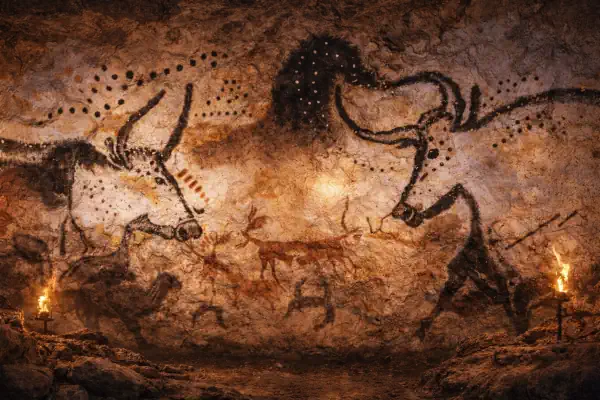
Since words themselves do not survive, archaeology examines traces of symbolic thought. Cave paintings, engravings, ornaments, perforated shells, decorated objects, or figurines do not mechanically prove the existence of an articulated language identical to ours, but they testify to a capacity to attribute shared meanings to forms, signs, and objects.
This capacity is essential. As soon as a group produces representations that go beyond immediate use, it enters a universe in which memory, identity, transmission, and imagination expand. Decorated caves, abstract motifs, and ornaments are not mere embellishments: they reveal a mental world in which people think in symbols, associating objects with values, narratives, or beliefs.
Such a level of symbolization becomes much more stable when supported by forms of language. Describing a motif, teaching its meaning, recalling a ritual, distinguishing a clan, recounting a hunt, or transmitting a taboo all require communication that is at least partly conventional. Symbolism does not replace proof of language, but it strengthens the idea of a humanity already capable of sharing complex mental universes.
Why archaeologists care so much about it
- it reveals abstract thought beyond immediate survival
- it presupposes shared meanings within a group
- it reinforces the hypothesis of cultural transmission supported by speech
By bringing together these material elements with anatomical and genetic data, articulated language appears less as a simple vocal capacity than as the support of an expanding culture.

When speaking transforms culture, learning, and cooperation
The true revolution of articulated language does not lie only in the production of differentiated sounds. It lies in what it allows people to do together. With speech, humans can explain a technique, anticipate an action, correct an error, recount a past episode, prepare for a future danger, and transmit knowledge without having to reinvent it completely with each generation.
This changes everything. It accelerates the learning of tools, makes finer social organization possible, strengthens collective hunting, facilitates the distribution of roles, and stabilizes traditions. Language becomes an instrument of social memory. Thanks to it, the group is no longer merely a sum of present individuals; it becomes a community that accumulates experiences, stories, practices, and norms.
It is also through language that culture gains depth. Myths, explanations, rites, prohibitions, proper names, origin narratives, comments about the absent or the dead: all these dimensions require communication that goes beyond immediacy. Articulated language thus gives humanity a new historical and symbolic depth. It links the biological to the social, and individual experience to the common world.
To study the emergence of language is therefore not to pursue a minor detail of evolution. It is to illuminate the moment when the human species begins to equip itself with a tool capable of organizing thought, densifying culture, and making possible the long history of transmission.