When Thinking No Longer Means Merely Speaking, but Ordering
In ancient Greece, a decisive shift occurred: thought gradually ceased to be only an art of speech or persuasion and became an activity that could be analyzed in its very form. The point was no longer merely to assert, narrate, or convince, but to understand how one idea leads to another, under what conditions a conclusion is legitimate, and why certain discourses can seduce without truly demonstrating.
This transformation was not spectacular. It did not take the form of a monument or a visible conquest. Yet its effects were immense. From the moment reasoning itself became an object of examination, human thought gained a new instrument: structure. This passage matters because it opened the way to a culture in which truth no longer depends only on the prestige of a master, on tradition, or on eloquence, but on the inner coherence of an argument.
It is in this context that Aristotle’s work emerges. Where other philosophers had already questioned, argued, or dialogued, he undertook something more radical: to formalize the rules of reasoning. He did not seek only answers about the world; he also sought the conditions that make thought rigorous, transmissible, and valid.
With Aristotle, thought does not simply become more learned: it becomes more structured, more controllable, and more demonstrable.
Aristotle: Turning Reasoning into a Method
Born in Stagira in 384 BCE, trained at Plato’s Academy, and later founder of the Lyceum, Aristotle observed with exceptional attention the ways human beings argue, contradict one another, generalize, or conclude. His ambition was not merely philosophical in the abstract sense; it was also methodological. He wanted to understand what makes a line of reasoning valid.
The logical treatises later grouped under the name of the Organon constitute one of the earliest systematic attempts to describe the mechanisms of deduction. In them, Aristotle distinguishes propositions, terms, relations of generality, and the forms of connection between premises and conclusion. Through this work, he transformed logic into a discipline in its own right.
This gesture is foundational. Thought no longer depends only on individual talent or momentary inspiration. It can be taught, transmitted, discussed, and verified. In that sense, Aristotle did not merely teach human beings what to think: he gave them instruments with which to think rigorously.
The Syllogism: A Mechanics of Deduction
At the heart of Aristotelian logic lies a famous form: the syllogism. Behind its apparent simplicity, it represents a major advance. Aristotle shows that a conclusion can follow necessarily from two properly articulated propositions. The canonical example is well known: all humans are mortal; Socrates is a human; therefore Socrates is mortal.
The importance of this form lies not in the example itself, but in what it reveals. A conclusion is not true because it sounds persuasive or because it impresses; it is true when it results from a valid structure. Reasoning then becomes an identifiable, reproducible, and criticizable intellectual mechanism.
What the syllogism makes possible
- showing that a conclusion depends on the form of reasoning, not only on the authority of the speaker
- distinguishing valid reasoning from arguments that are attractive but misleading
- making deduction a stable, reusable, and transmissible tool
By giving reasoning a form, Aristotle introduced a discipline of connection between ideas. It is this passage from persuasive speech to demonstrative structure that makes logic a major turning point in intellectual history.
Rules for Thinking Clearly and Recognizing Error
Before Aristotle, rational discussion already existed among the Greeks. Socrates questioned, Plato dialogued, and the Sophists argued. But Aristotle went a step further: he sought to establish rules that would make it possible to distinguish sound reasoning from sophisms, those discourses that create an impression of truth without supplying real proof.
He analyzed the structure of propositions, the categories of being, the ambiguities of language, and the mechanisms of contradiction. This desire to classify recalls his work in the natural sciences: just as he observed living beings in order to describe and order them, here he observed the forms of thought themselves. Reasoning, too, became an object of study.
In this way, logic ceases to be merely an art of debate. It becomes a normative discipline, capable of indicating what must be avoided: confusion of terms, abusive generalization, ambiguity, false causality, or concealed contradiction. In other words, Aristotle provides not only a technique for concluding, but also tools for exposing error.
When Thought Becomes a Transmissible Form of Knowledge
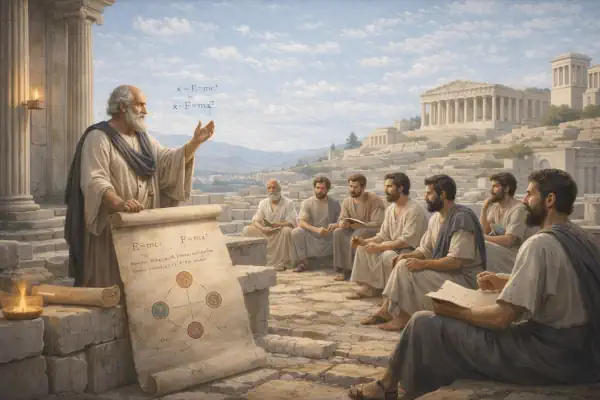
One of the deepest consequences of this formalization is transmission. A way of thinking founded only on charisma, memory, or individual talent remains fragile. A way of thinking founded on rules can, by contrast, be taught to others. Aristotelian logic thus transforms reasoning into a discipline, independent of the sole presence of the master.
This transmissibility helps explain the exceptional longevity of the Greek legacy. The Romans, medieval thinkers, scholars of the Arabic-speaking world, and later European universities appropriated this logical structure because it provided a common intellectual grammar. It made it possible to train jurists, theologians, philosophers, physicians, or administrators under the same demand for coherence.
Logic thus becomes more than a chapter of philosophy: it becomes an infrastructure of learned culture. It offers generations a framework for demonstrating, refuting, classifying, defining, and debating with method.
An Invisible Architecture at the Heart of Civilization
The influence of Greek logic extends far beyond antiquity. In science, it establishes a lasting demand: a theory must be intelligible, coherent, and articulated. In law, it nourishes the art of proof, pleading, and ordered argumentation. In philosophy, it provides for centuries the major framework within which concepts, causes, and demonstrations are examined.
Even when modern symbolic and mathematical logic develops much later, it does not arise out of a void. It still dialogues with Aristotle’s founding gesture: his realization that the validity of reasoning can be analyzed in its form. Modern logic does not erase that gesture; it extends and transforms it.
That is why Aristotelian logic can be described as an invisible architecture. It does not have the material presence of an aqueduct or the brilliance of a temple, yet it durably structures the way we debate, teach, demonstrate, and distinguish a sound idea from a misleading impression.
Why Greece Remains a Foundational Moment in Reasoning
Ancient Greece did not invent every form of rigorous knowledge on its own. But it produced a decisive turn: the idea that thought can be examined in its structure, that truth requires justification, and that conclusions must follow from a controllable sequence. With Aristotle, logic becomes a tool of civilization.
Each time a researcher checks the coherence of a hypothesis, a judge constructs an argument, a teacher distinguishes example from proof, or a citizen attempts to recognize a sophism in public debate, a part of this Greek legacy is still at work.
Logic is not a mere scholastic refinement. It is a way of inhabiting the world with greater clarity, greater method, and greater intellectual rigor. By giving reasoning a form, ancient Greece offered humanity one of its most durable instruments for seeking truth.
A Personal Perspective: Proof, Reflection, and the Greek Compass
To me, the Greek legacy remains essential because proof matters most when it is genuinely argued. Without that demand, what remains are often only opinions without foundations—positions that may flatter belief, but do not truly reflect the real world. This is precisely why Greek logic still matters: it teaches us that reason must be structured if it wants to approach truth seriously.
I also believe that reality cannot be reduced to opinion alone. A valid argument requires coherence, method, and proof. Yet at the same time, I do not see logic as something that eliminates philosophy. On the contrary, I think we always need philosophy and reflection to look beyond what is already known, and to keep exploring what still escapes us. Logic gives us discipline; philosophy keeps the horizon open.
In that sense, the Greek inheritance still gives us a direction. It preserves a course for thought, for philosophical inquiry, and for critical reflection. It reminds us that rigor and openness are not enemies: proof anchors us in the real, while philosophy allows us to keep moving toward what remains unknown. That balance is, to me, one of the most powerful lessons Greece has left us.